
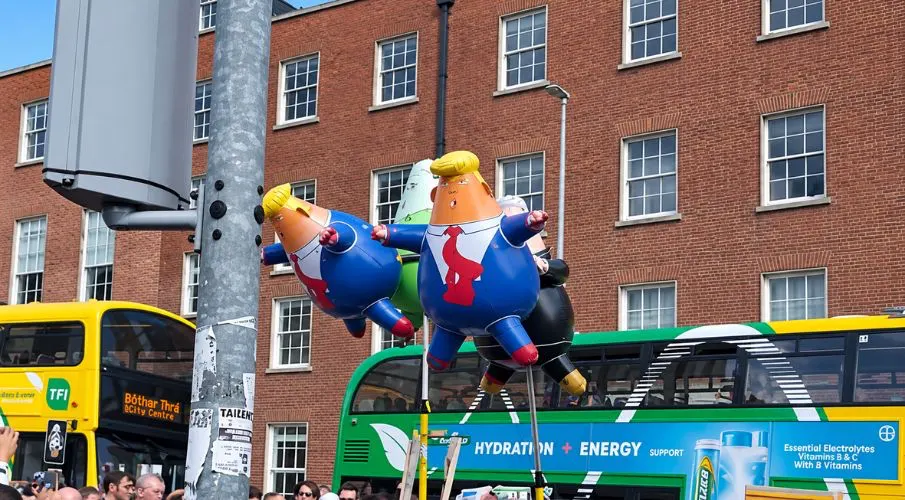
Some wounds demand that you touch them carefully. On Saturday, Donald Trump touched the deepest wound on the island of Ireland in passing, between a tournament at his own golf course and his next appointment. A united Ireland would be a cool thing, he said, and later said it would be fantastic. He talked about an issue that Irish and British people paid for with their lives in the tone of a man praising a good golf shot.
At his meeting with Irish Prime Minister Micheál Martin in Dublin, he laid out where he stood. He did not want to cause any problems, Trump said, but he would like to see the Republic and Northern Ireland, which is part of the United Kingdom, united. It was going to happen someday, so it might as well happen now. The United Kingdom, he added, would of course have something to say about that too.

At his next stop, in front of business leaders from both countries at the U.S. ambassador’s residence, he sounded different already. There was no good answer to the question of reunification, he admitted. Between the cool thing in the morning and no good answer in the afternoon, there had been just one more stop on the schedule. The casualness of those remarks stands against a century of history. Around 100 years ago, Ireland became a self-governing state with a Catholic majority, while the six counties of Northern Ireland, with their largely Protestant tradition, remained part of the United Kingdom. Two groups faced each other there, the nationalists, mostly Catholic, who wanted to join the rest of Ireland, and the unionists, mostly Protestant, who wanted to remain British.
Out of that divide grew the Northern Ireland conflict, in which paramilitary groups on both sides and British soldiers fought. The 1998 Good Friday Agreement largely ended the violence, and the United States played an important role in making it happen. The agreement left Northern Ireland’s future open. It provides for a vote on reunification only when a majority in favor appears likely. British Prime Minister Andy Burnham had spelled out that exact threshold on Wednesday. A referendum would only be considered once public opinion had shifted far enough that calls for one had to be taken into account. After Trump’s appearance, his office pointed to that statement again.

Previous occupants of the White House understood the weight of this. Joe Biden, with his strong ties to Ireland, held back, just as his predecessors had. Restraint seemed to them the price Washington had to pay if it wanted to be heard on the issue at all. Trump flipped that around and turned the most sensitive question on the island into an aside. The harshness of the appearance was in the tone. To describe a division that cost lives for decades as cool is to measure history by the standards of a tournament weekend. The dead of the Northern Ireland conflict and the hard-won order created in 1998 shrink in that kind of language into something that might as well be taken care of now instead of sometime later.
The timing adds an intention to the tone. His remark, together with his recent comments about the Falkland Islands, can be read as a shot at London. Britain had refused to get dragged into the American-Israeli war against Iran, which had angered Trump. When an ally does not fall in line, its own map becomes a bargaining chip. He also brought up the Falkland Islands again, the British overseas territory with around 3,500 residents that Argentina calls Las Malvinas and that lies around 300 miles off its coast. Argentine President Javier Milei, a Trump ally, recently reaffirmed his country’s claim. Washington could reconsider its neutral position, Trump had said earlier. He questioned whether Britain could retake the islands today the way it did in 1982. He would probably get dragged into that possible disaster, he said, and then he would probably be able to straighten it out.

In Dublin, he came face to face with someone who knows him. President Catherine Connolly had joined protesters during his 2019 visit and had previously called him a tyrant. Now, as a largely ceremonial head of state, she received him without abandoning her convictions. She told him about the strong position of the Irish people, she said afterward, that the normalization of war and genocide could never be accepted. Her gifts spoke more clearly than any communiqué. Connolly gave him a collection by the late poet Michael Longley that includes the sonnet “Ceasefire,” a poem about a ceasefire. Asked about the meeting, Trump first let his chief of protocol, Monica Crowley, answer before calling it very nice. They had talked about a lot of things, quickly.

Outside, the city gave a different answer. Police closed off parts of the 1,750-acre Phoenix Park, where the residences of President Connolly and Prime Minister Martin are located, along with that of U.S. Ambassador Edward Walsh. Thousands came to a rally in the city center, many carrying Irish or Palestinian flags, and chanted that Trump was not welcome here. By then, he had already left Dublin and was on his way to his course in Doonbeg on the Atlantic coast.
Paula B. had come with a group from the Dublin Rape Crisis Centre, protesting Trump’s positions on women, as well as on refugees and migrants. His support for Irish unity did nothing to win her over, no matter how many people in Ireland support that goal. She probably knew more about Irish unity in her little finger than he did, she said. Kim M., who moved from Florida to Dublin last year, said she had moved there to get away from Trump and his politics. It would be nice, she said, if governments would simply tell him to stay home.

Why he came at all is answered by the location. The president was standing on his own course at the Irish Open, alongside his son Eric, who had defended the family the day before. Go ask a real Irishman at Morrissey’s Tavern in Doonbeg what the Trumps had done for the country and what they had invested there, Eric had said. The golf course was the biggest employer in the area.
That is how the office and the business blur together. Trump spends most weekends at his courses in Florida and New Jersey, and he has another one in Virginia. His appearances at major tournaments benefit the family business, which makes money from hosting them. Last year, he spent 5 days playing at Turnberry and opened another course in Aberdeenshire. He promised he would be back for next year’s Ryder Cup, absolutely. The border on the island, meanwhile, remains where it was painstakingly settled in 1998, no matter how easily it might be moved between 2 holes.
Updates – Kaizen News Brief
Alle aktuellen ausgesuchten Tagesmeldungen findet ihr in den Kaizen Kurznachrichten.
To the Kaizen News Brief In English


