
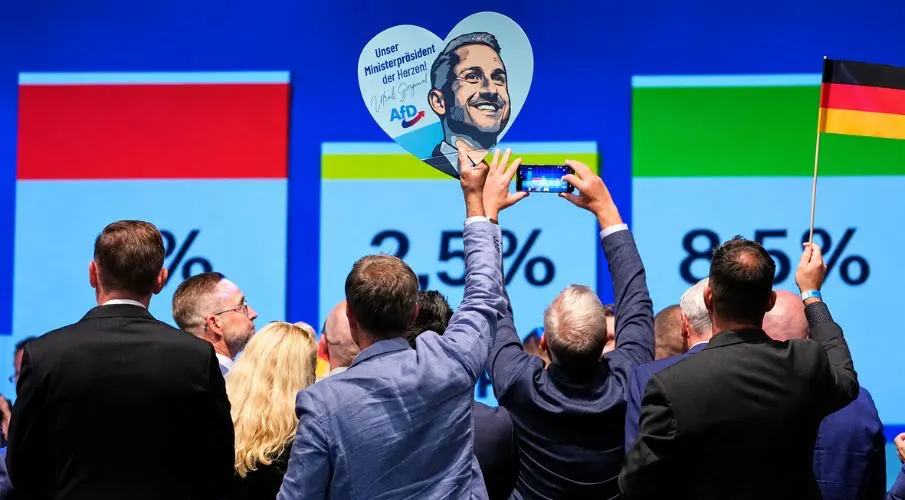
43.8 percent. Nearly every second second-vote ballot in Saxony-Anhalt bears the name of a party whose state chapter is classified by the domestic intelligence service as confirmed right-wing extremist. That is enough for 39 of 83 seats in the state parliament. The CDU collapses alongside it to 17.2 percent. Turnout reached 77.8 percent, 17.5 points higher than in 2021, and the result did not disappear into some quiet corner of politics. The next morning, they were reading it in Paris and Warsaw as a warning. London and Brussels sounded no different.
The quick answers explain nothing here. The single word "migration" carries just as little weight as reaching for "protest vote" or "typical East Germany." Just as cheap is the opposite claim that 43.8 percent of people in Saxony-Anhalt somehow adopted a right-wing extremist worldview overnight. Both answers avoid the harder work, explaining how a right-wing extremist party became this strong in a German state even though its radicalism has been openly discussed for years.

The result is disturbing because the AfD is no longer winning only where people have long expected it to. Parts of its electorate now see it as a party of the economy and social security. They trust it on energy and on peace. And they are tying their own future to it. A protest party can be waited out politically. But a party that people genuinely trust to run a state cannot be dealt with by simply sitting it out.
Right at the front of this equation is Friedrich Merz. 87 percent of those surveyed said they were dissatisfied with the federal government, and the anger at Berlin ended up on a state election ballot. Consistent reports from across Europe called the result a severe blow to the chancellor and a warning for the continent. Sven Schulze faced an almost impossible problem on the ballot. The full weight of the anger at Berlin hung over him. Reiner Haseloff had built up a personal standing over the years that had become partly detached from the party itself. Schulze did not have that protection. He paid the price for Merz before he had even had time to develop a political identity of his own.
Anger at Berlin alone does not produce 43.8 percent. Beneath it lies fear of the future. Only 20 percent of people in Saxony-Anhalt still consider the economic situation good or very good. In 2021, 41 percent still believed the state was well prepared for the future. In 2026, that figure is 28 percent. Among AfD supporters, 89 percent fear prices could rise so much that bills would no longer be affordable, and 80 percent worry they will not be able to maintain their standard of living. This is what a state sounds like when many people have traded hope for a better life for fear of a worse one.

The question is fair: "How much longer can Merz hold on?"
At this point, the usual migration debate becomes too narrow. Migration played its part, and a significant one. Among AfD supporters, 91 percent say they fear "foreign domination," while 85 percent say the way people live in Germany is changing too much. These numbers cannot be played down. They show just how strongly national and identity-based ideas shape this electorate. But they still do not explain everything. Social security and peace in Europe were among the most important issues in this election. Of all parties, 29 percent of eligible voters trusted the AfD most to secure peace in Europe, compared with just 18 percent for the CDU. 57 percent thought it was right that the AfD wanted no further weapons sent to Ukraine, which was attacked by Russia, and among its own supporters the figure was 92 percent. Two out of three AfD voters do not see Russia as a serious threat to Germany. Here, genuine fear of war meets a party that answers that fear with a decidedly Russia-friendly line.
The AfD is campaigning for closer relations with Moscow and for an end to major parts of German aid to Ukraine. A return to Russian energy is also among its demands. Consistent reporting describes the Russia question as a deep divide between parts of eastern Germany and the federal government's position. Russia is waging a war of aggression against Ukraine, while sabotage and espionage attributed to Moscow are keeping security agencies busy in Germany and across the rest of Europe. Drones over sensitive areas have been added to that, and the incident at Leipzig/Halle Airport shortly before the election made the situation even more serious. And yet the AfD still manages to present itself right in the middle of all this as the party of peace. Out of fear of war, people are voting for a party whose Russia policy could actually increase Germany's dependence on Moscow again. That does not make the answer any less dangerous.

The same reversal appears on climate. Saxony-Anhalt lives off industry. Chemicals and energy carry the state. Mechanical engineering and agriculture stand alongside them, and younger industries are pushing forward too. All of them depend on one question, how expensive energy is and where investment goes. Everyone sees the costs of the energy transition. Its returns usually lie somewhere in the future. Their message is simple: energy is expensive, climate protection costs money, so put an end to it.
Economically, things are far more complicated. Europe and large parts of the world are already pouring billions into renewable energy and the grid. Storage and hydrogen are being added. Electric mobility and lower-carbon production are drawing that money too. Companies decide where to locate based on whether energy will remain available and affordable over the long term, and simply scrapping climate policy does not help them one bit. Saxony-Anhalt urgently needs these investments. A sober economic analysis therefore sees the rise of the AfD as a slow-burning risk to prosperity. The party is anti-immigration and Russia-friendly. It is Euroskeptic on top of that, and it rejects major parts of existing industrial and climate policy. Positions like these can scare off investors and block reforms the state urgently needs for its aging population and weak productivity. Out of concern for jobs and their economic future, people are therefore voting for a party whose policies could put at risk precisely the investments and skilled workers that future depends on.
The issue of skilled workers gets almost criminally little attention in this debate. Saxony-Anhalt has lost people heavily since reunification. Many young people left, and entire regions are aging. Companies are looking for workers. Hospitals and nursing care cannot find enough. Neither can skilled trades or industry. And this is the very state that gives 43.8 percent to a party whose approach to immigration is supposed to become even more discouraging. Wanting to limit illegal immigration while also recognizing that Saxony-Anhalt needs legal immigration and trained workers is not a contradiction. Both realities exist side by side. The political challenge would be to keep them separate, while the AfD thrives on throwing them together.

The history since reunification belongs in this too, though not in the lazy version that says the East is simply more susceptible to radicalism. For decades, this state has watched people leave and towns shrink. Businesses disappeared, and the decisions about them were made somewhere else. It has lost roughly one in four residents since reunification, while at the same time much has improved economically. There is something in that tension that no statistic can capture. A person does not measure their life against 1990 alone. They compare themselves with Munich and Hamburg. They compare themselves with the West and with the old promise that one day equal conditions would arrive. The children have moved away, the village store has shut down. The bus comes less often. Economic distance gradually turns into political resentment. The election analysis shows how deep that feeling runs. 83 percent of AfD supporters say eastern Germans are still treated in many places like second-class citizens. This feeling is by no means confined to the right. Large parts of the CDU and SPD electorates share it too. It is no different among Left Party supporters. Telling these people that their perception is wrong only drives them farther away. But real disadvantage still does not automatically produce a sensible answer.
This is where the analysis has to get sharper again. The domestic intelligence service classifies the AfD state chapter in Saxony-Anhalt as confirmed right-wing extremist. The agency justifies that classification by pointing to an ethnic conception of the nation and identity that it considers incompatible with the free democratic basic order. This is not an insult coming from a newsroom and not a shout from a counterprotest. This classification comes from a German security agency. Consistent reports also point to demands from within the party's orbit to scale back the way Nazi history is taught in schools, as well as to its closeness to Russia. Even other right-wing parties in Europe kept their distance at times because some of its statements went too far even for them. Turning justified criticism into a harmless version of the AfD would be just as wrong as hiding behind the excuse of a protest vote. 43.8 percent does not turn right-wing extremism into the political center. It shows that for a large share of people, it is no longer enough of a reason to stay away from this party. That may be the most disturbing finding of the entire election night.
The warnings are not unknown to anyone. People have heard them, repeated for years, and still the AfD more than doubled its result. The question therefore can no longer be how to warn even louder. The question is why the warning is losing its effect. One answer has a name: Ulrich Siegmund. Thirty-five years old and confident on social media, he combines the AfD's hardline politics with a style that looks far less threatening, and in doing so reaches young men in particular, an audience the established parties can only dream of. The packaging matters. Right-wing extremism has taken off the combat boots and now shows a friendly face. It speaks in short videos, in everyday language, and promises to finally say out loud what supposedly no one else is allowed to say. That does not make it more moderate, only easier to swallow. The idea that the AfD is mainly the last uprising of old, bitter men is over. Siegmund reaches young voters while the CDU barely exists among them in some places. This is not a short-lived statistical curiosity. It could reshape the political makeup of eastern Germany for decades.
Then there is the massive mobilization of former nonvoters. 170,000 additional votes came from people who had previously stayed home. That means around 30 percent of all AfD second votes came from former nonvoters. That should scare the democratic parties more than any individual percentage point. The AfD reaches people others had long written off and apparently gives them the feeling that with their vote they can still change or destroy something. That does not necessarily mean agreement with every point in the platform, but politically it is just as powerful.
On the other side, a dangerous weakness is growing. More and more people are not voting out of conviction. Their vote is mainly directed against the AfD. That can work in the short term. In the long run, no democracy can sustain a situation in which one bloc wants something and the other mainly wants to stop that bloc from winning. This is where the difficult argument over the firewall begins. Drawing a line between a democratic party and a right-wing extremist one is understandable and necessary. But a firewall does not run hospitals and it does not replace industrial policy. It does not build housing and it does not restore lost political contact. It is a boundary, not government policy. If the democratic side behind that boundary cannot come up with convincing answers to everyday questions, from prices to nursing care, then the AfD will sell the firewall every single time as proof that everyone is simply ganging up against it. The mistake is not the separation. The mistake is believing that separation alone is enough.
That is why the outside world is also watching Saxony-Anhalt closely. Consistent reports spoke of a grave moment for Europe, with politicians in Paris and Warsaw reacting with alarm. Madrid and Rome sounded no different. The same tensions are now appearing in many European countries. The cost of living is rising, and migration is inflaming passions. Distrust of institutions is growing, and so is nationalism. Fear of war hangs over everyday life, and above it all sits a political center that often does little more than react instead of setting a direction of its own. A careful election analysis nevertheless warns explicitly against drawing a clear national trend from this one result, because the state has its own history and its own social conditions. On top of that, the AfD is particularly strong there. None of that makes the result any less serious. It shows how far a development can go when enough things are allowed to go wrong at the same time for long enough.

In the end, many things come together that were treated separately for years: economic fear, the question of peace, the loss of political ties in rural areas, the weakness of the CDU, a changed political landscape in eastern Germany, and an AfD that reaches people through social media whom other parties barely reach at all. The AfD did not cause all of this, but it learned how to live off it. Its answers are simpler than the problems themselves, and that is why they sound like salvation. The borders are supposed to close and immigration is supposed to shrink. Russia is supposed to move closer and aid to Ukraine is supposed to end. Climate policy is supposed to be rolled back and Brussels weakened. The country's sense of itself is supposed to become narrower. That simplicity is where the temptation lies, because complicated societies produce complicated problems while populism produces simple people to blame.
An analysis of this election therefore cannot end either in moral outrage or drift into sympathy for the AfD. Both would be too little. What has to be explained is why people vote for it and, at the same time, what they are voting for. Looking only at the voters downplays the party. Looking only at the party misunderstands the voters. Saxony-Anhalt forces Germany to do both. 43.8 percent does not mean that 43.8 percent of people are committed right-wing extremists. It does mean that 43.8 percent were willing to give their vote to a party whose state chapter is classified as confirmed right-wing extremist. That difference is crucial. It shields no one from criticism, but it also blocks the easiest explanation of all. People know about the classification and the debates. They know this country's history. And hundreds of thousands voted that way anyway.
Harsher insults will do little about that. Simply adopting AfD policies misreads the situation just as badly. The warnings were ignored. The social divides now reach far beyond party platforms. Sometimes all it takes is where a photographer is standing for people to classify him politically and turn him into an enemy. We have seen ourselves where that logic leads.
One example: Our photographer was taking pictures of the counterprotesters and was insulted and hit with obscene gestures even though all he wanted was to get good pictures in the camera. Sadly, you see that at a lot of demonstrations. This paranoia, this instant labeling, and this blind hatred are disastrous. Maybe that is also one reason fewer and fewer photographers go to protests. We will see where that leads. And when an AfD event and a counterprotest are right next to each other, sometimes you simply end up shooting from the AfD side. Quite frankly, a lot of this has gotten out of hand. When people put themselves among Nazis with a camera in order to document exactly that and, at the same time, are happy to get good pictures of counterprotests, only to be insulted for it, that is where our patience runs out too.
Then the democratic center is not winning its voters back. The AfD is getting its ideas through. The harder task is to solve the real problems without buying the right-wing extremists' answers. That requires a credible immigration policy that does not sort people by where they come from, and an energy policy that does not pit industry against climate protection. It requires a Russia policy that takes fear of war seriously without rewarding aggression, and an eastern Germany policy that does not rediscover every few years that people actually live there. And it requires an economic policy people can feel in everyday life, along with a language that pushes back without turning everyone who thinks differently into an enemy. That is what will decide whether Saxony-Anhalt remains an extraordinary election night or becomes a preview of what Germany may still be facing. 43.8 percent is not a fluke. It is the result of years of mistakes and real concerns. Political alienation and modern propaganda are part of it too. And hanging over all of this is a right-wing extremist party that has learned how to package it all into one single offer. That explains its success. It excuses nothing. And that distinction may matter more after this election than ever before.
Updates – Kaizen News Brief
Alle aktuellen ausgesuchten Tagesmeldungen findet ihr in den Kaizen Kurznachrichten.
To the Kaizen News Brief In English


