
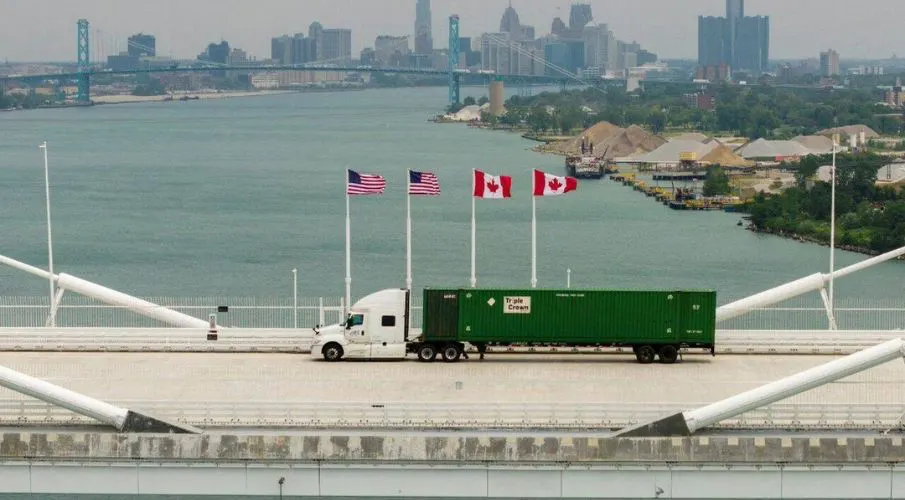
Donald Trump is going after Canada again in the trade dispute. In three weeks, Canadian dairy products, most alcoholic beverages and motorcycles will no longer be allowed into the United States. In several areas, tariffs are now turning into outright import bans. Washington is responding to Canada's retaliatory tariffs, which took effect Tuesday and hit about $20 billion worth of American goods. Ottawa is taxing hundreds of U.S. products at rates of 15, 25 or 50 percent. Steel, aluminum, cheese, clothing, cosmetics, household appliances and farm equipment are on the list.

Donald Trump's fitness for office is becoming more questionable by the day. Just as questionable now is whether these measures will even still be in place three weeks from now or whether Trump will already have changed them all again in another chaotic move.
Trump had already hit Canada with a 50 percent tariff on part of its exports on August 22. Only about five percent of all Canadian shipments to the United States were affected, but the political message was clear. Washington accuses Canada of treating American companies unfairly when it comes to dairy products, alcohol and cars. Some Canadian provinces then pulled American alcohol from store shelves. Now Trump is banning large parts of the corresponding Canadian products altogether.

What had been a decades-long dispute over individual trade rules has now turned into an open economic fight. Canada responds to American measures, Trump responds to Canada, and every round hits new industries. For decades, the two countries were economically more closely tied than almost any other pair of neighbors in the world. Politically, not much of that is left. For companies on both sides, it is becoming increasingly difficult to plan anything at all. What can still be sold today could be hit with steep tariffs or banned altogether just a few weeks later. That is where this conflict has now arrived.
Trump Is Now Taking U.S. Government Contracts Away From Canada Too
Donald Trump is now also using the purchasing power of the U.S. federal government in his dispute with Canada. Canadian goods are to be excluded from large, long-term U.S. government contracts. The federal procurement agency was instructed to stop allowing Canadian products into such contracts as long as Ottawa, in Trump's view, does not give American goods fully equal access. That takes Washington much further than ordinary import tariffs. Government contracts often run for years and can be worth millions or even billions of dollars to companies. Anyone shut out of those contracts does not just lose a single sale, but potentially an entire market for the long term. Canadian companies are now feeling exactly that pressure.
That same day, Canada put its new retaliatory tariffs on about $20 billion worth of American goods into effect. Ottawa says U.S. products cannot keep entering Canada without additional costs while Canadian companies are being hit with American punitive tariffs at the same time. Trump is not responding with an offer for new talks, but with the next escalation. First higher tariffs, then import bans, now exclusion from government contracts. The economic relationship between the two countries is being used politically piece by piece. And this is hitting two countries whose supply chains have been closely connected for decades. Companies manufacture on both sides of the border, with parts crossing back and forth several times before becoming a finished product. This trade war therefore cannot simply be stopped at a national border. Every new blow against Canada will sooner or later hit American companies, prices and jobs too.
Canada Looks to Europe: Carney Wants Out of Dependence on the U.S.

Canada is seriously starting to think about how the country can keep going economically if the United States can no longer be considered a reliable partner. Prime Minister Mark Carney's government is therefore exploring a much closer relationship with the European Union. This is not just about a few additional trade agreements. Ottawa is discussing models that could go almost as far as full membership in the European Union.
Nothing has been decided yet. Options could include new treaties, expanding existing agreements or another permanent form of cooperation. Canada is already talking with provinces, territories and labor groups about it. That shows how seriously the government is now taking this overhaul. The reason lies directly south of the border. More than 70 percent of Canadian exports still go to the United States. That dependence was comfortable for decades as long as the two countries worked closely together politically and economically. Under Trump, it has become a risk. Tariffs, threats and new restrictions can suddenly hit entire industries.
Carney therefore wants more production at home, new trade routes and significantly more business with other countries. Canada's exports outside the United States are supposed to double over the next ten years. Next week, Carney is traveling to Strasbourg. There, on September 16, he will attend European Commission President Ursula von der Leyen's State of the European Union address and will speak to the European Parliament himself one day later. This is no longer an ordinary visit. Canada is beginning to economically reorient itself. For decades, the country almost automatically looked toward Washington. Now Ottawa is looking increasingly across the Atlantic.
Carney Makes Serious Accusation: Washington Wanted to Make Canada Even More Dependent
Mark Carney is openly saying why, in his view, negotiations with Donald Trump's government failed. According to him, this was not simply about a few tariffs or getting more American products into Canadian stores. Washington had made demands that would have made Canada even more dependent on the United States in crucial areas. The Canadian prime minister points to several issues. The U.S. had demanded influence over future Canadian trade agreements. Conditions had also been put on the table that would have weakened Canada's auto industry, steel industry and forestry sector. Even protections for the French language and Canadian culture had been part of the American demands.

For Carney, that crossed a line. Canada could not settle a trade dispute by ending up with less control over its own decisions afterward than it had before. His government is now drawing a much bigger conclusion from that: The entire relationship with the United States is to be economically reorganized. That will cost Canada money. Carney himself says the retaliatory tariffs and the overhaul will cause pain in the short term. Even so, he considers the previous situation more dangerous. More than 70 percent of Canadian exports still go to the U.S. If Washington uses that dependence politically, Canada has little room to maneuver.
That is exactly what Carney wants to change. More is supposed to be produced at home, new infrastructure is supposed to be built, and other countries are supposed to become more important trading partners. The trade war has now crossed a line. Canada is no longer just debating how high a tariff should be. The government is now asking how much economic control it can leave to a neighbor whose president regularly comes with new demands and threats.
Canadians Have Had Enough: Fewer U.S. Trips, Boycotts and a Clear No to Becoming the 51st State
Donald Trump's treatment of Canada has long since started leaving its mark outside government buildings and negotiating rooms. Canadians are traveling to the United States far less often, American goods are being boycotted, and Trump's repeated comments about Canada possibly becoming the 51st U.S. state have caused massive anger across the country. That is becoming especially clear now in British Columbia. New signs are set to go up at border crossings into the United States. The message leaves little room for misunderstanding: Welcome to British Columbia, Canada - strong, proud and NEVER the 51st state. Followed by a dry "Sorry."

Premier David Eby says Canada's kindness should never be mistaken for weakness. That attitude is getting a lot of support right now. Prime Minister Mark Carney's approval rating is above 70 percent. Trump's pressure has therefore not weakened the Canadian leader, but strengthened him politically. That is changing the negotiations too. Carney currently has little reason to rush back to Washington asking for talks. The Trump administration is not showing much urgency either. Officials from both countries remain in contact, but formal trade talks are not taking place.
Canada is clearly preparing for this dispute to last longer. Even before Washington's latest response, the government said that even an especially harsh reaction from Trump would not change its course. And that is exactly where the White House now has a problem. The pressure was supposed to push Canada into making concessions. Instead, people are buying fewer American products, crossing the border less often and backing a prime minister who promises to break the country's economic dependence on the United States.
Updates – Kaizen News Brief
Alle aktuellen ausgesuchten Tagesmeldungen findet ihr in den Kaizen Kurznachrichten.
To the Kaizen News Brief In English


