
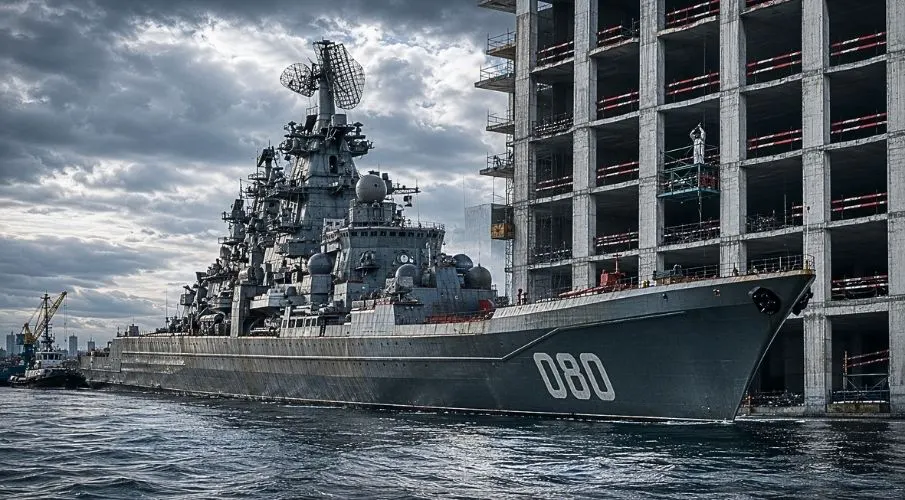
A state that arms itself outwardly while reaching inward at the same time is moving in one direction, even if the news comes from different corners. Outwardly, the weapons grow, inwardly, the state's grip grows, and the same citizen carries the burden of both. Russia is bringing a heavy nuclear-powered missile battlecruiser back after nearly three decades of sitting in a shipyard, and around this ship a picture is taking shape of rearmament and a long war that is becoming routine. According to the Russian Navy, the "Admiral Nakhimov" is expected to return to the fleet before the end of 2026. A colossus from yesterday is returning to a present that has long since taught itself how to fight all over again.

The cruiser is one of four heavy nuclear-powered missile battlecruisers of the Soviet-built Project 1144 "Orlan." It entered service in 1988 as the "Kalinin," but its time in service was short. Its last deployment at sea came in July 1997, after just nine years, and the most notable moment of its career was a six-month deployment to the Mediterranean in 1991. By 1997 it had effectively disappeared into repairs, officially entering the Sevmash shipyard in 1999, although the extensive modernization did not begin until 2013. In June 2026, it went back to sea for trials for the first time in 28 years, with state acceptance trials now still to come. A ship that sailed for nine years and sat for three decades is supposed to take the seas seriously again.
According to Russian state media, it was almost completely rearmed. The 20 "Granit" anti-ship missiles were replaced by 80 universal launch cells capable of firing "Kalibr" cruise missiles, "Oniks" anti-ship missiles, and "Zircon" hypersonic missiles. Another 96 cells for air defense were reportedly added as well. That would make the "Admiral Nakhimov" one of the most heavily armed surface ships in the fleet. The cost of the work was never officially disclosed; in 2023, a figure of more than 200 billion rubles was being cited. Experts question whether it made sense, because scarce shipyard capacity and skilled workers were poured into a single hull while Russia's military shipbuilding industry as a whole faces severe constraints. A showpiece is being created while the fleet as a whole struggles. What went into this one hull was missing elsewhere in shipbuilding. A victory of symbolism over arithmetic.
A second concern weighs even more heavily. A ship this large and expensive is vulnerable in modern warfare, where comparatively cheap anti-ship missiles and naval drones increasingly decide the outcome, and losing it would mean sacrificing an entire arsenal concentrated on a single platform. A target carrying that much firepower practically invites the enemy to go looking for it with a few inexpensive weapons. In the end, the most expensive platform is simply the biggest target. The cruiser does not stand alone. The news these days shows an alliance intensifying its training for drone warfare and a Germany massively increasing military spending. Russia is ramping up explosives production, and there is already discussion about possibly opening Starlink for Ukrainian strikes deep inside Russian territory. Each of these reports could be overlooked on its own, but together they form the grammar of a war economy settling in for the long haul. What looks like precaution one story at a time, taken together forms a landscape preparing itself for permanent conflict. The horror wears off, and vigilance wears off with it.

How close the danger has moved can be seen at the Zaporizhzhia Nuclear Power Plant in occupied Ukrainian territory. Since August 20, the plant has been cut off from external power after the "Ferrospлавna-1" line was damaged at a location controlled by Ukraine. On August 29, International Atomic Energy Agency Director General Rafael Grossi said the facility had been relying on emergency diesel generators for more than a week. He warned that the plant needed enough fuel reserves to maintain the power required for safety. Rosatom, the Russian state company operating the plant, asked the agency to provide an escort for a fuel convoy. Its chief, Alexey Likhachev, said they hoped nuclear inspectors would accompany the convoy; he called diesel a critical resource for nuclear safety and said the journey was extremely dangerous because access roads were being shelled, but promised the delivery would take place under any circumstances. The fact that a nuclear watchdog is being asked to escort fuel through a combat zone so a reactor does not go dark says more about this war than any battlefield report. At the same time, officials were working with the Defense Ministry and the Russian National Guard on a temporary ceasefire needed to repair the power line; the Foreign Ministry was involved as well. Even a power line can only be fixed here when the guns briefly fall silent. Ukrainian forces regularly shell roads in occupied areas and hit fuel trucks in an effort to disrupt supplies to the Russian military; they accuse Moscow of disguising military cargo as civilian transport. Between the front lines stands a facility whose accident would recognize no border, and both sides calculate the risk to their own advantage. The nuclear safety of an entire plant now depends on a fuel truck surviving the front. A brief ceasefire just for diesel is all the progress this war still allows at the reactor.
The state's outward reach has an inward counterpart. In Moscow, the state is seizing property on a massive scale for construction projects and roads, and the courts show just how tightly it squeezes citizens in the process. Property is taken on a large scale, compensation is kept small, and the legal road is long. The courts correct a lot, but only for those who can afford to wait. According to an analysis of 100 cases from 2023 to 2026, compensation increased by an average of 73 percent in court, while the city's original offers were on average 42 percent too low. About half of property owners do not challenge the amount at all because such proceedings take an average of 1.5 years, according to Sergei Ramazanov of the law firm "Strategiya." Some take what the city offers because they need the money quickly or want to avoid a long fight. That turns the right to fair compensation into a question of patience, and not everyone can afford patience.

Behind the seizures is the Comprehensive Territorial Development Program, known as KRT, with 470 projects covering more than 4,700 hectares, where around 73.7 million square meters of new development are planned. If an owner refuses to build according to the city's specifications, the property can be seized in exchange for compensation set by an "independent" appraisal. Lawyer Daniil Sinitsyn of the firm "Poverenny" said court action usually raises payments by 15 to 20 percent, while city valuations can be as much as 30 percent below market value. He considers an increase of 73 percent more of an exception, for example when authorities initially assessed the use or purpose of a property incorrectly. Since the beginning of 2026, however, courts have been allowed to commission only state appraisals, making higher compensation harder to obtain. That leaves the state sitting on both sides of the table, as buyer and appraiser. The scale is growing rapidly: between January and July 2026, the city seized 1,040 hectares, 37 percent more than the previous year. The area of confiscated buildings rose by 85 percent to 938,000 square meters, while the number of properties doubled to 8,100. Their cadastral value totaled 163.7 billion rubles, affecting 1,630 owners. The state is building its future on land it undervalues itself, while changing the rules so that challenging it becomes more expensive. Plot by plot disappears into a program that promises growth and takes property.
Two directions, one will. Outwardly, there is the cruiser coming out of the dock and the nuclear plant on a diesel lifeline, inwardly, the state's reach into property at home. A state that, by estimates, pours more than 200 billion rubles into a ship from yesterday while at the same time taking its citizens' property below value is expanding in both directions in the same breath. Nuclear safety travels in a diesel convoy, the long war becomes everyday life, and a person's home shrinks to a line in a construction plan. The ruble flowing into the cruiser and the ruble some dispossessed owners have to fight for in court tell the same story about the state's priorities. What makes these times dangerous is less the individual strike than the calm with which people get used to it.
Updates – Kaizen News Brief
Alle aktuellen ausgesuchten Tagesmeldungen findet ihr in den Kaizen Kurznachrichten.
To the Kaizen News Brief In English


