
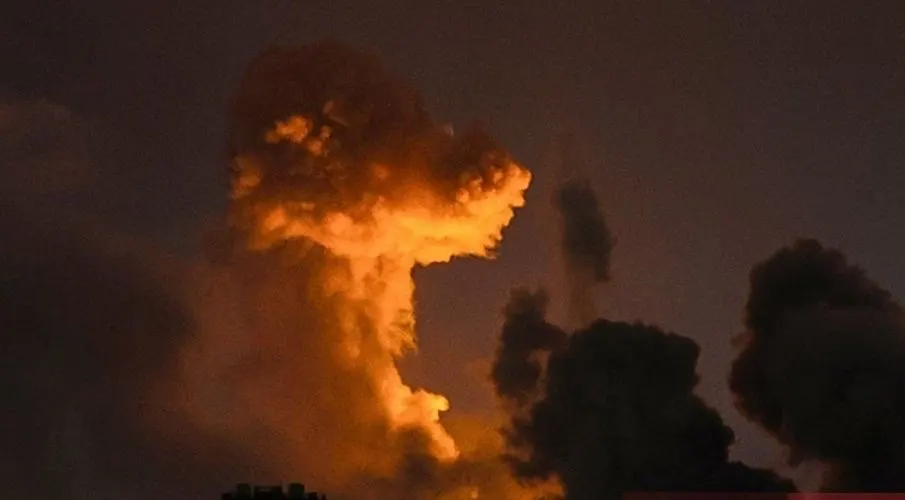
A war its architects keep all but declaring won still needs one more strike. On Sunday, U.S. forces attacked two Iranian missile launchers near the Strait of Hormuz, according to U.S. Central Command, the first U.S. military strike on Iran in a month. It broke a lull in a war that has now lasted more than six months. The last confirmed strike came on July 29, when Central Command hit dozens of targets inside the country, including command centers and missile and drone facilities. Since then, the major bombardments had stopped, with both sides turning instead to smaller attacks and threats. The military described the new action as measured, but the back and forth raises the danger of another round from both sides.

Capt. Tim Hawkins, a Central Command spokesman, said Revolutionary Guard forces had been observed preparing to fire mine-carrying missiles from Larak Island into the strait, a vital route for oil and gas. A few hours after the strike, Iran fired missiles at U.S. bases in Jordan, where several thousand American troops are stationed. Jordan's armed forces said they intercepted eight projectiles over their airspace during the night into Monday. Every strike brings the next one, and the bill grows with every response. A return to open war would be dangerous for the entire region, because since the war began Iran has targeted U.S. bases and facilities in the Gulf states, and a single missile can turn the pause into a regional firestorm.

The accounts of what happened differ. The U.S. military rejected Iran's accusation that this was an act of aggression and described it as a limited, precise action against forces laying mines. Iran created the threat, Central Command said, and the military removed it to protect civilian shipping and free trade. The Revolutionary Guards announced retaliation against the attacker; their spokesman, Gen. Hossein Mohebi, called the strike a fatal mistake by the Trump regime in the economic war. Iranian state media reported two deaths, a claim that could not be confirmed. The Pentagon initially had no comment. So two truths stand side by side, one's own clean and necessary, the enemy's bloody and malicious, and between them lie the dead nobody wants to count.

Just a few days earlier, the Trump administration had declared that from now on it would end the war through economic pressure instead of weapons and threatened every country and every entity that continued doing business with Tehran. Trump had already paused new strikes on August 1 at the urging of Gulf allies Qatar and Saudi Arabia, and the United Arab Emirates had also pushed for restraint. Then came Sunday's strike, less than a week after the announced change of course. The pivot to sanctions came as Washington, after months of war, weighs depleted ammunition stocks and fears that the prolonged conflict could weaken its ability to respond elsewhere. A country that is trying to preserve its arsenal while firing missiles at the same time is fighting two wars against itself. An economic war interrupted by missiles shows how little of a plan there is behind the grand phrase.
Iran's strongest weapon lies in the water. Normally, 20 percent of the world's oil passes through the Strait of Hormuz, and Tehran still has enough drones and missiles to hit ships that dare to pass through. Only a few tankers carrying oil and liquefied natural gas are taking the risk. After the U.S. strike, oil prices rose, with the U.S. benchmark up 1.8 percent to $84.94 a barrel and Brent crude up 1.9 percent to $89.79. A single strait is enough to make half the global economy nervous. Tehran has been exploiting exactly that narrow passage since the major attacks went into a pause, turning its weakness at sea into a threat to everyone. That narrow stretch of water answers to no superpower, it answers to whoever mines it next. That is how the weaker side dictates fear to the stronger one.

The passage remains deadly. Over the past two weeks, two sailors have been killed and another is missing. Since the war began, there have been at least 71 attacks on ships and 19 sailors killed. On Saturday, an unidentified projectile struck a tanker north of Khasab in Oman, with no casualties reported and no one claiming responsibility. The crews at sea are the ones paying the price for this war. Two fewer names on crew lists and one man missing, and the war calls these weeks a quiet phase. For shipowners, the passage has become a gamble, for the crews a matter of sheer luck.
Trump keeps saying the Strait of Hormuz is open, pointing to 24 ships that passed through last week. Before the war, around 130 passed through every day. A U.S. Navy-led coalition said traffic remained reduced. In June, Iran and the United States signed an agreement meant to reopen the strait, and for three days more than 60 ships passed through each day. Then the deal fell apart, and U.S. forces again imposed a blockade on Iranian ports. By Sunday, they had diverted 83 merchant ships and disabled three. Iran now charges fees for passage that used to be free and says the United States may not use the strait until it honors the agreement signed in mid-June. Shipping companies are avoiding the route, and Saudi Arabia is sending more oil through the Red Sea. Global trade has long since started looking for ways around Trump's open strait. A word like open loses its meaning when the numbers contradict it.
Little remains of the quick ending Trump once promised. Last week he stressed that he was in no hurry to bring Iran back to the negotiating table and called the leadership of the Islamic Republic weakened. Tehran's new appointments at the top of its security apparatus point more to defiance after decades of sanctions. There is little in those personnel decisions to suggest a leadership on its knees, as Trump describes it. Trump praises the U.S.-Israeli campaign as devastating for Iran's navy and air force; Iranian officials put the damage at $270 billion, and Israeli strikes wiped out much of the leadership structure in the first weeks. The war began on February 28, and after half a year both sides are bleeding without either giving in. Both talk about victory and mean simply enduring, paid for by those who make neither the decisions about missiles nor the decisions about sanctions.
And Europe?
Europe's hands are tied, although that does not excuse everything it failed to do. The reason for the conspicuous silence probably has less to do with approval than with Europe's pretty miserable position between opposition and dependence. In March, the EU explicitly responded to the war by calling for "maximum restraint" and respect for international law. Behind closed doors, however, European diplomats were just as blunt in saying that Europe had little influence over Trump. One EU diplomat put it devastatingly: Europe was standing on the sidelines because "nobody has any influence over Trump."
And so the language of the clean strike remains the consolation of a war nobody wants to end. A president who is in no hurry lets the clock run for everyone else, for the crews in the Gulf and the markets that flinch at every missile. Mines can be cleared from the water, as Central Command reported last week. A war cannot be cleared away nearly as quickly.
The world in 2026 with Trump and Putin, these two warmongers who are no longer just keeping an entire world on edge, but are well on their way to causing damage that may barely be possible to undo. So fight back against it, each in your own way. Or do most people really want to keep standing by and watching as this world is destroyed for future generations?
Updates – Kaizen News Brief
Alle aktuellen ausgesuchten Tagesmeldungen findet ihr in den Kaizen Kurznachrichten.
To the Kaizen News Brief In English


