
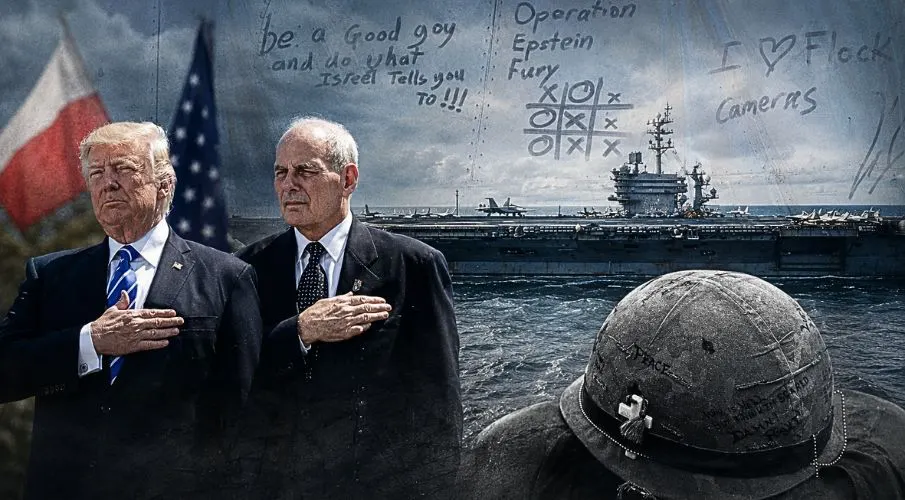
How a war is really going is rarely found in a press briefing. It is more likely to be found in the dirt on the equipment. On the flap of a fighter jet in the Persian Gulf, stranded U.S. service members traced messages into the dust with their fingers, much like frustrated men in the Vietnam War wrote on their helmets. "Operation Epstein Fury" is written there, alongside "Bibi's Cucks." Another line announces "Peace Deal #64," all of it "FOR THE HOLY LAND." There was even room for a game of tic-tac-toe. None of it sounds like a military that believes in its mission.

The messages resort to crude, sometimes ugly images of the enemy, yet what they are saying is unmistakable. "Be a good Goy and do what Israel tells you," one person scratched into the dust, while another wrote, "I love Israel, I am a good Goy." Someone else declares his love for "Flock cameras," the surveillance technology from back home. This is how men write when they believe they are bleeding for someone else's cause and to distract from a scandal. A war started to divert attention from the Epstein files and the rest of this administration's disasters has written its own testimony onto the flap.

The situation becomes clearest where people are trapped. On the USS Abraham Lincoln, which has been deployed for the war against Iran for nine months, conditions reportedly deteriorated so badly that individual sailors jumped overboard to escape them. The crew has been dealing for weeks with food shortages and disgusting sanitary conditions. At meetings with military leadership, including acting Navy Secretary Hung Cao, things have gotten heated. Family members have voiced concerns about the mental state of the crew and the danger that crew members could harm themselves. At several of these meetings, families have openly spoken about their fear.
Read also our article: Desperate Sailors Aboard the USS Abraham Lincoln Are Trying to Go Overboard After 250 Days Without Setting Foot on Land

The USS Abraham Lincoln is not alone. Miserable conditions have also been reported on the USS Benfold and the USS Carl Vinson. The crew of the USS Tripoli complained about the same thing. Pete Hegseth, who likes to call himself the "Secretary of War," reportedly went to considerable lengths to downplay these reports or deny them altogether. He called them false portrayals while at the same time concealing why the returning Lincoln had not been adequately supplied. The dust on the flap tells the other story.

Whether this openness is new is hard to say. The reports say there is no real frame of reference for comparison, but the willingness to express the anger this openly seems new. The comparison with the marked-up helmets from back then still holds. A war that was supposed to distract from the administration's own disasters is drawing even more attention to them, and the loudest voice against it is coming from within its own ranks. Messages in the dust are the last outlet for people whose chain of command no longer gets them anywhere.

There were reasons to question Trump's respect for his own troops long before this war. In September 2020, it was reported that he had canceled a visit to the Aisne-Marne American Cemetery outside Paris and asked why he should visit a cemetery full of "losers." He reportedly called the more than 1,800 Marines who died at Belleau Wood "suckers" for getting themselves killed. He was said to have wanted to avoid the trip so the rain would not ruin his hair. His former chief of staff John Kelly later confirmed it.

The contempt runs through his career. He has called senior military officers "dopes and babies" and compared them, of all people, to Adolf Hitler's generals, whom he apparently admires. He reportedly did not want to see wounded and disabled veterans at public appearances, and injured soldiers were supposed to be kept away because "nobody wants to see that." During his first campaign, he had already mocked the families of fallen service members, along with former prisoner of war John McCain.

The contempt is visible not only in the way he talks, but also in the money. With a massive increase in the defense budget, he reportedly poured billions into the Pentagon, while little reached the ordinary troops. Congress was supposed to add $30 billion to the current budget and another $54 billion the following year. None of it was earmarked for better infantry weapons or safer troop transport helicopters, and protective body armor was also left short. On the ground, troops were left with outdated rifles and helicopters from their grandfathers' era. Communications equipment was heavy and unreliable. Money flowed freely, just not to the people who had to carry it on their bodies.
Support is fading with every passing week. Approval of this president reportedly fell to a low of 33 percent, and support for the war against Iran was weak from the start. As conditions aboard the ships deteriorate, the administration is waging what amounts to a media campaign against the worried families of those deployed. Vital ammunition is being used up at an alarming pace. And at precisely this moment, Trump has ordered a bizarre redesign of aircraft carriers, going back to outdated steam catapults. The Iran adventure has exposed two things at once - his incompetence as commander in chief and his indifference toward the people who have to pay the price.
One service member put it perfectly: What people in the media don't understand is that there is absolutely no morale behind this operation; for men being sent indefinitely to places nobody wants to be, that makes a world of difference. According to the reports, there is only one thing left to do - simply end the war. But Trump is already knee-deep in it, and there is no end in sight. The troops have long since delivered their verdict, in a place no official statement will ever reach, written with a finger in the dust.
Updates – Kaizen News Brief
Alle aktuellen ausgesuchten Tagesmeldungen findet ihr in den Kaizen Kurznachrichten.
To the Kaizen News Brief In English


Fakt 1: Trump verdient gut am Krieg
Fakt 2: Trump interessiert nicht ein einziger Soldat … sagt Mr Bone spurs
Hoffentlich tragen die Soldaten diese schlechte Stimmung nach Hause.
Zeigen auf, dass Trump sich einen Sche*ß für sie und die Veteranen, insbesondere die disabled, interessiert.
Trump interessiert Trump.
Deals für Trump. Darüber hinaus gibt es nichts.
Ach doch, die vollständige Freigabe der Epsteinfiles bis zu seinem Tod verhindern.