
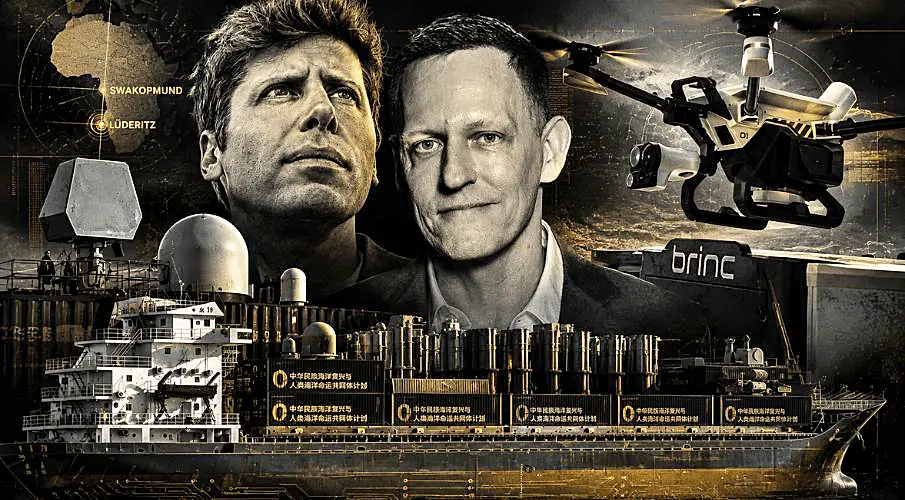
125 million dollars in fresh capital for a drone manufacturer whose aircraft are meant to fly above American streets for police and fire departments. That is the headline, and at first it sounds like an ordinary venture capital story. It only becomes interesting once you place the timing beside it.

The company is called Brinc Drones. It is based in Seattle, was founded in 2019, and has since raised more than 250 million dollars. Its founder and chief executive officer is 26-year-old Blake Resnick. Among the company's earliest backers are OpenAI Chief Executive Officer Sam Altman and Peter Thiel, who supported Resnick from the very beginning. The latest funding round was led by Motorola Solutions, a company that had already invested in Brinc. Also participating were Index Ventures and billionaire Dylan Field, co-founder and chief executive officer of software company Figma.

For years, the civilian drone market in the United States was dominated by Chinese manufacturers, led by SZ DJI Technology. Then, in December, the Federal Communications Commission announced a ban on most foreign-made drones and their essential components. Overnight, that created a gap American manufacturers could move into, first and foremost those backed by Altman. The money from the latest funding round is intended to flow precisely into that opportunity - expanding sales to police and fire departments after the government pushed Chinese competitors out of the market.

Peter Thiel is more than just another investor in this story. He was among Blake Resnick's earliest supporters and is also the force behind Palantir, a company whose software has been used for years by security agencies, law enforcement, and the military. The fact that his capital is now also flowing into a manufacturer selling drones to those very same agencies makes this far more than an ordinary venture capital investment.

Adam Smith, often cited in Silicon Valley as the ultimate champion of the free market, left behind a warning for precisely these kinds of situations, one that is quoted there far less often. Every proposal for a new trade law, he wrote, that comes from merchants themselves deserves the greatest suspicion and the most careful scrutiny, because it comes from people whose interests never fully align with those of the public and who have every incentive to mislead and even oppress it. An import ban that clears an entire market and hands it to a small group of domestic companies backed by the very same men who present themselves elsewhere as prophets of innovation is exactly the kind of case Smith had in mind.
Resnick himself has explained just how tightly this circle has closed. Motorola, he said, is the ideal partner because the company already has business relationships with virtually every potential customer in the United States and many more around the world. The reason is simple, and precisely because of that revealing - Motorola has supplied police and fire departments with communications equipment for decades. The distribution network already exists. It simply has to be filled. According to its chief executive, Brinc already works with roughly 1,000 police and fire departments and markets drones capable of responding autonomously to emergency calls.
You have to read that sentence twice. Drones dispatched to emergency calls over American neighborhoods, sold to 1,000 agencies in a country where, just over a month ago, three people died during immigration enforcement operations. What is marketed as rescue technology is also surveillance technology, and the line between the two is not in the device itself, but in the intentions of the person controlling it. That Altman, of all people, has spent years publicly warning about the dangers of artificial intelligence and calling for regulation worldwide, while also investing in a company that sells this technology to American law enforcement and public safety agencies, is not irony. Whoever helps write the rules can decide where they apply and where they don't.

That brings us to the question of how the American ban was justified. Officially, the United States based its decision on security risks posed by foreign drone technology and on its dependence on Chinese manufacturers. Almost at the same time, images from a shipyard in Shanghai drew worldwide attention. At the Hudong-Zhonghua shipyard, China had transformed a medium-sized cargo vessel within just a few days, first into an improvised missile platform equipped with roughly 60 containerized launch cells, radar systems, and close-in defense weapons. Barely a week later, the very same ship had been reconfigured again, this time into a carrier for modern combat drones. Mounted on its deck was a modular electromagnetic launch system based on the EMALS principle, assembled from four interconnected vehicles that formed a launch track whose length could apparently be adjusted to match the aircraft being launched. In the published images, one drone sat ready for launch on the rear vehicle, while another stood directly behind it on the deck.

To make that conversion possible, 36 of the original 60 missile launch cells had been removed, leaving 24 still on board. The 30-millimeter Type 1130 close-in weapon system and the large radar installation also remained in place, while the starboard-side container housing the decoy launchers and life rafts had disappeared. Just a few yards away in dry dock sits the massive Type 076 amphibious assault ship Sichuan, which carries such a catapult as a permanent feature. Satellite imagery from December 28 clearly shows the drone mockups and the vehicles positioned on the pier despite the limited resolution.

The technical doubts are considerable. Whether a segmented catapult assembled from separate modules can operate reliably on a rolling ship, whether it can withstand constant exposure to saltwater, whether it can generate enough power to launch a heavy drone over such a short distance, and whether the aircraft itself could survive such a violent acceleration all remain open questions. More importantly, there is no visible recovery system. Whatever launches from that deck does not come back, unless the drones are designed to parachute into the water and be recovered afterward. As it stands, the concept appears to be built for a one-way launch.
And this is where the American side of the story becomes uncomfortable. Experts who reviewed the images believe it is entirely possible that the drones are mockups and that the entire configuration is nothing more than a proof-of-concept, intended as much for foreign observers as for China's own testing. From the very beginning, the ship appeared to have been arranged for outside audiences. Beijing knows exactly which images leave its shipyards, unless it deliberately allows them to. The photographs that surfaced most recently are of such unusually high quality and were taken from such close range that their release is unlikely to have been accidental. The message is unmistakable: We can turn our vast commercial fleet into warships and drone carriers within days. The timing is equally remarkable, because almost exactly one year earlier, another wave of Chinese military technology had entered the public spotlight.
That leaves two developments unfolding side by side, each reinforcing the other politically. On one side stands a state that is openly demonstrating its military capabilities, regardless of whether they are already fully operational. On the other stands an American government that has largely closed its market to new Chinese drones, giving domestic manufacturers a significant competitive advantage. The drone scare out of Shanghai and the newly cleared market in Seattle ultimately tell the same story, even if one cannot be proven to be the direct cause of the other. Whether the mockups on that deck will ever fly is beside the point. They fulfilled their purpose the moment they were photographed.
None of this means that China's military buildup is harmless. Anyone who has watched the speed with which China has advanced its military technology in recent years would be wise not to dismiss a mobile catapult of this kind as fantasy. But there is a gap between acknowledging that a threat exists and claiming that a particular ban is the answer to it. Filling that gap requires arguments, not business interests.
What remains is a 26-year-old founder with a newly opened market, a communications giant with access to virtually every law enforcement and emergency services agency in the country, and two billionaires behind him, one of whom tells the world that artificial intelligence urgently needs to be brought under control. Smith would not have been surprised. He described men like these long before drones ever existed.
To be continued ...
Updates – Kaizen News Brief
Alle aktuellen ausgesuchten Tagesmeldungen findet ihr in den Kaizen Kurznachrichten.
To the Kaizen News Brief In English


Die totale Überwachung, getarnt als Hilfe bei 911 Anrufen.
Menschen in Not lösen eine Überwachung aus, die weit über den wahren Notfall hinaus gehen.
Ist es Zufall, dass Blake Resnik aussieht, wie Alex Karp in jungen Jahren?