
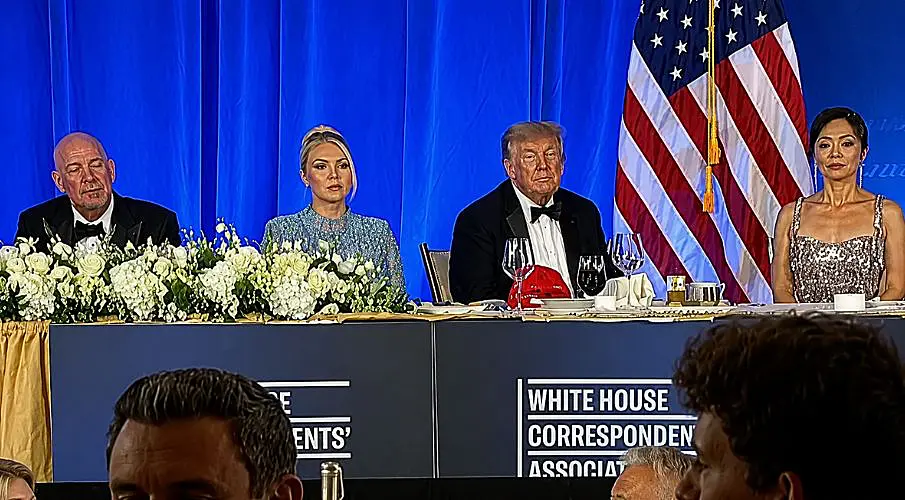
Washington, D.C. - On Friday evening, beneath the chandeliers of the Waldorf Astoria, a hotel that once belonged to him and today merely still carries his scent, the most powerful man in the Western world stepped up to the podium and seemed unsure who he wanted to be. What exactly are we doing here, he asked the room. Am I supposed to be funny? Am I supposed to be serious? Am I supposed to be a comedian? He promised to be a little of everything, and he kept that promise in the worst way imaginable. For 1 hour, he really was a little of everything - except funny.

It was the rescheduled dinner of the White House Correspondents' Association, the event that had ended in panic 3 months earlier when an armed man forced his way through security at the Washington Hilton. Now came the second attempt, smaller, easier to secure, inside a ballroom whose splendor the speaker simply couldn't ignore. Look at these beautiful chandeliers, he told the audience. I could tell you everything about them. Later he returned to the subject and revealed what he had supposedly intended to keep to himself, that they were made of Bohemian crystal, not American crystal, and that he would love to walk out carrying them under his arm because you couldn't buy them anywhere. A man who attends a dinner honoring the press and openly jokes about stealing the furniture has already said more about himself than any newspaper column ever could.

The president who spent that evening honoring the work of journalists is the very same president who, just 1 week earlier, demanded that 2 television networks lose their broadcast licenses because he didn't like their news coverage. The audience was asked to applaud the Pentagon correspondents, and nobody mentioned that his secretary of defense, who was sitting right there in the room, had been trying to throw those very reporters out of the Pentagon while his administration was fighting a new war. Earlier this month, the administration issued subpoenas seeking the phone records and testimony of journalists who had reported on security flaws involving the presidential aircraft gifted by Qatar. On Thursday, a federal judge in Manhattan sharply rebuked the Justice Department over those subpoenas, after which the administration withdrew them. One of the reporters who had been targeted, Tyler Pager, walked to the front of the room on Friday night to accept an award, while the president whose administration had just tried to dig through his communications sat there applauding - or perhaps not applauding at all.
The most embarrassing moment of the evening didn't belong to him, but it was about him. Wolf Blitzer called the Wall Street Journal reporters to the stage, honoring them for their reporting on the president's past ties to financier Jeffrey Epstein. And Blitzer kept going, clearly and without mercy. The president, he said, had responded by filing a $20 billion lawsuit against the newspaper, publicly revealing reporter Khadeeja Safdar's home address, forcing her family to move, and banning the paper from Air Force One. As the award winners accepted their trophies, the president theatrically threw his hands into the air, the way someone does when they're trying to say, well, what can you do. Nervous laughter rippled through the room, the laughter of people who recognized that raised hand as an admission and didn't know what to do with themselves while the award winners held their trophies close.
There's an old observation about laughter that says we laugh whenever something living suddenly freezes into a machine, when a person no longer responds to the world around them and instead simply runs through the same mechanical routine. That night, everyone in the room watched that machinery running, and nobody laughed because what had frozen wasn't funny, it was governing the country. What followed was no longer a speech, but the same campaign rally people have heard countless times before, delivered to an audience that hadn't come for one. I hate some people, he said, before launching into Adam Schiff. Then came Rosie O'Donnell, Alexandria Ocasio-Cortez, Chris Christie, Jerry Nadler. There were no punchlines, only the same familiar talking points from every one of his appearances.
He compared the battered faces of cage fighters to those of Bette Midler, Jane Fonda, and Bruce Springsteen. Then he doubled down on Springsteen, saying the man looked frightening and that his tour ought to be renamed Bored in the U.S.A. He mocked the appearance and careers of individual female reporters sitting in the room. Kaitlan Collins, he said, was a young, attractive woman who never smiled. At first he thought she was the face on a beer can, but then realized it wasn't her after all, it was Dylan Mulvaney. You sit there listening to a president who mistakes a journalist for someone from an advertising campaign and then treats the mistake itself as the joke.

In between came the cheap jokes that even he no longer seemed able to keep straight. That the word dumb contained a silent B in English, for which nobody ever gave him any credit. That after the assassination attempt people were shouting get down, whereupon Nicki Minaj supposedly started twerking. That he had been forced to turn away 450,000 people who wanted to attend his speech, a claim that didn't even make the room shake its head anymore. Speaking about the secretary of health sitting beside him, he called him a very special person, then claimed in closing that the secretary had personally run over the cow for dinner with his own car, butchered it himself, and brought it to the event. As an appetizer, he added, the secretary had also recommended his favorite cut - roadkill raccoon.
Between the insults, he scattered the lines by which the evening will ultimately be remembered. Speaking about the governor of Illinois, he said people shouldn't call him a fat pig, because he himself was defending the man, otherwise the press would come after him instead. Referring to the award winners as a whole, he remarked that it hadn't been an easy evening, all these awards. Then, almost in passing, came the sentence that tore away the evening's polite facade. Some of you should be glad the last dinner was canceled, because I was planning to come after you. Your lives really were in danger last time, for a different reason, but your careers were saved. A president who stands before a ballroom full of journalists 3 months after an assassination attempt and tells them their survival was basically a lucky accident has already told you everything you need to know about himself, and he says it voluntarily.
One person noticed that night. Reporter Weijia Jiang said out loud what the evening should have been about all along. There is a fundamental, an existential difference between criticizing the press and trying to destroy it, she said. One makes all of us better. The other is exactly what the Founding Fathers hoped to prevent. In a room that had spent an hour being insulted, hers was the only sentence that remained standing.
The president, meanwhile, had already moved on to settling scores with everyone who had ever offended him. The late night hosts, Kimmel, Fallon, and Colbert, had no talent, he said. They weren't comedians, they were angry, sick people. Don Lemon had won a contest for the lowest ratings and the lowest IQ. Schumer had become a Palestinian, and he was going to send him Palestinian robes. Speaking about a newsroom that had changed ownership, he said it was now being run by a gay dictator, before wishing its new leader all the best anyway. By the time the audience had gone completely silent, he admitted the collapse himself. A joke about the aging members of Congress, he said, had been the only good part of this whole damn stupid speech, and even that one hadn't gotten much laughter. He threw his arms into the air, and out of exhaustion or pity, they laughed again.
He had something for everyone. Rosie O'Donnell, he claimed, had reached out because she wanted to honor him, loved him dearly, and was desperate to return to the United States so she could pay her respects to Donald J. Trump. The only problem, he said, was that nobody wanted her back, a sick old woman. They had considered hiring a professional clown to entertain the audience that evening, but Adam Shifty Schiff wasn't available. Speaking about his own press secretary, he said she had one of the toughest jobs in the White House. She could be nasty, but sometimes she had no choice, after all, she had to deal with all of you. Referring to a congressman from Texas, he said the man hated sex and hated women, which was why he wouldn't do well against Ken Paxton. Everyone looked wonderful tonight, he added, and he knew how difficult it had been to find shoes that matched the bulletproof vests, which many people had preferred not to wear because they'd rather die than look 20 pounds heavier.
It had been an interesting evening, he said. He hadn't really known what to expect, and, honestly, it had turned out to be far worse than he had imagined. He had read that 93 percent of the coverage about him was negative, and he wondered how the hell he had managed to win the election by such a large margin. This room, he said, was probably the biggest gathering of people suffering from Trump Derangement Syndrome ever assembled in one place. One friendly television network later declared that he had been brilliant and that the real losers of the evening were the people in the ballroom, a bunch of losers. But someone else said over the phone that he had laughed for all the wrong reasons. It had been so bad that, while the whole world was watching, he felt embarrassed for America.

At the end, he pulled out a hat, placed it on his head with theatrical flair, and let it speak for him: Trump 2028. Some people applauded, others laughed, but most of the reporters simply stared straight ahead. Just like with his presidency, he said, the second time was much better than the first, and the third would be even better. He was ready to make an announcement, and, as he put it, this was the big one. He intended to run for a fourth term, after all, he had already won 3 times. Anyone who still believes the United States Constitution is an obstacle had every reason to reconsider that belief after this evening at the Waldorf.
And then came the sentence that rises above the evening's unintentional satire because, by accident, it explained everything. When I'm gone, the president told the room full of his enemies, you'll all go broke, because there won't be anyone left to report on. He meant it as a threat, but it became a confession. A man who believes that, without him, the public has nothing left to care about has abandoned the distinction between himself and the nation itself. That loss was what 1 hour beneath Bohemian crystal had put on display. Outside, a war is raging. Inside, a president counts chandeliers and announces his third reelection. Anyone still looking for the joke has already understood the evening, and that is precisely the story leaving the Waldorf, heading out into the world beyond, where wars are not measured by chandeliers.
Updates – Kaizen News Brief
All current curated daily updates can be found in the Kaizen News Brief.
To the Kaizen News Brief In English


Warum sind nicht alle einfach gegangen statt diesem schweinsäugigen Ekelpaket zuzuhören.