
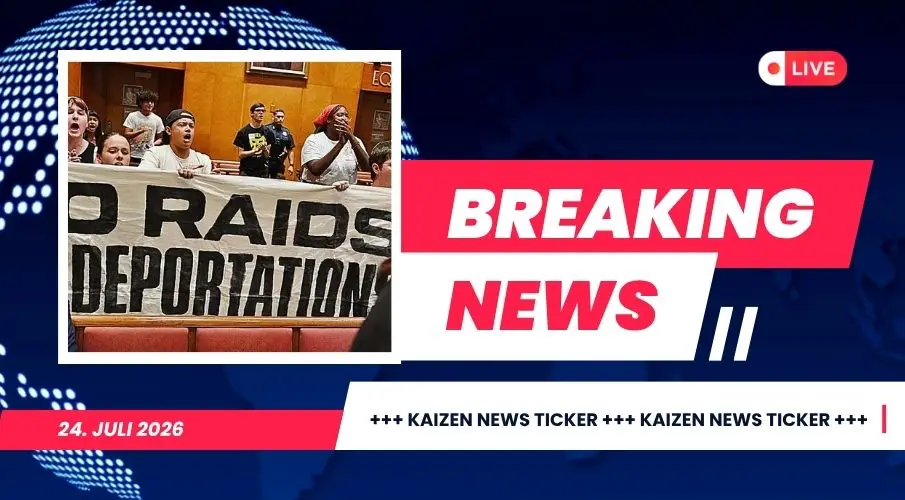
Bundesstaaten wollen, dass ICE sein Gesicht zeigt – Trump zieht vor Gericht

The Trump administration is now suing at least five states and the city of Philadelphia because they want ICE officers to show their faces during operations and wear clear identification. Washington claims doing so would put agents at risk. As evidence, the Justice Department points to a website called ICESpy. The problem is that, according to its own creator, the facial recognition system doesn't even work for most current ICE officers. The database is based mainly on old LinkedIn profiles from employees dating back to 2018. Many of today's deportation officers aren't even included.
The actual use of the site is also far smaller than the administration claims. During one week, it recorded just 84 page views. Only two people even attempted to match faces, and both results were completely wrong. The site's creator says the idea that anyone could identify active ICE officers through it is simply absurd. Even so, the Justice Department is also relying on a second platform called ICE List. The site documents agents, vehicles, and enforcement operations. According to its operators, it does not publish home addresses or information about family members. Most of its information comes from publicly available sources and independent research.
While Washington warns about alleged threats against its officers, the states point to a different problem. During fatal incidents in Maine and Texas, ICE officers were not wearing body cameras despite legal requirements. In Minnesota, federal authorities withheld key evidence related to fatal shootings for months until courts forced them to hand it over. At the same time, it became public that ICE's internal oversight office is now spending time monitoring citizens who criticize the government and its immigration policies online.
The fight is no longer just about masks. It is about whether armed government officers can operate anonymously or whether they have to be accountable to the public. That question is now being decided in courtrooms across multiple American states.
Canada Pushes Back - Trump Threatens 50 Percent Tariffs, Ottawa Prepares to Hit Back

Donald Trump wants to impose 50 percent tariffs on a wide range of Canadian goods starting August 19. The list includes honey, liquor, cement, dairy products, wood products, and even hockey sticks. Oil, natural gas, potash, fish, and critical minerals would be exempt. At the same time, the U.S. government has also labeled Canada as a country with forced labor problems in its supply chains. The accusation is aimed at one of America's closest allies. Canadian Prime Minister Mark Carney responded with unusual unity. After meeting with the provincial premiers, he said Canada would continue negotiating a trade agreement but was preparing for every possible escalation. Everything is on the table if Trump follows through with his threat. For now, Ottawa does not want to respond prematurely and risk undermining the negotiations. But if Washington moves ahead, Canada says it will respond.
Pressure is also growing inside Canada. Ontario, Quebec, and British Columbia would face the biggest economic impact. Ontario Premier Doug Ford called for an aggressive strategy and made it clear that countermeasures remain an option. At the same time, Ottawa is accelerating efforts to expand trade relationships beyond the United States. The message is unmistakable. If Trump hits Canada's biggest trading partner with punitive tariffs, Canada has no intention of paying the economic price alone.
War Over the Shipping Lanes - The Global Economy Is Now in the Crosshairs
The war between the United States and Iran is spreading far beyond the battlefield itself. Overnight, the U.S. military carried out its 13th straight round of strikes inside Iran. Shortly afterward, air raid sirens sounded across Bahrain after incoming projectiles were detected. At the same time, Iran reported new explosions on Qeshm Island, a key base for drone boats and naval forces operating near the Strait of Hormuz. According to Iranian officials, a U.S. missile strike near Ahvaz killed four people and wounded five others. While Washington says its goal is to restore security for commercial shipping, the conflict is now threatening to expand well beyond Hormuz. Yemen's Houthi rebels, backed by Iran, claimed responsibility for attacks on two Saudi oil tankers in the Red Sea and warned they could also shut down the Bab el-Mandeb Strait. Around 12 percent of global trade and roughly one quarter of the world's container traffic between Europe and Asia passes through that route. If both Hormuz and Bab el-Mandeb become inaccessible, the global economy would lose two of its most critical shipping corridors at the same time.
The economic impact is already becoming visible. Oil climbed back to around $100 a barrel for the first time since May. Saudi Arabia has begun diverting millions of barrels of crude every day through pipelines to the Red Sea port of Yanbu in an effort to bypass the Strait of Hormuz. Shipping companies are watching the situation with growing concern. Every new attack increases the risk to global trade. Diplomatically, a solution appears to be slipping farther away as well. Iraqi Prime Minister Ali al-Zaidi traveled to Tehran to push for negotiations after meeting with officials at the White House. At the same time, Donald Trump announced that damage to commercial vessels would be paid for using frozen Iranian government assets held by the United States. Iran condemned the proposal as a dangerous precedent, warning that once governments begin seizing foreign assets at will, no country's money is truly safe anymore. Even as leaders continue talking about peace, the war at sea grows a little larger every single day.
Trump Is Giving Saudi Arabia a Shortcut to a Nuclear Bomb

The United States and Saudi Arabia have signed an agreement on civilian nuclear cooperation. The deal gives American companies preferred access to building Saudi nuclear reactors and supplying nuclear fuel. Energy Secretary Chris Wright called it part of America's nuclear renaissance and insisted the agreement meets the highest safety standards. But the most important details have not been made public. What is known so far is what appears to be missing: there is no clear prohibition on using American technology to enrich uranium or reprocess spent nuclear fuel. Saudi Arabia would not be allowed to turn American nuclear material directly into weapons. But it could use American technology to build its own enrichment or reprocessing facilities. That is exactly where the line between a civilian nuclear program and a military capability begins to disappear. Any country that can produce its own nuclear fuel already possesses a major part of what is needed to build a nuclear weapon. Stricter inspection powers for the International Atomic Energy Agency, like those included in U.S. agreements with the United Arab Emirates, also appear to be absent.
Experts are now warning about a chain reaction across the Middle East. The United Arab Emirates could demand that its own nuclear agreement be renegotiated because it currently prohibits domestic fuel production. Turkey and Egypt, both of which are already building major nuclear reactors, could soon follow. Whatever Washington allows Saudi Arabia to do, other governments will demand for themselves. Iran already has uranium enrichment facilities. Saudi leaders have repeatedly stated that if Iran develops a nuclear weapon, Riyadh will do the same.
Back in 2019, Marco Rubio, then serving as a U.S. senator, wanted to block any nuclear cooperation with Saudi Arabia unless complete transparency could be guaranteed. Today, as secretary of state, he calls the agreement a logical step. His argument is that if countries are going to develop civilian nuclear programs anyway, the United States would rather be involved. But that ignores one basic reality. No inspection system on earth can guarantee that small amounts of weapons-grade material will never be diverted. And any government can expel inspectors and convert an existing facility to military production within days.
If the United States builds a uranium enrichment facility on Saudi soil, Riyadh would only have to take control of the site later and send the American personnel home. According to analyst Henry Sokolski, Saudi Arabia could then produce enough weapons-grade material within just a few weeks. Building an operational nuclear weapon would still require additional facilities, a warhead design, and specialized manufacturing equipment. But much of that work could already be carried out in secret beforehand. Instead of taking decades, Saudi Arabia's path to a nuclear bomb could be shortened to just a few years.
Trump must now submit the agreement to Congress. Lawmakers have 90 days to block it. But doing so would require a two-thirds majority to override a presidential veto. That is where the White House believes it holds the advantage. Saudi Arabia is being given technology that officially exists to generate electricity but could dramatically shorten the road to a nuclear weapon. Washington calls it cooperation. The rest of the Middle East will be watching very closely to see exactly how many rights Riyadh receives.
New Malware Is Going Straight After AI Development Systems

As artificial intelligence becomes deeply embedded in software development, attackers have found a new way in. Cybersecurity researchers have uncovered a new type of malware specifically designed to target AI development environments. It hunts for access tokens, server credentials, encryption keys, and other sensitive data, gradually gaining more control over the system as it digs deeper into the infrastructure. Once it has enough privileges, it can steal confidential information, erase files, or even lock legitimate users out of their own systems. What makes it especially dangerous is that it behaves almost exactly like the legitimate tools developers use every day. It relies on the same workflows, the same automation, and the same processes. To security software, it often looks like perfectly normal activity. Finding it is no longer like searching for a needle in a haystack. It is like searching for one needle among thousands of identical needles.
The malware has another advantage. Many of its functions are deliberately delayed. Instead of acting immediately, it may wait hours or even days before launching the next stage of the attack. That breaks the intrusion into small, disconnected events that are much harder for investigators to piece together. To system administrators, everything appears to be business as usual even though the compromise may already be well underway. Researchers say the discovery shows how quickly attackers are adapting to the AI era. Their targets are no longer just individual computers. They are going after the entire software development pipeline itself, where stolen credentials can be enough to alter code, steal sensitive data, or compromise countless additional systems.
The researchers believe this exposes a much bigger problem. Most security tools were built for traditional IT environments. Modern AI development platforms often do not generate enough useful signals for those tools to reliably detect an attack. As more companies shift software development toward artificial intelligence, the opportunity for attackers grows right alongside it. The very tools designed to make development faster and easier are rapidly becoming some of the most valuable targets for cybercriminals.
Trump Wants to Rename New York's Penn Station After Himself

Apparently, the White House isn't enough for Donald Trump. Now his administration is going after one of the most recognizable train stations in the United States. The Department of Transportation has instructed Amtrak to begin the process of renaming New York City's Penn Station. No official name has been announced yet. But Transportation Secretary Sean Duffy said last year that "Trump Station" had "a nice ring to it." Internal design mockups featuring Trump's name across the building and gold decorative accents had already surfaced months earlier.
The move comes as no surprise. Back in February, Trump threatened to withhold federal infrastructure funding from New York unless the city agreed to rename both Penn Station and Washington Dulles International Airport after him. Palm Beach International Airport in Florida now already carries his name. A similar effort involving the Kennedy Center ultimately failed. Critics say this is no ordinary naming dispute. They see it as an attempt to permanently stamp Trump's name onto America's public landscape while he is still alive. Train stations, airports, and cultural institutions are increasingly becoming political monuments.
Nearly 1.6 Million Eggs Recalled - America Faces Yet Another Food Safety Crisis

The United States is dealing with yet another major food recall. Nearly 1.6 million eggs have been pulled from store shelves over possible salmonella contamination. The affected products include white and brown eggs from a Texas producer that were distributed across several states. The bacteria can survive both on the shell and inside the egg, causing severe illness including fever, stomach cramps, vomiting, and diarrhea. The company has already stopped shipping the affected products.
The recall comes as the country is still dealing with a widespread outbreak linked to contaminated lettuce. At the same time, the New World screwworm continues spreading through Texas and other states, attacking livestock and causing damage estimated in the billions of dollars. Critics argue that the administration weakened key monitoring programs and cut public health teams responsible for responding to these types of outbreaks. Whether those cuts directly contributed to the current problems has not been proven. What is clear is that the United States is now confronting multiple major food safety and animal health crises within just a matter of weeks.


