
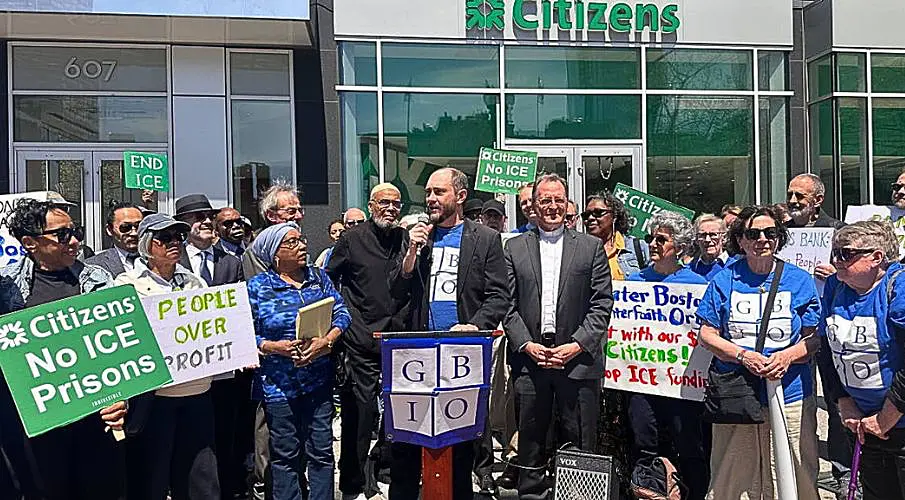
It's a victory, and it leaves a bitter taste. Citizens Bank has announced that it is pulling out of the credit facilities that tied it to CoreCivic and the GEO Group, the two private prison corporations that provide detention facilities for ICE. The decision came after months of organizing, demonstrations outside bank branches, sustained public pressure, investigative reporting, and entire cities deciding to pull their money. Jersey City withdrew roughly $265 million, Montclair pulled out millions more. The coalition calling itself De-ICE Citizens Bank is celebrating it as proof that communities refused to accept a major bank financing companies that profit from locking people up.
The victory is real, and it deserves recognition. What had been buried inside loan agreements and corporate filings was dragged into the open by organizers and turned into a public liability. A GEO Group credit agreement from April 2024 listed Citizens as the administrative agent and lead arranger, while public filings identified a GEO revolving credit facility of roughly $550 million and a separate $500 million agreement with CoreCivic. Those credit lines are far more than paperwork. They provide the money these corporations use to manage debt, renovate facilities, hire guards, reopen shuttered detention centers, and bridge the gap until government payments arrive. A revolving line of credit becomes detention capacity the moment it helps open beds and move detainees.

But this is where the story takes its bitter turn, and the irony is almost impossible to invent. Citizens itself explained why walking away now costs the bank so little. CoreCivic and GEO need less private financing because the federal government is now buying detention facilities outright. On July 2, 2026, the Department of Homeland Security purchased CoreCivic's California City Correctional Facility and the Otay Mesa Detention Center for roughly $1.5 billion. California City holds 2,560 beds. Otay Mesa holds 1,994. After taxes and expenses, CoreCivic expects to clear about $1.1 billion in profit, and the company openly told investors exactly how part of that money would be used. It will pay down corporate debt, including debt tied directly to the very revolving credit facility that made private bank financing necessary in the first place.
You have to read that twice to grasp just how perverse it really is. Taxpayer money puts the company in a position to eliminate the very debt that required the bank in the first place. Public pressure forces Citizens out of the financing, and in the very same moment the government makes private financing unnecessary by buying the company out with $1.5 billion. Citizens loses. The taxpayers pay. The corporation walks away with its balance sheet repaired. And the people behind those walls remain exactly where they were, trapped inside the same system.

The philosopher whose idea belongs here does not even need to be named because the image speaks for itself. Power that shifts from a visible jailer to an invisible owner does not become kinder. It simply becomes harder to confront. As long as a bank held the financial strings, protesters had a place to apply pressure, a branch, a name, an account. Once ownership shifts to the government, that place disappears. You cannot close your account with the Department of Homeland Security. The chain grows longer, more anonymous, and with every new link it moves farther beyond the reach of those trying to break it.
Government ownership does not mean the government suddenly operates these facilities itself. Homeland Security can own a detention center while still paying a private corporation to supply the guards, control detainee movement, provide or deny medical care, run the food service, impose discipline, and limit access to legal counsel. The California City operating contract runs through August 2027. The Otay Mesa agreement extends through December 2029, with options for renewal. The name on the deed changes. The lives of the people inside do not. Families are not reunited. Independent medical care is not guaranteed. Public oversight does not suddenly appear. The financial structure changes while the human suffering stays exactly where it has always been.

Read also our article: Rotten Food and Cells Without Toilets: How Misery in Detention Pushes Immigrants to Request Their Own Deportation!
What that suffering actually looks like can be seen inside GEO's Delaney Hall detention center in Newark. Detainees there have described the food, the medical care, the ventilation, the sanitation, forced labor, and endless delays in their immigration proceedings. They launched both a hunger strike and a work strike while supporters gathered outside demanding their freedom, faster hearings, and humane treatment. That is the reality hidden behind those revolving credit facilities, and it is exactly why the role of the bank matters in the first place.
In the end, this remains a victory that should neither be dismissed nor mistaken for something it is not. Citizens' withdrawal has not even been fully documented yet. The bank has not announced a final exit date, has released no repayment schedule, and has offered no explanation about what other services it may continue providing to these corporations, whether it will still hold their deposits, advise them financially, handle securities transactions, or whether another bank will simply step into its place. Announcing an exit from credit facilities is not the same thing as proving a complete break.
And above all hangs the direction this entire system is moving. Citizens indicated that additional purchases of GEO detention facilities by the federal government may already be on the way. The government can remove the burden of private real estate financing from these corporations simply by buying their buildings. The companies receive massive payouts, reduce their debt, and remain inside the system as paid operators. That does not weaken the detention machine. It makes it more permanent. Washington is not dismantling the system when it buys the very facilities needed to imprison even more people while continuing to pay private corporations to run them.
The victory over the bank has proven that sustained resistance, investigative reporting, and public accountability can make participation in this system expensive. But the suffering will end only when the detention system itself is dismantled, the system jointly financed and operated by banks, private prison corporations, ICE, and the federal government. As long as one player walks away while another steps in to buy, responsibility merely changes hands, moving from a bank's balance sheet to the government's property records, while the people behind those walls disappear behind both.
Resistance continues...
Updates – Kaizen News Brief
All current curated daily updates can be found in the Kaizen News Brief.
To the Kaizen News Brief In English


Mir fehlen immer wieder die Worte. Diese Industrie erinnert an die Organisation der KZs.
Viel fehlt bicht mehr
Ein Dank an die De-ICE Aktivisten!
Sie haben sich rein gekniet. Und konnten einen kleinen Sieg erreichen.
Aber leider nur einen Kleinen.
Die ICE und Haftmaschinerie läuft gut geölt weiter.
Die Regierung zahlt mit Steuergeldern.
Andere Banken können einsteigen.
Und selbst bei der Citizens Bank ist nicht klar ob sie wirklich ganz aussteigt und wann.
Du hast recht, es wird erst besser, wenn das ganze System zerlegt ist.
….man wird weitermachen, um im ganze system mindestens änderungen wieder zu erreichen