
The Man Who Kept Trump's Back Covered in the Senate Is Dead

Lindsey Graham is dead. The Republican senator from South Carolina died Saturday evening at the age of 71 after a brief and sudden illness. Cardiac arrest is suspected but has not been officially confirmed. Following a medical emergency at his home on Capitol Hill, Graham was transported to George Washington University Hospital, where he later died. The hospital has not released any information. Details about the medical emergency come from emergency radio dispatch communications. With his death, Washington loses one of Donald Trump's most influential defenders in the United States Senate. Few Republicans stood as consistently behind the president over the years, even after Trump downplayed the attack on the Capitol and granted clemency to those involved. The relationship began very differently. During the 2016 Republican presidential primary, Graham was one of Trump's fiercest critics. Later, the former rival became one of his closest political allies. From the impeachment proceedings to the criminal cases against Trump, Graham defended him almost without exception and helped keep the Republican conference united behind the president.
The relationship began very differently. During the 2016 Republican presidential primary, Graham was one of Trump's fiercest critics. Later, the former opponent became one of his closest political allies. From the impeachment proceedings to the criminal cases against Trump, Graham defended him almost without exception and helped keep the Republican conference united behind the president.
Graham was also one of the loudest advocates of a hardline immigration policy. He supported tougher border measures, called for strict deportations, and defended numerous Trump administration policies that civil rights organizations criticized as discriminatory toward immigrants and minorities. He repeatedly drew criticism over his remarks about immigration and countries of origin. Only a few weeks ago, Trump praised Graham as a senator who had helped him more than almost anyone else. That political loyalty made Graham one of the Republican Party's most important power brokers. His death comes in the middle of an election year and leaves a void in a party that has increasingly organized itself around Trump.
Kennedy Center: The Carpet Was Beige, So It Had to Go

Donald Trump has long since done more than take over the Kennedy Center. He is reshaping it according to his own taste. Internal documents that whistleblowers reportedly handed over to Congress now show just how far that ambition reaches. They describe multimillion dollar contracts awarded without competitive bidding, new procurement rules, and a newly installed bathroom floor that was torn out because the White House considered the tiles too beige. The subject line of the email read: "Tile Emergency," complete with a red siren emoji. The floor had only just been installed.
The documents span eighty two pages and come from former project managers. They accuse the Kennedy Center of awarding contracts to companies without the usual competitive process. The justification, they say, was that there was supposedly only one qualified contractor or that the work had to be completed in time for Trump's events. The whistleblowers' attorneys argue that federal procurement rules were ignored in the process. The Kennedy Center rejects the allegations. It says it confirmed with the Office of Management and Budget that the institution is not bound by standard federal procurement rules. It therefore introduced new purchasing guidelines designed to allow faster action. Those new rules are now at the center of the criticism because they make sole source contracts significantly easier to award. The renovations also included presidential boxes fitted with gold plumbing fixtures, gold electrical outlet covers, and marble baseboards. Even the exterior facade was scheduled to be repainted before the Kennedy Center Honors. One contract worth $4.4 million reportedly began before any agreement had been signed. Another company received a contract worth up to $8 million without competitive bidding.
So far, there is no evidence that Trump or his family personally profited financially. But that is not the central question at the moment. The issue is whether public money was awarded according to transparent and understandable rules or whether political wishes became more important than open procurement procedures. A beige bathroom floor has now become a matter for Congress. Sometimes a major story really does begin with a single tile.
Five Years Later, Trump Erases the Last Remnants of January 6

More than five years after the attack on the Capitol, the final major pillar of one of the most significant criminal cases in American history has now fallen. A federal judge has dismissed the remaining convictions of leading Proud Boys members after Donald Trump's sweeping clemency policy effectively erased nearly every prosecution connected to January 6. What was once regarded as an attack on American democracy is now disappearing piece by piece from the court record. Judge Timothy Kelly made no attempt to hide why the government no longer wanted to pursue the case. Trump's views regarding the defendants had been well known for years, he wrote. Whether those views were based on fact or fiction apparently no longer mattered for the political decision. At the same time, Kelly explicitly stated that his ruling should not be interpreted as approval of the Justice Department's actions.
Read also our article: The End of the “Proud Boys” – How a Black Church Took Over the Name of a Hate Movement
The judge reminded the public that the attack on the Capitol had been a dangerous assault on the constitutional principle of the peaceful transfer of power. If American democracy is to survive another two hundred and fifty years, he wrote, its citizens must preserve, protect, and defend it together. Those are unusually direct words for a ruling that ultimately produces the very outcome against which it warns.
The ruling applies to Ethan Nordean, Joseph Biggs, Zachary Rehl, and Dominic Pezzola. Trump had already commuted their prison sentences. Enrique Tarrio, the former chairman of the Proud Boys, who had received twenty two years in prison, the longest sentence handed down in any January 6 case, had already received a full presidential pardon.
This does not simply bring one case to an end. It changes the standard by which an attack on American democracy is ultimately judged. First a court declared them guilty. Then a president declared them free. What remains of one of the most important prosecutions arising from January 6 is now little more than a reminder that even final criminal convictions can become temporary once political power returns.
America Pays the Price While Trump Loves Inflation

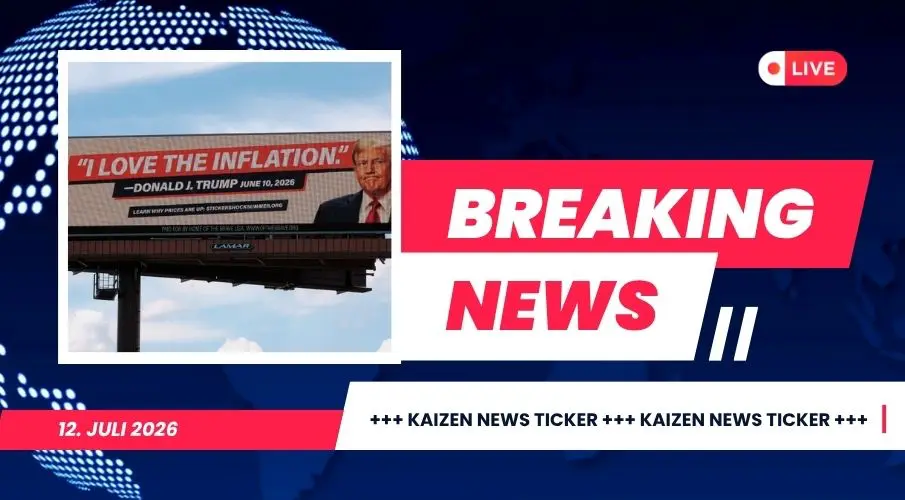
An electronic billboard featuring President Donald Trump and the words "I love inflation." - Donald J. Trump, June 10, 2026 - stands near Interstate 74 in Cincinnati
Inflation is back, the dream of owning a home is slipping further away, and even the Federal Reserve no longer seems certain where the economy is headed. While Donald Trump declared only weeks ago that he loves inflation, the latest economic data show that Americans are paying for it every time they visit the grocery store, fill up their cars, or try to buy a home. The International Monetary Fund has lowered its forecast for the global economy. Instead of strong growth, it now expects only 3 percent growth this year. It identifies the energy shock caused by the Iran war as the primary reason. The United States is still expected to grow by 2.3 percent, while the eurozone is forecast to expand by only 0.9 percent.
The American housing market illustrates the trend particularly clearly. Existing home sales declined in June, yet the median sales price climbed to a record $440,600. Home prices have now risen continuously for thirty six consecutive months. For many families, the dream of homeownership is moving even further out of reach. Uncertainty also dominates the Federal Reserve. Members of the Federal Open Market Committee remain deeply divided. Some expect inflation to remain elevated and interest rates to rise further. Others believe inflation will ease once the Iran war subsides. There is no clear direction. The oil market adds another layer of uncertainty. The International Energy Agency expects global oil demand to decline for the first time since the pandemic because of high prices and continuing disruptions around the Strait of Hormuz. Ironically, the United States is the exception. Gasoline consumption continued to increase despite sharply higher prices. The labor market also sends mixed signals. New unemployment claims declined slightly, yet employers created only 57,000 jobs in June. Businesses are hiring far more cautiously than they were only a few months ago.
The financial markets have remained surprisingly calm. Stocks and oil prices continue to fluctuate with every new development from the Middle East, yet a major market collapse has not materialized. Consumers, however, face a different reality. They experience every day what no economic statistic can soften. Food costs more. Fuel costs more. Housing costs more. You may love inflation. Other people are the ones who have to pay for it.
Putin's War Is Losing Momentum, but the Kremlin Has No Reverse Gear

For four years, Vladimir Putin counted on Russia having the longer endurance. The calculation was simple. More soldiers, more equipment, more time. Eventually, the Kremlin believed, Ukraine would collapse. But that calculation is beginning to unravel. Not because Russia has suddenly been militarily defeated, but because the war itself has changed, and Ukraine is now striking precisely the vulnerabilities for which Moscow has no convincing answer. Russian forces are still advancing along the front, but far more slowly than they were a year ago. Their gains are shrinking while their losses continue to grow. Military observers now believe that, since last winter, Russia has been losing more soldiers than it has been able to recruit. As a result, discussion of another compulsory mobilization has returned. So far, Putin has avoided taking that step because he knows the political cost it would carry at home.
At the same time, Ukraine has adapted. Russian tactics that produced results throughout 2025 are steadily losing their effectiveness. Ukrainian units are detecting infiltrating infantry more quickly, disrupting Russian drones through electronic warfare, and deploying their own interceptor drones. Pure defense has increasingly given way to localized counterattacks that tie down Russian units and, in some sectors, even reclaim territory. Even more significant, however, are the developments far behind the front lines. Ukrainian long range drones are striking refineries, fuel depots, and military logistics hubs deep inside Russian territory. Even regions thousands of miles from Ukraine are no longer beyond reach. The attacks are no longer affecting only the energy sector. They are increasingly disrupting Russia's military supply system. In occupied Crimea, fuel shortages are already becoming noticeable.
Russia's greatest strength is increasingly becoming its greatest weakness. The country's enormous territory cannot be defended in its entirety. Every additional drone strike forces Moscow to decide which cities, industrial facilities, or military bases deserve priority protection. Air defense systems assigned to protect Moscow are unavailable elsewhere. Protect the refineries, and the airfields become vulnerable. Protect the military depots, and the energy infrastructure becomes the next target. The political picture is changing as well. Donald Trump, who only last year told Volodymyr Zelensky that he held no cards, is now speaking far more favorably about Ukraine's military capabilities. According to officials in Washington, U.S. intelligence reports detailing the expanding range and precision of Ukraine's drones have left a clear impression. At the same time, the desire to end the war is growing inside Russia itself.
That still does not mean a turning point has arrived. Russia continues to possess one decisive advantage. Ballistic missiles continue to strike Kyiv and other Ukrainian cities, while Ukraine still lacks enough modern Patriot air defense systems. President Zelensky now describes those missiles as Moscow's last major military advantage and continues urging Western allies to provide additional air defenses. Whether Putin will draw any conclusions from these developments remains the central question. Publicly, the Kremlin continues to insist on its maximalist demands, including territorial concessions and renewed political influence over Ukraine. At the same time, there are growing indications that Putin is receiving a far more optimistic assessment from his military leadership than conditions on the battlefield actually justify. Several Western analysts believe the Russian president no longer has an accurate picture of the true condition of his own army.
The war has therefore reached a point that few would have predicted only months ago. Ukraine has regained the initiative in key areas without being able to decide the war. Russia is losing momentum without being decisively defeated. What was once a war of attrition has become a race defined by technology, range, and the ability to adapt. Whoever adapts faster gains time. Whoever believes everything can continue as before loses it. That is where Putin faces his greatest danger today.


Lindsay Graham, vom Trump Kritiker zum Trump Loyalisten.
Wie Vance und andere Republikaner.
Mehr kann ich nicht sagen, weil ich mich an ddn Spruch halte „wer nichts Nettes zu sagen hat, sollte schweigen“
Es wird eine special Election geben.
Eine Chance für die Demokraten.
Trumps Name am Kennedy Center ist ab.
Aber drinnen drückt er dem Crnter seinen Stempel auf.
Wie schon bei den Reflecting Pools ohne das Vergabeverfahren.
Trump muss nicht direkt persönlich finanziell profitiert haben.
Aber mit der Vergabe an wohlwollende Spender/Loyalisten/Lobbyisten festival man seinen Einfluss und andere Firmen gehen leer aus, weil sie gar keine Chance bekommen haben.
Auch hier wird es dank MAGA im Kongress keine Aufarbeitung geben.
Zumindest keine mit echten Konsequenzen.
Die Randalierer, Körperverletzer, ja Terroristen vom 6. Januar werden alle begnadigt.
Einige sind erneut straffällug geworden.
Der Zeitaufwand wäre zu groß, aber es wäre wirklich interessant, welche der Täter erneut straffällig geworden sind.
Der Olympionike, der kurz in den Reflecting Pool gefasst hat, wird angeklagt und ihm drohen 5 Jahre Haft.
Das ist die USA 2026 🤬
MAGA sieht die Inflation als kurzfristiges Übel, damit America Great Again wird.
Ihr Messias Trump findet Inflation toll, also ist es was Gutes.
Leider glauben dass immer noch gut 38% der Amerikaner.
Man fragt sich, wie dumm die Menschen sind.
Sie glauben lieber etwas, was Trump und seine Entourage erzählen, als das, was sie mit eigenen Augen sehen.
Typisch für Sektenmitglieder.
Und genau das ist MA. Eine Sekte.
Putin ist ein Narzisst.
Narzissten ziehen sich nicht zurück.
Ich bin mir sicher, dass Putin den Zustand seiner Armee genau kennt.
Er ist ein Taktiker und Stratege.
Er hat immer noch Trump „auf seiner Seite“ und due Waffenlieferungen an die Ukraine stocken.
Russland ist groß, er kann das noch eine Weile aussitzen.
Sein Volk ist ihm dabei egal. Ihm geht’s nur um sich, dem Mann, der das Großrussische Reich zurück bringt.
So will er in die Geschichtsbücher eingehen.