
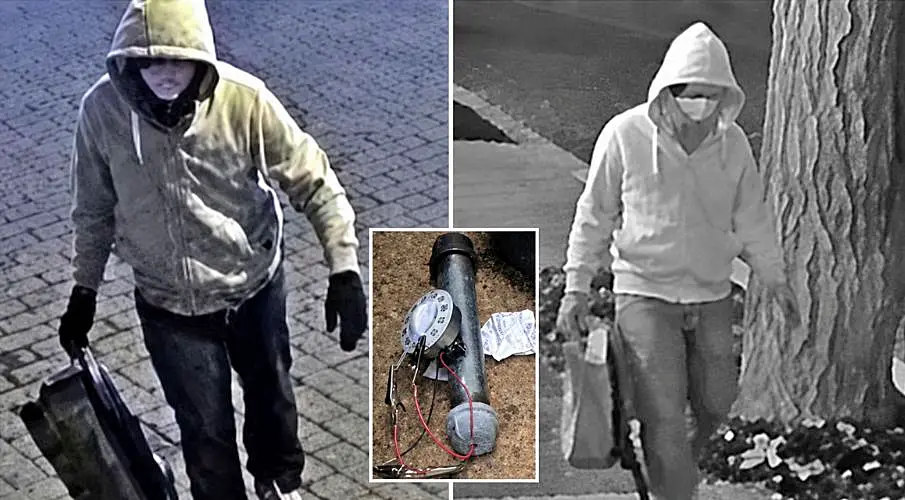
There comes a point where even the broadest pardon reaches its limit, and on Monday a federal judge marked that boundary. Donald Trump's sweeping pardons for the supporters who stormed the Capitol do not apply to a Virginia man accused of placing pipe bombs near the headquarters of both the Democratic and Republican National Committees on the eve of January 6, 2021. Federal Judge Amir Ali refused to dismiss the case against Brian J. Cole Jr., offering a rationale that is as simple as it is compelling. Trump's blanket pardon explicitly covered only those who had been convicted of crimes connected to the Capitol attack. Cole, however, had neither been charged nor convicted when Trump issued those pardons.

To understand the significance of the ruling, it is worth remembering what happened on the first day of Trump's second term. With the stroke of a pen, Trump erased the largest criminal investigation in the history of the Justice Department. He pardoned more than 1,500 people charged in connection with the attack on the Capitol, commuted prison sentences, and ordered pending prosecutions dismissed. It was an act of extraordinary reach that the country still has not fully absorbed, an amnesty for an assault on the heart of American democracy, proclaimed by the very man in whose name that assault had been carried out.

Cole, however, was not arrested until nearly a year after that act of clemency. Prosecutors allege that on the night before the attack he placed two pipe bombs outside the headquarters of the Republican National Committee and the Democratic National Committee in Washington. The devices never detonated before law enforcement discovered them on January 6. It is a chilling detail, because between those unexploded bombs and a massacre may have been nothing more than sheer luck. Cole's attorneys attempted to bring their client under the same umbrella Trump extended to the Capitol rioters. They argued that his alleged actions were inseparably and demonstrably connected to the events at the Capitol. According to the government's own account, they contended, this was precisely the kind of case Trump's pardon was meant to cover. It is a remarkable legal maneuver. The defense seeks to turn the very proximity to January 6 that would ordinarily weigh against their client into a lifeline. If he was close enough to the insurrection, their reasoning goes, he was close enough to the pardon.

Prosecutors responded that Trump's pardons have no bearing on Cole's case because the proclamation applies only to people who had already been convicted or formally charged at the time it was issued. And even if the proclamation could somehow be read to cover this case, they argued, the Justice Department's interpretation deserves deference as the reasonable reading adopted by the very agency entrusted with carrying out the proclamation. There is a quiet irony in that position. The same Justice Department that, under Trump, buried the cases against Capitol rioters now insists that clemency has limits, relying on its own authority to define where those limits lie.
Judge Ali, appointed by former President Joe Biden, followed the plain language of the law in his three page ruling. Anyone who had not been charged when the pardon was issued was not pardoned. It is that simple, and it is that correct. A pardon is not a magic word that reaches backward and covers everyone who happened to stand near a particular event. It is a precise legal act, bound by what actually existed at the moment it was proclaimed. Anything else would mean that a president could not only forgive the past but also grant immunity for future prosecutions in advance, and that would no longer be clemency. It would be a blank check for the impunity of his supporters.

The statements Cole made after his arrest give the case its unsettling depth. According to investigators, he told FBI agents that he had become consumed and confused by conspiracy theories surrounding the 2020 presidential election, and that something inside him finally snapped. Investigators used cellphone data and other evidence to identify him as a suspect. It is that remark about something snapping that reaches beyond this individual case. If the allegations are true, Cole is not an isolated actor who emerged from nowhere. He is the product of a story that was fed to him, the baseless lie that the 2020 election was stolen, a lie Trump himself created and repeated relentlessly. The supporters who came to the Stop the Steal rally and then became a mob followed the same story. Cole stands at the edge of that picture with two pipe bombs in his hands, and no one can say how many others were led to the same edge by the very same narrative.
This is where the truly disturbing reality of the entire episode becomes impossible to ignore. A president spreads a lie. People believe it. Some storm the Capitol, one allegedly plants bombs. Then that same president, once back in office, frees the perpetrators as though nothing had happened. That it is now a judge appointed by his predecessor who has barred an alleged bomber from sheltering beneath that same umbrella is not an accident of history. It is a lesson in the separation of powers. It shows that within the American system there remains an institution that answers not to loyalty but to the law, and that is still willing to say, this far and no further.
The importance of this modest ruling should not be underestimated. At a time when the line between law and political favor continues to blur, when pardons become rewards and prosecutions become weapons, one federal judge has held fast to a simple truth. Clemency has a moment in time, and it has a written scope, and anyone who falls outside both falls outside its protection. That may seem like very little, yet it is also a great deal. It is a reminder that a pardon is not a law of nature but a legal document with defined boundaries, and that at those boundaries the rule of law still stands watch.
Cole is scheduled to appear in court again on Wednesday for a status hearing. No trial date has yet been set. What is already certain is something else entirely. He will have to answer for the charges before a court that does not regard his connection to January 6 as a shield, but as exactly what prosecutors allege it was. Part of that dark night when a lie became a bomb, and from which a president's clemency cannot rescue everyone who believed they had come close enough to claim its protection.
To be continued ...
Updates – Kaizen News Brief
All current curated daily updates can be found in the Kaizen News Brief.
To the Kaizen News Brief In English


