
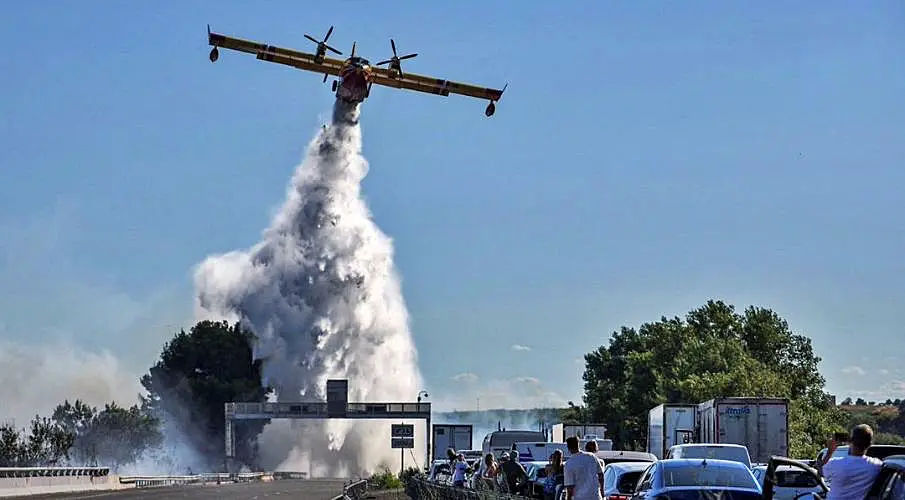
There are facts that need no embellishment because they already carry the full weight of reality. Climate change is here, said a French fire brigade commander, we are living through its consequences, and it is only early July. That single sentence contains everything there is to say about a weekend in which four European countries were engulfed in flames. Greece, Spain, Portugal, and France all battled wildfires immediately after a deadly heat wave, and the growing fear is that this is only the beginning of a summer of extremes.
The numbers alone already tell a story that should not be ignored. By Sunday, roughly seventeen thousand hectares of land had burned across Spain, France, and Portugal alone, an area twice the size of Manhattan. Hundreds of firefighters were mobilized, battling day and night, yet everyone involved says the real test is still to come. This is the beginning of a season that experts believe could become long and relentless.

In France, one of the fires in the south of the country forced the organizers of the Tour de France to close the third stage to spectators on Monday. The fire had already consumed an area of roughly sixteen square kilometers and left two people in critical condition. An extraordinary fire requires extraordinary measures, even for the Tour, race director Christian Prudhomme said. It is an image of remarkable power. The world's greatest cycling race, for more than a century a symbol of the French summer, is forced to yield to the flames produced by that very summer. On Sunday, seven départements were under a very high wildfire risk as temperatures in the south climbed toward thirty eight to forty degrees Celsius.
Across the border in Spain, a wildfire on the Costa Brava tore through more than twenty two hundred hectares in just forty eight hours. Nearly fifty thousand people were forced either to evacuate or remain sheltered inside their homes. Catalonia's fire service said on Sunday that crews had worked tirelessly throughout the night to secure the perimeter of the blaze near La Bisbal d'Empordà, which has now been stabilized. You hear those words and can almost feel the exhaustion behind them, the sleepless nights, the struggle against a force that cannot be negotiated with.

In Portugal, a wildfire broke out on Thursday in the central region near Vouzela. It burned twelve thousand hectares and required the efforts of twelve hundred firefighters before it was partially contained by Sunday. In Greece, meanwhile, two major fires burned on Saturday and Sunday. The first, in the suburb of Oraiokastro outside the country's second largest city, Thessaloniki, forced residents to flee or remain inside their homes after it spread into a recycling facility and released hazardous smoke into the air. That smoke, explained Dimosthenis Sarigiannis, Professor of Environmental Engineering at Aristotle University of Thessaloniki, contained volatile organic compounds that irritate the eyes and throat, along with carcinogenic substances such as benzene, dioxins, and furans. The fire damaged homes and businesses. A second blaze ignited on Sunday west of Athens, where two hundred ten firefighters raced against time to bring it under control before sunset, when firefighting aircraft were forced to remain on the ground.

One can view these events as a chain of unfortunate coincidences, as the whim of an exceptionally hot summer. But that interpretation would be the real lie. These fires followed a heat wave that scientists say would have been virtually impossible without climate change caused by the burning of fossil fuels. What is happening is not coincidence. It is the result of a cause that has a name, and that name has been known for decades. French Interior Minister Laurent Nunez pointed out that this year's fire season began a full month earlier than usual. A month that may seem insignificant at first glance, yet means everything because it shows that the order of the seasons is shifting, that nature is following a calendar we ourselves have forced upon it.
This is where the thought extends beyond the individual fires. For a long time, humanity believed it stood apart from nature, like an observer looking at a painting, separated from it, safely behind the glass of civilization. That illusion is burning away before our eyes, quite literally. What is happening across Southern Europe these days is not a disaster descending upon people from the outside, but one emerging from humanity's own actions. These fires are not some foreign fate. They are the response of a world to what has been done to it, and that response is delivered in the same language in which the cause was written, the language of physics, which recognizes neither excuses nor campaign promises.

It is one of the bitter ironies of these days that those who have warned about precisely this development for decades were dismissed for so long as alarmists. Now the forests are burning, and the predictions once dismissed as exaggerated are proving to have been too cautious. Climate change was never a distant threat for future generations, an abstract problem for the year 2100. It is a present reality that can be smelled in the smoke above Thessaloniki, in the soot drifting over the Costa Brava, in the ash settling across the closed roads of the Tour de France. Anyone still speaking of the future today has failed to understand that the future has already become the past while we were still arguing about it.

And yet it would be too easy to end in resignation alone. The same realization that weighs so heavily also carries an obligation. If these fires are the result of human action, then human action is also the only way to reduce their number in the future. The fatalism that says it is already too late is merely the more comfortable sister of denial, which says nothing has happened. Both lead to the same destination, inaction. Fire brigade commander Belgioino expressed it in words that could hardly have been simpler, and that is precisely why they resonate. The season will be long for the men and women fighting these fires, he said, and they need help. It is a cry for help directed not only at other fire departments, but at an entire society that still hesitates to acknowledge the connection between its own consumption and these flames.
In the end, one image remains impossible to forget. A continent in the height of summer, its forests burning, its cities covered in smoke, its most famous celebrations interrupted by the force of a natural world striking back. It is only early July, and already this summer has burned an area that could cover Manhattan twice. What remains is one question - how many more weekends like this will it take before the fire commander's warning is no longer heard as an alarm, but accepted as nothing more than an ordinary description of reality? Climate change is here. It is no longer waiting. And the only question that still matters is whether we are finally prepared to treat it with the same seriousness with which it has already begun treating us.
Updates – Kaizen News Brief
All current curated daily updates can be found in the Kaizen News Brief.
To the Kaizen News Brief In English


