
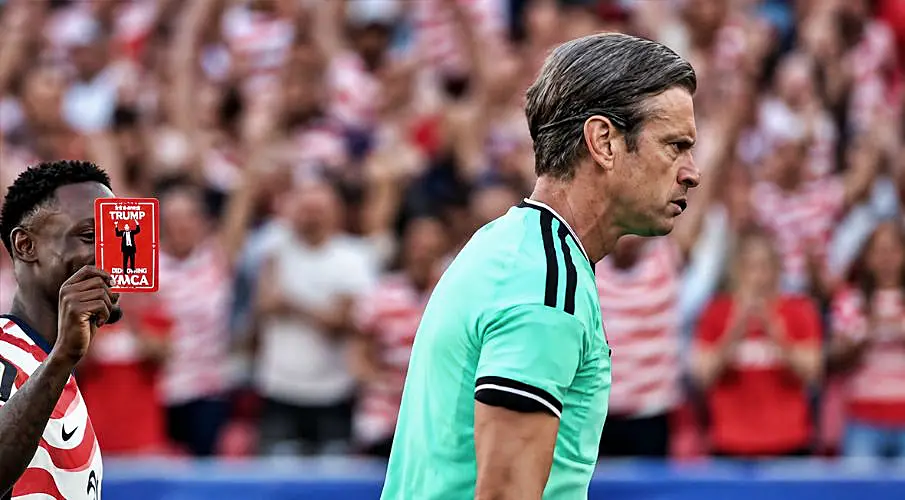
There are stories you read twice because the first time you assume there must be a mistake. This is one of them. The President of the United States called FIFA, and as a result the suspension of an American striker was lifted. Let that sentence settle for a moment, because it says more about the state of the world than many foreign policy analyses ever could. A head of state picks up the phone, not because of a war, not because of a famine, but because of a red card in a soccer match, and the most powerful sports organization on the planet yields.
First, the facts. Folarin Balogun, with three goals the leading American scorer of this tournament, awkwardly caught Tarik Muharemović on the right ankle during the Round of 32 match against Bosnia and Herzegovina. Brazilian referee Raphael Claus initially showed no card, then changed his decision to a red card after reviewing the video. As the rules require, an automatic one match suspension followed. Up to that point, everything unfolded exactly as it has at tournaments for decades. What became extraordinary was everything that followed.

After the match, Donald Trump called FIFA President Gianni Infantino and asked for the red card to be reviewed. That was confirmed by a person familiar with the conversation who requested anonymity because they were not authorized to discuss it publicly. On Sunday, FIFA announced that the suspension would be lifted, allowing Balogun to play against Belgium on Monday. As far as the historical record shows, this is the first time since 1962 that a red card at a World Cup has not resulted in a suspension. Trump immediately thanked FIFA on social media for doing what was right and for correcting what he called a great injustice. Notice the choice of words. Injustice. As though an innocent man had just been saved from the gallows rather than a striker being suspended for one match.

The Belgians responded the way one would expect from people who still believe in rules. The Belgian federation said it was astonished and announced that it would examine every available option. Head coach Rudi Garcia delivered perhaps the most accurate words of the entire affair. Through an interpreter, he said he had not realized that July 5 had become April 1 inside FIFA headquarters. An April Fool's joke in the middle of summer. The Belgian federation, Garcia added, was not defending itself. It was defending soccer itself, its integrity, its ethics. As far as he knew, it was the first time in World Cup history that such a decision had ever been made. When asked whether Trump had influenced FIFA, he remained silent. Sometimes silence says more than any accusation ever could.
FIFA relied on Article 27 of its Disciplinary Code, which allows a judicial body to suspend the enforcement of a sanction in whole or in part. Balogun now remains under a one year probationary period. If he commits a similar offense during that time, the suspension will be enforced retroactively. It is the language of legal provisions, and it sounds orderly, almost convincing, until one remembers what set that provision in motion. Not an appeal by the federation. Not newly discovered evidence. But a phone call from the White House. The U.S. Soccer Federation learned of the decision at 10:31 a.m. Eastern Time through a FIFA news release. The American players themselves first read about it on their phones while riding the team bus from the hotel to training, a ten minute trip that ended with their being greeted by an Alaskan Malamute named Dubs. There is something strangely fitting about that image. A suspension disappears during a bus ride, between two traffic lights, so to speak.

Of course, there was no shortage of people who welcomed the decision. U.S. head coach Mauricio Pochettino, who played for Argentina at the 2002 World Cup, applauded it and said the United States had already been punished enough against Bosnia and Herzegovina, playing thirty minutes with ten men because of what he considered a completely unfair decision. Trump picking up the phone did not surprise him. He came from a culture, Argentina and Europe, where soccer is a religion, even more than religion itself. The sport, he said, is magical, powerful, bringing together people and nations. Christian Pulisic, the American star, defended his teammate by insisting there had been absolutely no intent in the challenge and that far worse incidents had occurred during this tournament. All of that may well be true. It changes nothing about the essential point. Whether the red card was justified is a question for the referee and the proper disciplinary bodies. It is not a question for the President of the United States.
That is where the central idea lies, and it reaches far beyond the soccer field. Sport rests upon a single principle, without which it collapses like a house of cards. Everyone submits to the same rules, and those rules apply equally to the weakest and the most powerful. The moment a single phone call is enough to overturn a decision, that principle ceases to exist. From that moment on, victory no longer belongs to the better team, but to the one with the more influential advocate. Soccer, which so often claims to know neither borders nor classes, demonstrated on this Sunday that it, too, can be bought with the currency of power. No money is required. All it takes is a phone number that Gianni Infantino is willing to answer.
Die FIFA wird einwenden, es habe Präzedenzfälle gegeben, und formal stimmt das sogar. Im November wurde Cristiano Ronaldo ein Teil seiner Sperre erlassen. Nicolás Otamendi und Moisés Caicedo profitierten im April von aufgeschobenen Sperren aus Qualifikationsspielen. Und ganz weit hinten, im Jahr 1962, durfte der Brasilianer Garrincha nach einem Platzverweis im Halbfinale gegen Chile im Endspiel auflaufen, nachdem sich eine Lobbykampagne für ihn eingesetzt hatte, an der auch der chilenische Präsident Jorge Alessandri beteiligt war. Brasilien gewann das Finale. Man sieht, die Einmischung der Mächtigen in den Sport ist so alt wie der Sport selbst. Nur macht das die Sache nicht besser, sondern schlimmer. Es zeigt, dass die FIFA aus vierundsechzig Jahren nichts gelernt hat außer der Kunst, den Rechtsbruch in einen Paragrafen zu kleiden.
Balogun selbst, fünfundzwanzig Jahre alt, in Brooklyn als Sohn nigerianischer Eltern geboren, die damals in London lebten, hatte 2023 seine Nationalmannschaft gewechselt, von England zu den Vereinigten Staaten. Mit seinen drei Toren hat er Landon Donovan von 2010 eingeholt, nur Bert Patenaude mit vier Treffern beim ersten Turnier 1930 liegt noch vor ihm. Am Freitag hatte er selbst gesagt, eine gelbe Karte statt der roten wäre fair gewesen. Nach der Entscheidung teilte er ein Bild von sich vor amerikanischen Fans, unterlegt mit einem Lied von Michael Jackson, mit dem Titel Bad. Man kann darin einen Scherz sehen, einen jugendlichen Übermut. Man kann darin aber auch die ganze Leichtigkeit erkennen, mit der eine Regelverletzung heute zur Pointe wird, sobald die Macht sie aus der Welt geräumt hat.
Der Gastgeber USA will zum ersten Mal seit 2002 ins Viertelfinale, und vielleicht wird Balogun am Montag gegen Belgien das entscheidende Tor schießen. Vielleicht wird man dann von einem großen amerikanischen Fußballmärchen sprechen. Doch über jedem Tor, das er schießt, wird der Schatten dieses Anrufs liegen. Denn ein Sieg, der auf einer gebeugten Regel steht, ist kein ganzer Sieg. Er ist ein Sieg mit Sternchen, mit einer Fußnote, die man nicht mehr entfernen kann. Und die eigentliche Verliererin dieses Sonntags ist nicht die belgische Mannschaft. Es ist die Idee, dass es im Sport, anders als im Leben, wenigstens noch eine Instanz gibt, vor der alle gleich sind. Diese Idee ist an einem Sonntag im Juli in einem Telefonat zerbrochen, und niemand bei der FIFA scheint zu bemerken, wie viel damit verloren ging. Man ist, um es schlicht zu sagen, nur noch sprachlos.
Updates – Kaizen News Brief
All current curated daily updates can be found in the Kaizen News Brief.
To the Kaizen News Brief In English


Als ich gestern die Meldung hörte, dachte ich, jetzt verschleiern sie ihre Korruption in keinster Weise mehr. Fußball ist ein Trauerspiel geworden.
…vielleicht könnte Merz auch anrufen 😂