
There is one sentence hanging over this NATO summit like a verdict, and it came from Donald Trump. We don't need their money, we don't need anything, he said, I just want loyalty. Let that sentence sit for a moment, because it contains the entire transformation the largest military alliance in history is now undergoing. This is no longer about money, no longer about percentages of GDP, no longer about tanks and fighter jets. It is about loyalty. And loyalty is not something that can be captured in a bar chart, no matter how hard Mark Rutte tries.
Rutte, who has served as NATO Secretary General for nearly two years, has turned his office into a single mission. He is trying to keep the United States committed to the alliance, and he is doing it with a method diplomats usually recommend only behind closed doors, open flattery. At first, the argument was about money. For years, Trump accused the Europeans of spending too little on defense, and that dispute seemed settled at last year's summit, when the allies agreed to invest as much as the United States itself. One could have assumed the issue was finally resolved. But the goalposts keep moving, and no sooner had one demand been met than another appeared.
Rutte's performance on June 24 was almost impossible to surpass in its extraordinary flattery and unsettling display of deference toward Trump.
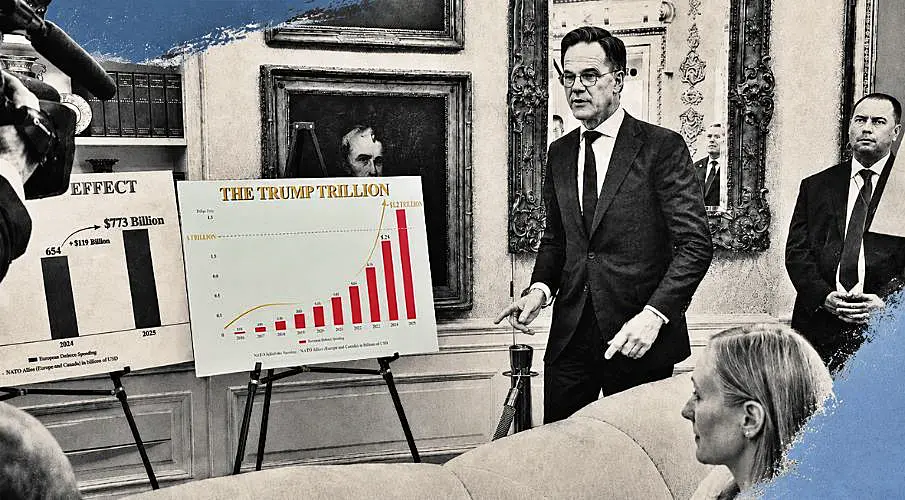
NATO Secretary General Mark Rutte unveiled what he called the "Trump Trillion" and praised President Donald Trump for pushing the European allies to increase defense spending. Rutte said Europe and Canada had increased their defense spending by roughly $1.2 trillion since Trump's first term while also placing hundreds of billions of dollars in orders with American defense companies. "This is your proof," Rutte said, pointing to those figures as evidence that the alliance was moving toward a fairer sharing of the defense burden with the United States.
How far Rutte is willing to go became clear during his appearance at the White House last month. He arrived carrying a chart titled in gold letters "The Trump Trillion," intended to demonstrate that the European allies and Canada had spent roughly $1.2 trillion since 2017. Tens of thousands of American jobs had been created, along with some $300 billion in European orders for military equipment, and all of it, according to Rutte, thanks to the leader of the free world. It was a remarkable performance from a man who had already been criticized for treating Trump like a daddy. One can only rub their eyes in disbelief. The chief civilian official of an alliance of thirty two nations stands in the Oval Office presenting the American president with a chart bearing his name in gold, as though Europe's collective security were a promotional gift.

Trump remained unimpressed. He said he was still disappointed that some allies had refused to support his war against Iran, the war he launched alongside Israel without even consulting those same allies. Consider the logic. First you start a war without consultation, then you complain that nobody wants to join you. Rutte cautiously pushed back, reminding him that before the ceasefire in April, as many as five thousand American aircraft had operated from bases across Europe. It made little difference. Trump suggested he might have skipped the summit altogether had it not been hosted by Turkish President Erdoğan. Even Erdoğan and Rutte, among the very few foreign leaders Trump has shown unusual respect toward, may struggle to hold this meeting together.
Behind the spectacle lies a far more serious reality. NATO cannot function without its most powerful member, and that very member is pulling away just as Russia, the historic reason for the alliance's existence, is once again becoming a growing threat. Last month, the Pentagon surprised its allies by announcing it would reduce the number of troops, warships, aircraft, and drones it would make available in the event of an attack. At the same time, Trump continues sending contradictory signals, speaking one day of withdrawals and the next of reinforcements. This mixture of cuts and confusion undermines the alliance's unity precisely as Russia probes Europe's defenses with drone flights near military facilities in several countries. The house is beginning to shake, and its strongest resident is openly wondering whether he should move out.
Trump has threatened to leave the alliance, toyed with withdrawing American troops, announced his intention to take Greenland, the semi autonomous territory of NATO ally Denmark. He has cast doubt on whether he would defend a member that spends too little on its military, and with every one of those doubts, the trust on which the alliance rests erodes further. Article Five, the promise that an attack on one is an attack on all, does not live because it is written on paper. It lives because people believe it will be honored when the moment comes. It has been invoked only once, when America's allies came to its defense after September 11. There is a bitter irony in the fact that the American president is now undermining the very certainty that once benefited his own country.
Rutte's predecessor, Jens Stoltenberg, wrote in his memoirs about the 2018 summit that Trump nearly caused to collapse. If an American president were to declare that he no longer intended to defend the other allies and walked out of a summit in protest, then the NATO treaty and its security guarantee would no longer be worth very much. This is where the philosophical core of the matter lies. An alliance built on loyalty cannot demand that loyalty without destroying it. Loyalty that is demanded is no longer loyalty. It is submission. And submission recognizes no equals, only one master and many servants. The moment Rutte hands the president charts decorated in gold, he has already betrayed the very character of the alliance he believes he is saving.

That is why this summit in Türkiye stands beneath a double shadow. One is cast by a man who treats the alliance like a business deal that can be abandoned whenever the return no longer satisfies him. The other is cast by a Secretary General who trades the dignity of his office for the favor of a single individual. Rutte will flatter. Erdoğan will mediate. Trump will demand more. In the end, everyone will declare success simply because nobody slammed the door. But an alliance that must purchase its unity year after year through flattery is no longer an alliance. It is a royal court hoping the king wakes up in a good mood. And a peace that depends on the temperament of one man is merely another name for a danger people still refuse to see.
Updates – Kaizen News Brief
All current curated daily updates can be found in the Kaizen News Brief.
To the Kaizen News Brief In English


Wenn sich jemand auf eine ungewöhnliche Weise anbiedert und mit Schmeicheleien sein Gegenüber fast erstickt, der ist entweder äußerst gerissen und lockt den Geschmeichelten in eine dunkle böse Falle oder aber er ist hilflos und meint, mit Schleim zu imponieren.