
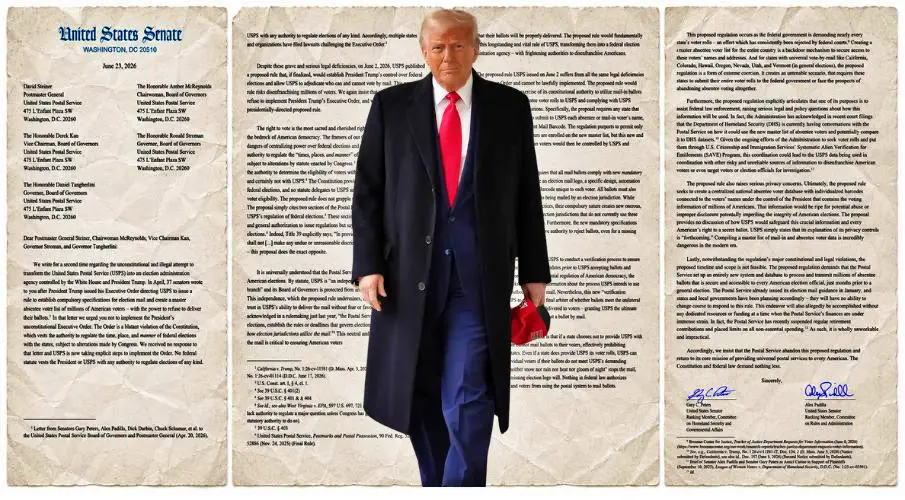
There are institutions so deeply embedded in the daily life of a society that their destruction is only noticed once the letters stop arriving. The United States Postal Service is one such institution. Since 1775, it has delivered mail - regardless of party affiliation, income, race, or place of residence. Its unofficial motto reads: Neither snow nor rain nor heat nor gloom of night stays these couriers from the swift completion of their appointed rounds. Donald Trump found a way to stop them. It is called: Executive Order.
On June 23, 2026, Democratic Senators Gary C. Peters and Alex Padilla - Ranking Members of the relevant committees on Homeland Security and voting rights - wrote to USPS leadership for the second time. The first letter, signed in April by 37 senators, went unanswered. In the meantime, the postal service has begun implementing Trump's order. The June 23 letter is no longer an appeal. It is an indictment.

What Trump ordered by decree, and what the USPS published as a proposed rule on June 2, 2026, is clear in its consequences: The postal service is to establish a central national database of all mail voters in the future - including names, addresses, and individual Intelligent Mail Barcodes, unique to each voter. Every state that allows voting by mail must transfer its complete voter rolls to the USPS. If it does not, it loses the right to send ballots through the postal system. The USPS would additionally receive the authority to reject ballots - including for missing or incorrect logos. And it would become the authority that reviews whether a ballot complies with the new federal standards before delivery.
The Constitution of the United States explicitly assigns the regulation of federal elections to the states. No federal law grants the USPS any authority to regulate elections or determine voter eligibility. Title 39 of the U.S. Code explicitly states that the postal service may not make unreasonable distinctions between users of the postal system. This proposed rule does exactly that. Peters and Padilla call it unconstitutional. Several states have filed lawsuits - including California v. Trump (No. 1:26-cv-11581) and the Democratic Senatorial Campaign Committee (No. 1:26-cv-01114).
The proposed rule has a second dimension that has received too little attention in the public debate. In court filings, the administration admitted that the Department of Homeland Security is currently in discussions with the USPS on how the new voter database could be matched with DHS data sets. That means: The national mail voter list is to be run through the SAVE program - the Systematic Alien Verification for Entitlements system, an immigration authority tool used to verify immigration status. Anyone appearing on the voter list whose status is flagged by the system not only risks losing voting eligibility - they risk becoming a target of deportation authorities.
This is not a minor side effect of the apparatus, but a deliberately anticipated effect. This is intentional. The use of health, social, and now potentially voting data to identify deportation targets is the structural principle of this administration.
What Tennessee does with sick children, Washington is doing here with voters
It transforms civilian infrastructure into an instrument of immigration enforcement. Anyone participating in or seeking to participate in voting by mail now leaves behind a data trail that can be shared with law enforcement agencies. The act of voting, the most intimate act of democratic participation, becomes self-reporting.
Totalitarian systems do not begin with violence, but with administration. With the repurposing of neutral institutions. With turning agencies that once served the common good into instruments of political control. The USPS was one such neutral institution. Its Board of Governors is legally protected from arbitrary removal by the president - precisely because its independence is regarded as a democratic good. As recently as last year, the USPS stated in one of its own regulatory documents that it does not administer elections, does not set deadlines, and does not determine how election authorities use the mail. This proposed rule turns all of that into a lie.
For states such as California, Hawaii, Oregon, Nevada, Utah, Colorado, and Vermont, which practice widespread voting by mail, the situation is especially precarious. They would have to hand over their entire voter rolls to a federal agency under the control of the White House - or abolish voting by mail. Peters and Padilla describe this openly in their letter: extreme coercion. And they are right. It is a choice between capitulation and self-elimination.
That all of this is happening at a moment when the USPS is financially at the edge of collapse gives the situation a bitter irony. Postmaster General David Steiner testified before the Senate Committee on Homeland Security and Governmental Affairs on the same day the Senate letter was dated: The USPS no longer has free capital. It is financing ongoing operations by drawing from the pension funds of its own employees.
Steiner stated verbatim: "We have no money."
In the second quarter of 2026, the agency reported a net loss of two billion dollars. One year earlier, it was nine billion. Without congressional intervention, operating capital could be exhausted within months - Steiner had previously warned that 2027 could be the year when nothing works anymore.
The structural causes are well known: Since 2007, mail volume has fallen from approximately 220 billion to 110 billion pieces annually. Digitalization destroyed the business model of traditional mail. In 2020, Congress rescued the USPS with ten billion dollars in emergency funding. In 2022, a reform freed it from the absurd requirement to pre-fund pension obligations for future retirees decades in advance - an estimated savings of 107 billion dollars. It did not help. The USPS has operated at a deficit for almost twenty consecutive years.
Trump is loading a broken agency with the task of controlling American elections - without resources, without legal foundation, without legitimacy.
Steiner himself confirmed that the USPS suspended regular pension contributions and capped all non-essential spending. An institution that can no longer pay its bills is now supposed to oversee voting by mail for three hundred thirty million Americans.
What is happening here is not administrative reform. It is the conversion of democratic infrastructure into a tool of executive control - carried out through an institution too weak to defend itself and too important to disappear. Whoever controls voting by mail controls access to democracy. Whoever controls access to democracy while simultaneously sharing voter data with immigration authorities is doing something for which political language has a precise term - even if it rarely appears in mainstream American media.
It is called: Fascism
A look at Germany sharpens the picture. In its rhetoric surrounding voting by mail, the AfD follows a pattern that differs from Trump's method only in lacking access to executive power. Again and again, it portrays voting by mail as especially vulnerable to manipulation - without reliable evidence, without concrete cases, without substance. In Germany, voting by mail is a regular, legally established part of democratic elections. That does not interest the AfD. What it is doing is not criticism of election law. It is deliberate delegitimization: distrust is spread, uncertainty becomes politically useful, democratic routines are marked as suspicious. Trump was able to act directly on administration and the postal service and thereby cause structural damage. The AfD does not have that lever. But the language works in a similar way - slowly, cumulatively, below the threshold of proof. If you say long enough that elections are unsafe, eventually you no longer need to provide evidence. Distrust has become self-sustaining. That is precisely where the strategic similarity lies: not in the goal, but in the method. Not in the power, but in the effect of words.
Updates – Kaizen News Brief
All current curated daily updates can be found in the Kaizen News Brief.
To the Kaizen News Brief In English


Unglaublich.Ein Dekret was bis ins Mark verfassungswidrig ist.Es greift unrechtmäßig in das verfassungsgemäße Recht der Bundesstaaten zur Ausführung der Wahlen ein.Es verstößt gegen Datenschutz in massivster Form, vor Allem, da die Daten mit dem DOH, dem Dave Programm verglichen, wahrscheinlich eher eingepflegt werden.Die Wähler werden vorab sortiert, katalogisiert.Im zweiten Schritt werden sie dann wohl mit perfiden Maßnahmen am Wählen gehindert.Also die Kritiker, die Demokraten per se.Keiner sieht es.Es wird lapidar von MAGA gesagt, man kann ja ins Wahllokal wählen gehen.Und das due AfD das als Blaupause sieht, wen wundert es.Briefwahl gehört genau so zum Wahlsystem, wie vor Ort wählen.Hoffentlich haben die Klagen Erfolg.Aber wer weiß, wieviel Schaden die Umsetzung des Dekretes bis zu einem Urteil schon anrichtet.
…das wird beklagt, dass es kracht – done