
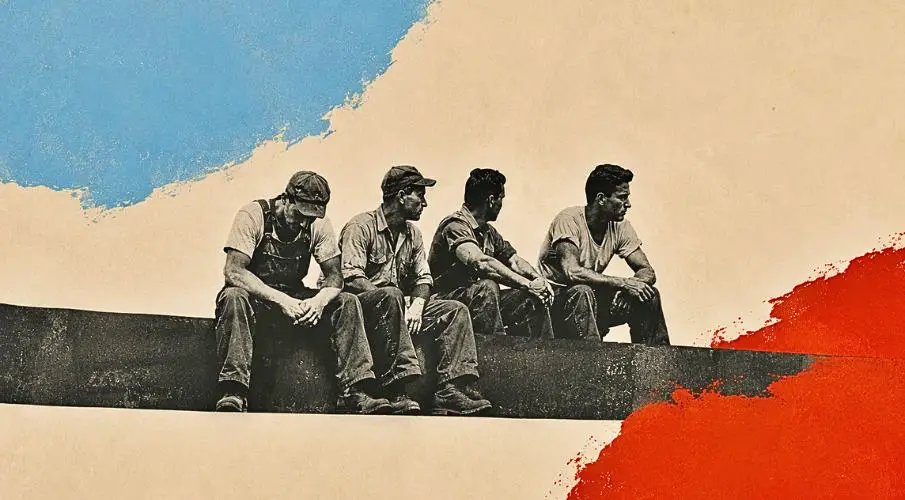
Among white voters without a college degree, the foundation of his coalition, support for Trump’s economic policy is collapsing, a shift that could decide the election this fall. Anyone in Germany voting for the AfD from this very demographic should pay attention before following the same path!
The last time Donald Trump faced a midterm election, in 2018, Republicans in Congress were dragged down by his unpopularity and lost more than three dozen seats in the House of Representatives. But the ground did not entirely give way back then. The party even gained seats in the Senate because white working class voters stayed loyal to him on the economy. That deep reservoir of goodwill has now largely evaporated.
For the first time, white working class voters are seriously doubting Trump’s economic policy. A review of many polls shows an unusual shift among white voters without a college degree between his first midterm and today. Back then, they approved of his handling of the economy by margins of thirty points and more. Today, they disapprove, depending on the poll, by fourteen to more than thirty points. The figures come from polls by CNN from March 2017, November 2018, March 2025, and the first days of May this year.

Trump’s standing on economic issues has fallen in almost every group. But the collapse among the very loyal bloc that has formed the foundation of his coalition for a decade could become one of the most consequential developments of 2026, according to strategists in both parties. A majority of white voters without a college degree no longer approve of his economic policy, and the numbers are low: Fox News shows 33 percent approval, CBS News 39, the NPR, PBS and Marist poll 40, and CNN 43. He has lost the faith of his most loyal supporters, and on the most urgent issue of the year.
His advisers are trying to stabilize the situation and sell the measures from last year’s tax package. This month, the Treasury Department released a report listing how workers benefited from the tax law. And last week, MAGA Inc., Trump’s 350 million dollar campaign machine, spoke out publicly for the first time since the 2024 election. The theme was telling. It focused on how tax cuts had helped working and middle class Americans.
Trump returned to power in 2024 promising to stop illegal immigration, bring inflation under control, and revive the economy. According to exit polls, he won 66 percent of the white working class vote, exactly the same share he received in his first victory in 2016. But since his second inauguration, his tariff policies, stubbornly high gasoline and food prices, his focus on foreign policy, especially the war with Iran, and continuing inflation have weakened that support, even though border crossings have dropped sharply. In April, a gas station in San Francisco advertised prices above seven dollars per gallon, well over 1.85 dollars per liter. The greatest pressure comes from the cost of living, from prices and stagnant wages, and from fear of what the next blow will be.
Molly Murphy, a Democratic pollster who worked for former Vice President Kamala Harris’s 2024 campaign, calls the shift striking. After he began the war with Iran, she said, workers who had voted for him no longer had words to explain the decision and felt it directly through gasoline prices. After a decade in which Trump has been part of their lives, it feels like a turning point in which they are struggling with the realization that he was not who they believed he was.

Tim Spencer from Pella, Iowa, seventy two years old and a former tool and die maker, once voted for Trump. Now rising gasoline prices are squeezing him, and together with what he sees as the president’s increasingly erratic behavior, they have turned him from supporter into dissenter. Filling his Chevy pickup now costs him about 140 dollars instead of 90. In previous summers, he and his wife pulled a camper across the Midwest to campgrounds. At today’s gas prices, he says, it is now only a camper for Iowa. And one should know this: in Pella, Iowa, a town where Trump still received more than 70 percent of the vote, people were already walking through the streets in October 2025 wearing cardboard crowns and shouting, “No kings! No crowns!” In Pella, Iowa, a town where Trump is still treated almost like a king, around 150 people dared to take to the streets to chant “No Kings, No Crowns.” Most were older women, some over seventy, who once could not own a credit card without a man’s signature and who now protest for their granddaughters.

For years many had trusted him, especially on economic issues. During his first term they believed the image he projected of himself, the decisive businessman from The Apprentice, and they remembered the economy under his leadership when he ran again in 2024. In 2018, the losses of his party came elsewhere, mainly among wealthier suburban women. On the eve of that midterm election, his economic approval among white voters without degrees still stood at 66 percent according to CNN. That was one of the reasons Republicans lost the House but also unseated four Democratic incumbents in the Senate.

In this term, his standing on the economy, the issue strategists in both parties consider the most important of 2026, has fallen even further than his overall approval. Among those same voters, disapproval of his economic policy recently reached 57 percent according to CNN, and overall 38 percent approve of him while 58 percent disapprove. Where polls dig deeper into inflation and living costs, the picture becomes even darker for him. Among white working class voters, only 36 percent approved of how he was handling living costs, and Fox News found only 25 percent approved of his handling of inflation. Many voted for Trump in 2024 precisely because of those promises. Trump had talked about falling gasoline prices, but prices rose. Trump does not make things easier with his own words dismissing the economic concerns of so many people. “I love inflation,” he said last week in the Oval Office. He had previously brushed aside rising gasoline prices as trivial, and regarding the timing of scaling down the Iran war, he said he was not thinking about Americans’ financial situation. That final line is already appearing in Democratic ads, including one targeting Representative Rob Bresnahan in Pennsylvania, showing him three times from three camera angles in the first twelve seconds, interrupted only by three words on screen: gasoline, groceries, and utilities.
Democrats see early success in this. Eva Kemp, a strategist with the group American Bridge, has spent years looking for disappointed Trump supporters for campaign advertising, and she says that has become easier. In focus groups, the disappointment sounds more intense, and women in particular seem to have run out of patience. In one such session in Iowa, almost all of the women gave Trump grades of four or five, while white men rated him more favorably. Republican strategists, speaking only under the protection of anonymity, we are talking about America here, not North Korea, observe the same divide between the sexes. John McLaughlin, a Republican pollster who has worked for Trump for years, warns that workers are dissatisfied with the party and may stay home on Election Day, and that Trump’s gains from 2024 are also eroding among Black and Hispanic working class voters. In the end, he says, only one group still remains loyal to him on the economy: Republicans themselves. Even a lower turnout among these workers, who backed him by more than two to one in 2024, could put the party at risk in November. It is essential to bring them to the polls, because if they do not turn out, Republicans lose the House and the Senate.

That does not mean the other side has already won. Democrats have a deeply damaged reputation among white working class voters, and many of them are still nowhere near voting Democratic. Alex Pfeiffer, a spokesperson for MAGA Inc., argues that Democrats must defend their record on immigration and their opposition to the president’s tax law, and must explain why they voted to take more away from workers with tips and overtime pay and from retirees through Social Security.

Democrats do not actually have to win these voters. It is enough to lose them by a smaller margin. In the latest NPR, PBS and Marist survey, 44 percent of white voters without degrees said they leaned Democratic, compared with a meager 30 percent on the eve of 2018. Back then, the Democratic path to a majority ran through educated and affluent districts. They won four seats in Orange County alone, plus seats around Chicago, Minneapolis, New York, Atlanta, and Washington. “You only had to sort districts by education level,” says Mike Smith, who runs the Democrats’ main House campaign arm. “The higher a district ranked, the more likely it was to vote Democratic.” Today they can compete even where they long left the field untouched, in Iowa, Texas, Ohio, and Maine, because, Murphy says, the Senate is built on white working class votes. Trump took the party of the country clubs and gave it to the caddies, says McLaughlin, except this time he himself is not on the ballot. Veteran Republican pollster Neil Newhouse puts it most bluntly: the only person who can excite these voters is also the reason they are no longer excited, and that person is Trump.

Viewed from Berlin, this carries a familiar sound. Here too, one party draws its strength from precisely this environment, from the same worries about wages and prices and from the same desire for someone who will finally speak for ordinary people. The AfD lives from that trust, and among its voters it remains intact, in the very places where it is now breaking apart across the Atlantic. It is worth looking closely before following the same path. Because what cost Americans a decade, the slow realization that the man was not who they thought he was, can be anticipated here without first having to pay the price personally. Whoever votes that way is not only voting themselves into trouble but taking the country with them.
In the end, what remains is a simple sentence about faith. It is the last thing a person gives up, and the hardest thing to admit losing. The promise comes before the deed and outlives it, and between the word and the price at the gas pump lies the distance by which every belief is measured. “I love inflation,” says the man who was supposed to drive inflation out, and only at the gas station, too late, do some learn that what they mistook for strength was never anything but contempt.
Updates – Kaizen News Brief
All current curated daily updates can be found in the Kaizen News Brief.
To the Kaizen News Brief In English


Vielleicht reicht es schon, wenn die Trump Wähler vermehrt nicht wählen gehen.
Trump hat nicht gewonnen gehabt, weil ihn so Viele gewählt gaben, sondern, weil viele Demokraten nicht gewählt haben.
Das eingefleischte Republikaner demokratisch wählen, ist illusorisch.
Dazu liegen die Meinungen über Migration, LGBTQ oder Abtreibung zu weit auseinander.
Aber wenn sie aus Trotz nicht wählen, wäre das sehr hilfreich.
Aber, man muss bedenken, dass ihn immerhin noch 38% unterstützen.
Die AfD Wähler hier sind, dass muss man sagen, intellektuell nicht in der Lage den Zusammenhang USA und AfD zu sehen.
Man kann nur hoffen, dass die „Trotzwähler“ aufwachen und demokratisch wählen.
Keine AfD
…die zwischenwahlen dürfen zu einem donnerschlag führen …
Das wäre so zu hoffen