
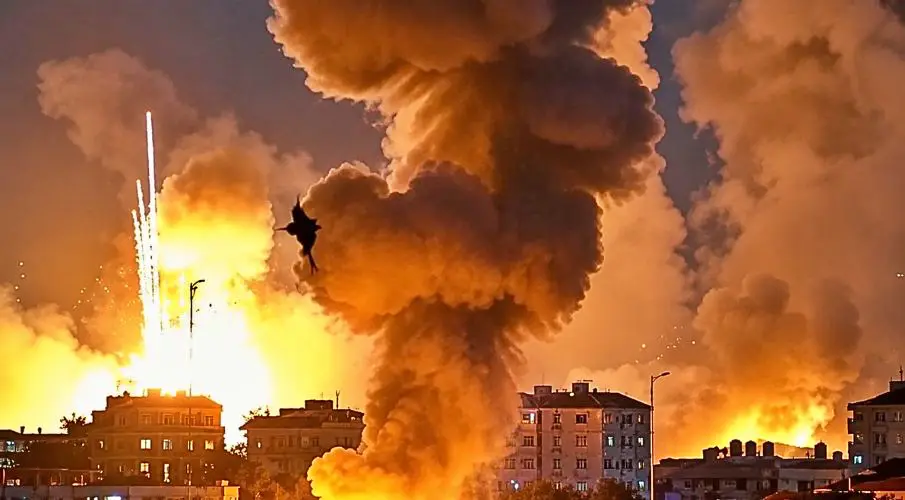
While its own investigators are still trying to determine whether Iran intentionally struck the crashed Apache at all, retaliation strikes are already underway against five targets in the south of the country. This is being called a proportionate response.
Off the coast of Oman, in airspace so crowded that it is difficult to say who came too close to whom, military investigators from the United States spent Tuesday trying to answer a simple question. Did the Iranian drone deliberately bring down the American helicopter, or was it a reckless accident? They did not yet have an answer. The retaliation, however, had already launched. At 5:00 p.m. Eastern time, on President Trump’s orders, American missiles struck five locations along Iran’s southern coast, and Central Command described it, before anyone knew exactly for what, as a proportionate response to unjustified Iranian aggression.

The helicopter at the center of the incident was an AH-64 Apache, one of the most formidable aircraft in the region, equipped with Hellfire missiles. During the night into Monday, it crashed into the sea while patrolling over the Strait of Hormuz near the Omani coast. Its two person crew was rescued within roughly two hours, both men unharmed. Trump blamed Iran. Our great military has just briefed me, he wrote, the Iranians shot down a highly advanced Apache overnight, both pilots are safe, but America must inevitably respond to this attack. He did not explain how Iran supposedly brought down the helicopter. A US official later referred to a simple Iranian Shahed attack drone.

Iran did not claim responsibility. State broadcaster IRIB cited an unnamed officer who insisted the country had conducted no air operations over the Strait in the previous twenty four hours and warned against renewed aggression under the pretext of a crashed helicopter. Experts also expressed doubt. Reporting raised questions about whether a Shahed could even hit a moving target, adding weight to the possibility of an accident. Mark Cancian, a retired Marine colonel and senior adviser at the Center for Strategic and International Studies, argued that Iran might possess a modified Russian version of the drone equipped with remote guidance capability. The standard Shahed is satellite controlled, he said, making it unsuitable against moving targets such as ships or aircraft, but reports of Russian transfers to Tehran suggested capabilities of that kind.
The American side signaled what it wanted to discuss and what it did not. Central Command confirmed Tuesday morning that the helicopter had crashed and that the crew had been recovered, but described the incident as unresolved and said nothing about the cause. Until media reports emerged Monday evening, the administration had not even acknowledged the loss of the aircraft. The following morning, command officials wanted to speak only about the unusual rescue, not about whether Iran had brought down an Apache armed with Hellfire missiles.
What followed had previously been described by officials as a proportionate response designed not to break the fragile ceasefire and not to derail difficult negotiations over reopening the strait. The goal, officials said, was to respond without escalating. Plans called for strikes against the bases and positions from which the drone had allegedly launched. Iranian state television reported explosions and sirens along the Persian Gulf coast, in Bandar Abbas and on Qeshm Island, in Sirik, with some locations struck multiple times. Two Iranian officials speaking anonymously referred to naval facilities in Sirik and Jask, air defense systems in Bandar Abbas, and missile sites on Qeshm. Residents in the area reported multiple explosions.

The US Navy and the US Air Force conducted joint precision operations against IRGC positions on Qeshm Island and in Bandar Abbas, Sirik, and Bandar-e Jask. Command centers, air defense systems, radar installations, drone storage facilities, and missile launchers were targeted.
The man who ordered the response simultaneously treated the trigger as something minor. In a phone call with a Wall Street Journal reporter, Trump downplayed the incident, saying it was not a big deal and that the pilot was fine. The same event thus appears on the same day both as an unavoidable reason for military action and as an insignificant episode, and both interpretations come from the same mouth. Following the strikes, Iranian Foreign Minister Abbas Araghchi declared that his country’s armed forces would leave no attack and no threat unanswered. America is testing Iran’s resolve, he wrote, adding the warning that if the United States wanted to remain safe, it should leave the region.

Speaker of the House Mike Johnson, who had spent the day in the Situation Room with the president and several cabinet members, said he had been briefed before the strikes. The action, he said, was proportionate and limited, a response to unjustified Iranian aggression. The word proportionate appears so often in these hours that one forgets it assumes a measure, and that the measure itself, the cause, remains in the dark.
What revealed the most about this war was not the strike but the rescue. The two aviators were not pulled from the water by a ship with a crew, but by an unmanned vessel controlled remotely by a human operator, the first rescue of its kind carried out by an autonomous surface vehicle, according to Central Command spokesman Captain Tim Hawkins. It was a Corsair operated by Task Force 59 of the Fifth Fleet, a vessel just over seven meters long built by Saronic Technologies, diesel powered, capable of reaching speeds up to sixty five kilometers per hour, carrying roughly four hundred fifty kilograms, and operating over distances exceeding eighteen hundred kilometers. It transported the pilot and weapons officer to another point on the water where a helicopter picked them up. Since late March, the task force has operated such drones in the region, shortly after the war began.
In this way, both parts fit together, the destructive and the rescuing, and neither carries a crew. Until now, attention has focused on flying drones, on Iranian Shaheds, but unmanned systems have long since moved onto land and sea as well. In Ukraine, unmanned vehicles evacuate the wounded and deliver supplies, and increasingly they attack, while sea drones sink Russian ships in the Black Sea, some equipped with air defense missiles to target combat aircraft. None of this is new. As early as 2022, Naval Forces Central Command was operating unmanned vessels from its headquarters in Bahrain, accumulating twenty five thousand hours of operations, and in January 2024 Task Force 59 created a dedicated division for these systems.
Behind the technology stands a business that can be measured. Saronic, which builds the Corsair, holds a production contract with the Navy worth 392 million dollars, is headquartered in Austin, Texas, and was founded only in September 2022, less than four years ago, yet already employs more than 1,300 people. Its chief executive, Dino Mavrookas, served eleven years with the Navy SEALs and completed eight combat deployments. It is a young company growing quickly, and it is growing through war.

This war began on February 28, and it has already cost the United States dearly. Apache helicopters patrol the waters around the Strait of Hormuz and repel attacks by small boats, while also bringing down Iranian drones, pushing ever closer to Iranian territory and to islands controlled by Iran. Alongside them, armed Reaper drones and F/A-18 and F-35 jets fly missions against Iran’s hold over the strait, which the country has effectively closed. Iran has shot down roughly thirty Reapers, along with several combat aircraft through both enemy and friendly fire. In April, it brought down an F-15E over its territory, whose two crew members ejected and were rescued. The Apache, however, is the first of its kind lost in this war, a system valued at approximately twenty five million dollars.
Since April 13, the American military has responded to Iran’s closure of the strait with a blockade of its own, targeting ships entering or leaving Iranian ports. One hundred thirty four vessels have been turned away and seven more disabled. The latest was an oil tanker sailing under the flag of Palau that on Monday was heading toward Iran in international waters in the Gulf of Oman. An F/A-18 Super Hornet launched from the aircraft carrier Abraham Lincoln fired into the engine and steering compartments and brought the ship to a halt after it ignored repeated warnings.
Where people rather than machines are dying in this war is not Iran but Lebanon. While America struck the Iranian coast, the Israeli military hit southern Lebanon, now the most fragile point in all efforts to end the war with Iran. Lebanon counts more than 3,600 dead from months of fighting, Israel thirty. On Tuesday, the Israeli army ordered the evacuation of the entire city of Tyre, one of the largest in the south, and for the first time in this war also its Christian quarter. Shortly afterward, the bombs hit, killing at least eight people and injuring dozens, another sign that a new ceasefire mediated by the United States is not holding. Before the war between Israel and the Iran backed Hezbollah that began in early March, around one hundred thousand people lived in Tyre. Near the border, Israeli soldiers, according to the military, killed an armed man who crossed from Lebanon and opened fire, and two villages were forced into shelter. Iran had warned that attacks on southern Lebanon would trigger a new wave of retaliation, but as night fell, the threat had not been carried out.

Even the direction of the world’s thirst for oil has been reversed by this war. The US Energy Information Administration expects global consumption in 2026 to fall by more than one million barrels per day below the previous year’s level, driven by prices pushed upward by the war, whereas before the conflict an increase of 1.2 million barrels had been forecast. The Strait of Hormuz, a lifeline for oil and gas, is expected to remain effectively closed for the foreseeable future, with traffic not returning to normal until early 2027. Brent crude closed the day three percent lower after temporarily falling by five percent.
And over everything hangs the promise the president keeps renewing, that an agreement is near, one that will end the war, determine the future of Iran’s nuclear program, and reopen the Strait of Hormuz. The agreement, American officials say, contains four major points and would freeze Iran’s program for roughly fifteen years. Vice President JD Vance contradicted himself in the preview of an interview with CBS. The agreement could come next week, he said, but just as easily only months from now.
While missiles were flying, FIFA was occupied by a smaller yet revealing concern. The organization said it was working closely with Iran’s football federation to determine how Iranian supporters could attend their team’s matches at the World Cup in the United States. The federation had protested because supporters with long planned trips were being deprived of the opportunity. Because Iran remains under US sanctions, FIFA is not permitted to sell tickets there. On June 15, Iran’s national team will play its first match in Los Angeles against New Zealand.
What remains is the word that is meant to hold everything together: proportionate. It promises calculation, measure for measure, yet a measure requires a known quantity, and the quantity here, the cause itself, is not known. So calculation becomes incantation, a word that pretends certainty where none exists. Machines carry the wounded away and launch the missiles, while human beings step aside and watch, except where they die, in Lebanon, by the thousands. We are close to an agreement, they say, and they have been saying it for months, while for just as long the bombs have continued to fall. Perhaps the most honest account of this evening is that a superpower struck back before it knew for what, and called it proportionate because no truer word was available.
Updates – Kaizen News Brief
All current curated daily updates can be found in the Kaizen News Brief.
To the Kaizen News Brief In English


