
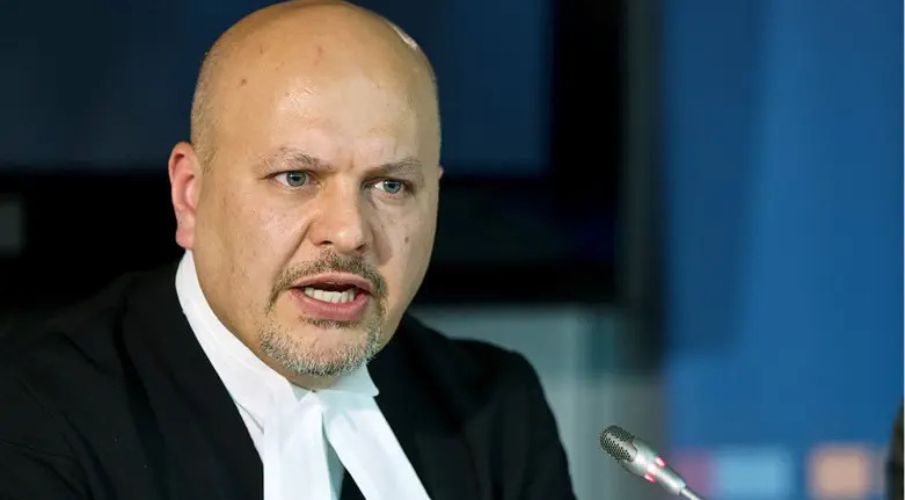
The International Criminal Court has suspended its chief prosecutor Karim Khan over allegations of sexual misconduct, which he denies. Now the court that holds the powerful of the world accountable must decide whether its principle also applies within its own walls.
In an unprecedented move, the chief prosecutor of the International Criminal Court was suspended from his duties late Monday after the court’s oversight body referred British lawyer Karim Khan to disciplinary proceedings. The fifty six year old faces allegations of sexual misconduct involving a staff member in an affair that has stretched on for more than two years. He firmly denies any wrongdoing. It is the office itself that makes this case so consequential. Khan is not just another official but the man whose role is to prosecute the gravest crimes in the world and bring the powerful before a court that few others would dare to establish. Now he is the one whose conduct others must judge.

His future will now be decided by the Assembly of States Parties, the body that oversees the court and will convene in a special session to determine whether Khan can remain in office. The Bureau of the Assembly, its executive committee, stated that it based its decision on the findings of an investigation by the United Nations Office of Internal Oversight Services, the underlying evidence, the advice of a specially appointed panel of judicial experts, and written submissions. The suspension until the Assembly meets, it added, should not be taken as an indication of the final outcome. The United Nations investigation found evidence that Khan, as stated in the report available to us, engaged in non consensual sexual contact with the staff member in his office, in his private residence, and during official travel. A three judge panel, however, appointed by the executive committee to provide a legal assessment of the findings, concluded that the investigation was not sufficiently conclusive. In response to a request for comment, Khan’s legal counsel stated that they would issue a response on Tuesday.
Khan had already stepped aside from his duties temporarily in May 2025 pending completion of the investigation. For the court, the entire process is without precedent, and the Assembly of States Parties has repeatedly had to create new procedures simply to address it. The allegations were first reported to the court’s independent oversight mechanism more than two years ago. According to whistleblower documents, Khan allegedly noticed the woman while she worked in another division of the court and brought her into his office, where she soon became a regular companion on official trips. During an overseas trip, he allegedly asked her to lie with him on a hotel bed and then touched her sexually. Additional alleged non consensual conduct described in the documents includes locking the office door and placing his hand into her pocket. He is also alleged to have repeatedly asked her to accompany him on vacations.
Only the Assembly of States Parties has the authority to remove Khan from office, and doing so would require a majority in a secret ballot among its 125 member states. Sixty three countries would need to support a motion for his removal. No date had initially been set for the session, but the Assembly stated that it would convene as soon as possible.
The court in The Hague rests on a single principle, that no one stands above the law, not the powerful and not the victor. That very principle is now being tested within its own institution, and its credibility depends on whether the court is capable of applying to itself what it demands of the rest of the world. Between those principles stands a staff member facing a superior upon whom her position and professional future depended, and within that distance between power and dependence the word consent easily loses its footing. The presumption of innocence applies, Khan denies everything, and a judicial panel found the evidence inconclusive. But it is equally true that an institution that presents itself as guardian of the conscience of nations cannot take two years simply to open its own door. Whoever holds the world accountable must have the courage not to spare itself first.
Updates – Kaizen News Brief
All current curated daily updates can be found in the Kaizen News Brief.
To the Kaizen News Brief In English


