
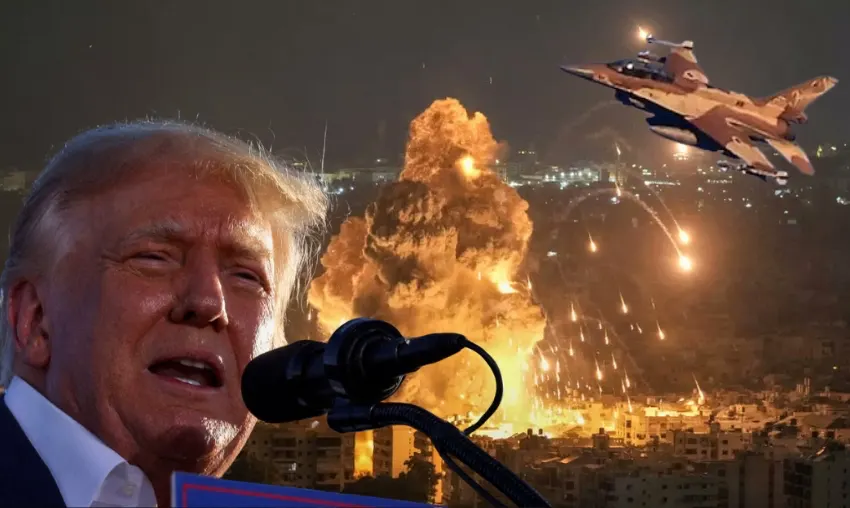
Donald Trump had already spoken of a "very major attack." By his own account, the decision had essentially been made. Preparations were underway. Military options were on the table. Another strike against Iran was supposed to follow. Then the situation changed once again. On Monday, Trump stated that he had authorized a new wave of attacks against Iran but had temporarily placed them on hold. According to him, the reason was a request from the Gulf region. The leaders of Qatar, Saudi Arabia, and the United Arab Emirates had asked him to postpone the attack for another two or three days. They believed they were getting closer to reaching an agreement with Iran.
Trump described the development as positive while remaining cautious at the same time. Similar situations had occurred before in which an agreement appeared within reach and ultimately collapsed. This time, however, he said it felt different.
At the same time, Trump published a message on social media stating that he had informed his military advisers not to proceed with the attack scheduled for Tuesday. At the same time, however, he instructed them to prepare for a "full-scale major attack on Iran" if no "acceptable deal" could be reached.

The situation therefore appears contradictory. On the one hand, the White House is speaking about diplomacy and negotiations. On the other hand, preparations for a possible new phase of war continue simultaneously. The attack was not canceled. It was postponed. For weeks Trump has moved between threats and new deadlines. Over an extended period he publicly stated that he wanted to resume military strikes against Iran. He said his patience had run out. At the same time, however, the burden created by a conflict that was originally expected to be significantly shorter continues to grow. Trump had stated that the war could be ended within six weeks. The conflict has now already lasted more than two months.
American military officials are now openly explaining that Iran has proven more resilient than originally expected. Despite intensive attacks, the country has maintained its ability to inflict regional damage and generate consequences for the global economy.

During the ceasefire, Tehran reportedly used the time to reopen destroyed missile positions. Mobile launch systems were relocated. Tactics were changed. According to one American military official, many Iranian missiles had been stationed deep within underground facilities built into granite mountain ranges and were therefore difficult to destroy.
Read also our article: The war beneath the ground - What becomes visible after weeks in Iran and what Washington keeps quiet
American attacks therefore frequently bombed and collapsed entrances and access points while not always fully destroying the facilities themselves. According to military officials, Iran has now reportedly reopened a significant number of these sites. Another issue is increasingly causing concern within military circles. According to an American official, Iranian commanders may have analyzed the flight patterns of American fighter jets and bombers with Russian assistance.
Particular attention is being focused on incidents from recent weeks. According to military circles, the downing of an F-15E last month and damage sustained by an F-35 may have demonstrated that American flight patterns had become too predictable. That, in turn, could improve Iran's defensive capabilities.
An entirely different development may weigh even more heavily on Washington. Five weeks of intensive bombing may have eliminated Iranian leadership figures and commanders. At the same time, according to assessments from American military officials, it may also have created an opponent that has become tougher and adapted itself.

Iran has reportedly redistributed its remaining weapons and appears to have strengthened confidence within its own structures that it can withstand American pressure. Several possible scenarios are being discussed. A blockade of the Strait of Hormuz. Attacks on energy facilities in neighboring Gulf states. Threats against American aircraft and military facilities.
At the same time, political pressure on Trump is also growing at home. A large portion of the American public considers the war against Iran to be the wrong decision. Many have expressed dissatisfaction especially regarding the economic consequences and the rising costs of the conflict. Trump nevertheless continues to insist on one central demand. Any potential agreement must prevent Iran from obtaining nuclear weapons. Yet this exact issue has been among the largest points of contention between both countries for months. Several proposals have already been rejected.
Now only a few days are once again on the table. Once again it is about time. Once again about negotiations. Once again about the question of whether threats will become actual orders.
The attack has been temporarily halted. The preparations apparently have not.
Updates – Kaizen News Brief
All current curated daily updates can be found in the Kaizen News Brief.
To the Kaizen News Brief In English


Heute las ich, dass D.T. resp. seine Administration am vergangenen Freitag 250 Mitarbeiter des diplomatischen Dienstes entlassen habe, allesamt Nahostexperten. Könnt Ihr das bestätigen, und steht das möglicherweise im Zusammenhang mit Eurem Bericht 🤔
Hallo. Nein, diese Information ist nicht richtig. Geplant ist ein möglicher Abbau von 80 Mitarbeitern in der Region Naher Osten, jedoch ist das noch nicht endgültig beschlossen. Liebe Grüsse
Samstag oder Sonntag gepostet, Montag/Dienstag zurück gerudert.
Das ist auch ein Muster.
Sicher gab es von Trump und seiner Entourage diverse Börsen/Öl-Aktivitäten.
Trump will seine Maximalforderung, bis dahin droht er martialisch.
Das Russland den Iran unterstützt, will Trump nicht sehen.
Nicht sein Buddy Putin.
Es bleibt eine furchtbare Kriegssituation, die minütlich eskalieren kann