
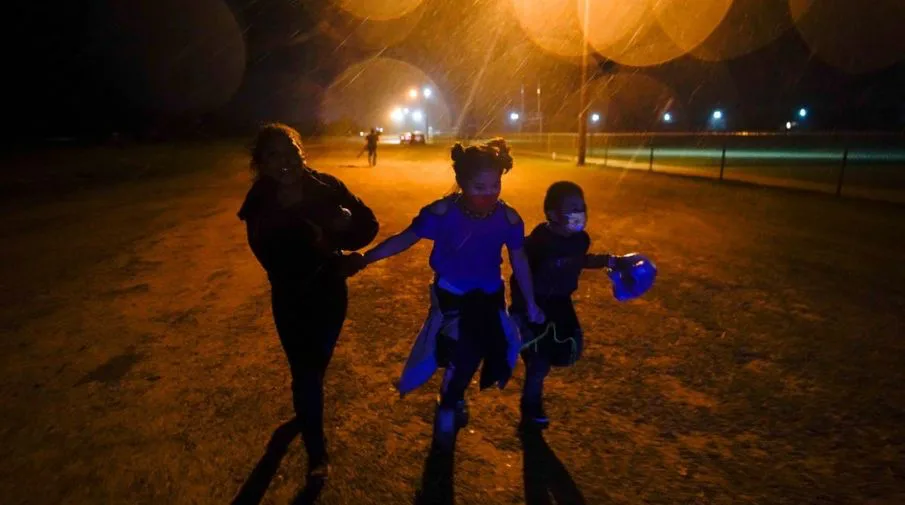
In official tables, numbers often look clean. 60,000. 100,000. 145,000. Rows, columns, statistics. Behind those numbers, however, are children sitting in apartments where a chair suddenly remains empty. Children waking up at night asking for their mother. Children who do not understand why a parent went to work and never came back. A new analysis by the Brookings Institution concludes that reality may be significantly larger than the numbers authorities have reported so far. According to researchers' calculations, more than 100,000 children may have been separated from their parents since the beginning of the intensified deportation campaign. Roughly three quarters of them are believed to be American citizens.
Here is a small selection of additional articles: “Please Get Me Out of Here” - Dilley, the Letters of the Children, and What Remains After the Outrage
Investigations reveal: Masked proximity - how ICE penetrates private groups with false identities
We Are All Fighting for Liam – and the Right-Wing Agitation Against Liam
But this is increasingly becoming reality in Germany as well
Read also: Bagrat may stay and will not be deported - A boy who can sing forced Germany to make a decision
The scale would be enormous. According to estimates, around 205,000 children may already have experienced a parent being arrested. Approximately 145,000 of them would be American children. Even the most cautious estimates still exceed 117,000. The upper estimates reach around 175,000 affected children. Researchers Tara Watson of Brookings and Maria Cancian of Georgetown University consider their middle estimate of around 145,000 children to be the most likely figure.

The numbers differ significantly from figures provided by the Department of Homeland Security. There, officials estimate that the parents of approximately 60,000 American children have been arrested. Researchers suspect that many affected individuals are never asked about their children or are afraid to provide information. For some parents, simply mentioning a name could mean placing additional relatives within the focus of authorities.
The development would overshadow even the family crisis of the first Trump administration. In 2018, the so-called Zero Tolerance policy caused international outrage when approximately 5,500 children were separated from their parents immediately after crossing the border. The current numbers would be many times larger. Only this time much of it is not happening in front of television cameras at border fences, but in cities, parking lots, workplaces, and after traffic stops.

For Ledy Ordonez, everything began at a seafood wholesaler in San Antonio. Last July, officers arrived there and arrested several people. Since then, she has been sitting in a deportation center in Texas. Her son Alonzo, an American citizen who is now two years old, is currently living with acquaintances. During her detention, she missed nearly everything. His first words. New steps. The small changes parents only get to experience once. "He can walk and talk now," she said. "I have missed so much."
Particularly painful is a legal reality that can tear families apart. American children cannot be held in immigration detention. Parents are therefore often confronted with a decision that barely feels like a real choice. They can take their children with them if the legal requirements are met, or they can leave them behind. Ledy Ordonez tried to remain in a family facility with her son while her case was being reviewed. It did not work. Now her deportation appears to be imminent. Alonzo needs a passport. If that passport does not arrive in time, his mother could be deported without him. The case has been on our desk for several days now.
She does not describe the people currently taking care of her son as family. They are simply caring for him because they wanted to help.
"If they deport me, I want to take my child with me," she said through tears.

Relatively few of these children, however, end up in foster care facilities. Most remain with relatives, neighbors, or friends. But problems emerge there as well. Older siblings suddenly take responsibility for younger children. Families that barely have enough money themselves take in additional people. Other caregivers do not even possess the necessary documents to make medical decisions or handle school matters.
Sharon Cartagena of the organization Public Counsel now regularly reports receiving calls from schools, churches, and volunteers. There are children sitting there whose parents have suddenly disappeared and for whom no one knows exactly who is responsible.
Samantha Lopez is also among the children now living without her mother. The girl is three years old and an American citizen. Her mother was handed over to ICE last month after a traffic stop while driving to work at a restaurant. The father describes his daughter's conversations with her mother as difficult to endure. The child listens closely and then begins to cry.
"This is my American child who is being hurt," he said.
At the same time, fear of workplace raids is growing in many regions. In California, more training sessions have been organized in recent months in which business owners and employees are informed about their rights. The issue no longer concerns migrants alone, but entire neighborhoods, businesses, and families suddenly confronted with the question of what happens if officers appear at the door.
California also has specific workplace protection rules in place. Under the Immigrant Worker Protection Act, employers are not permitted to voluntarily grant immigration officers access to private areas or employee records. Marisa Almor of the East Bay Sanctuary Covenant explained that many business owners do not even realize they could expose themselves to legal consequences by opening doors or handing over internal information without the proper basis. That is why the training sessions are not only about protecting migrants, but also about informing business owners what they are allowed to do and what they are explicitly prohibited from doing.
During the training sessions, attention was also drawn to a distinction many people do not know. A judicial search warrant is different from administrative paperwork that immigration authorities often carry with them. According to organizers, officers only rarely appear with judicial warrants. That is exactly why it is important for employees and business owners to examine documents carefully and not automatically assume that every paper presented grants immediate access to all areas.
The uncertainty was further intensified by a Supreme Court decision. The Court temporarily allowed the Trump administration to continue using broad criteria during operations in the Los Angeles area, including language, apparent ethnic background, and certain professions. Critics fear that American citizens themselves could also become targets simply because of their skin color, language, or occupation.

José Antonio Dorado, who helps organize the Comunidad y Comerciantes de Fruitvale association, spoke not only about fear, but also about solidarity. His goal now is for business owners themselves to become multipliers and train other merchants. The 77-year-old former police commissioner therefore also sees these developments as a moment in which a community could become more closely united. Education alone would not be enough, he said. What matters is that people begin supporting one another.
The government says that parents can decide whether they want to take their children with them or leave them with trusted individuals. On paper, that sounds like a choice. Inside apartments, inside children's bedrooms, and in the voices of those affected, it sounds very different. There, this is not about forms or responsibilities. There, it is about children suddenly having to learn that a door can open and someone simply never comes back.
Anyone in Saxony-Anhalt, Mecklenburg-Western Pomerania, or Berlin considering giving their vote to the AfD in September should take a close look at what is happening in America right now. Children there are growing up without their mothers because a policy has been set in motion that no longer treats people as people, but as what remains after you take away their names. A two-year-old American citizen is living with acquaintances while her mother sits in a deportation center - that is not a scenario, that is a country that has stopped being what it once promised to be. Anyone who believes things would be different in Germany has not read the AfD. A party that talks about remigration means exactly what is happening in America right now. Doors opening and people never coming back. Families being torn apart because of a missing passport or a stamp. Anyone handing governing authority to the wrong hands on September 6 or September 20 should not be surprised if they later wake up in a country where children cry on the phone because their parents have disappeared.
Updates – Kaizen News Brief
All current curated daily updates can be found in the Kaizen News Brief.
To the Kaizen News Brief In English


Eine ganze Generation traumatisiert.
Die Menschheit lernt bicht.
Immer wieder werden Moral und Mitgefühl für Macht und Geld über Bord geworfen.
Diese scheinheilige Trump Entourage.
Pro Live, dass ich nicht lache 🤬
Kinder werden ihren Familien, ihren Müttern entrissen.
Sie sind US-amerikanische Staatsbürger, mit allen Rechten.
Und dennoch werden sie mit ihrer Familie wie Kriminelle behandelt.
Die Communities rücken zusammen.
Wollen kein Kind in staatliche Obhut geben.
Es werden Notfallpläne erstellt, wo die Kinder selber hingehen können oder wohin sie gebracht werden können.
Aber oft droht da das gleiche Schicksal.
Bekannte, Freunde, Familie haben oftmals auch keine Papiere.
Oder nur einen begrenzten Schutzstatus.
Ich weiß, dass in den Hispanic Communities eigene Unterkünfte für Minderjährige geschaffen werden.
Abseits vom Staat, dem man (zu Recht) nicht mehr traut.
Wer weiß, wieviele dieser Kinder ihre Geburtsurkunde verlieren und ihre Staatsbürgerschaft bicht mehr nachweisen können.
Ich mag nicht dran denken.
Mit dieser Generation wachsdn hunderttausdnde Menschen heran, denen die USA viel genommen hat.
Es wird immer diese Grundskepsis, vielleicht sogar Hass bleiben.