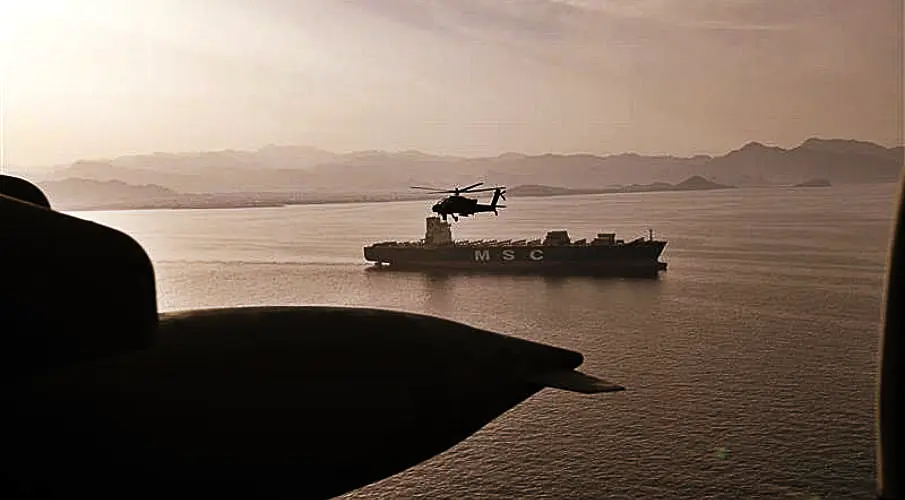
For days, American warships have been blocking the exit of Iranian ports. Twenty-three ships have already been pushed back before reaching open sea. That was the first phase. What comes next is larger.
In the coming days, U.S. forces will begin boarding and seizing Iranian-linked oil tankers and merchant vessels in international waters - not only in the Persian Gulf, but everywhere in the world where these ships are currently operating. General Dan Caine, Chairman of the Joint Chiefs of Staff, put it bluntly at the Pentagon on Thursday: “We will actively pursue any Iranian-flagged vessel or any vessel attempting to materially support Iran. That includes dark fleet ships transporting Iranian oil.”
The dark fleet - those are tankers that operate without proper insurance, circumvent international regulations, and sail under changing or false flags to evade sanctions. They are the backbone of Iran’s oil exports. Caine explicitly stated that U.S. Indo-Pacific Command will be involved in this operation. This is no longer a regional measure. This is a global reach.

The name of this new phase is “Economic Fury.” The Trump program aims to force Iran at two points at once: to fully open the Strait of Hormuz and to make concessions on its nuclear program. Both together, not sequentially. White House spokesperson Anna Kelly said Trump is confident that the naval blockade combined with “Economic Fury” will help bring about a peace agreement.
At the same time, the Treasury Department has expanded its sanctions list. Newly added are ships, companies, and individuals from the network of Mohammad Hossein Shamkhani - son of Ali Shamkhani, one of the closest security advisers to the late Supreme Leader Ali Khamenei, who was killed in an Israeli airstrike at the end of February. Treasury Secretary Scott Bessent named him directly. These newly sanctioned targets are added to hundreds of already sanctioned Iranian-linked vessels that now become potential boarding targets.

The criminal dimension is unfolding in parallel. Acting Attorney General Todd Blanche has announced that anyone buying or selling sanctioned Iranian oil will be prosecuted. The U.S. Attorney’s Office for the District of Columbia under Jeanine Pirro is working with its Threat Finance Unit on seizure warrants for ships. Pirro’s office was already the driving force behind vessel seizures against Venezuela - tankers were intercepted in the Atlantic and the Indian Ocean at the time. The Department of Defense worked closely with the Department of Justice and the U.S. Coast Guard. This mechanism, once tested, is now being applied to Iran - on a significantly larger scale.
The Trump administration is pursuing three approaches at sea simultaneously - the blockade in front of Iranian ports, the possible seizure of dark fleet ships in other parts of the world, and the disruption of smuggled goods such as missile components. “If you want to apply maximum pressure on Iran, you use every single available legal authority.”
Behind this strategy lies another target that is not openly named in Washington. The vast majority of Iran’s roughly 1.6 million barrels of crude oil exports per day goes to China - purchased by small, independent refineries, so-called teapot refineries. China has in recent months increased its strategic reserves to shield itself from supply disruptions caused by the conflict. Caine’s public statement about the dark fleet was, as a U.S. government official confirmed, also deliberately meant as a warning to Beijing. Anyone buying Iranian oil risks having the ship transporting it intercepted by the U.S. Navy somewhere on the world’s oceans.
Ground troops are hardly part of these considerations. The costs are too high, the idea too unpopular among the American public. Defense Secretary Pete Hegseth did say U.S. forces are “maximally positioned” to resume operations if needed and mentioned Iranian power plants as possible targets. But internally, it is understood what such an attack could trigger - Iran would likely target energy infrastructure in Saudi Arabia and other U.S. allies. So economic pressure remains the preferred tool as long as negotiations are still ongoing.
See also our article: The great ground war narrative - the hour of the TV alarmists
And those negotiations stand on shaky ground. Last week’s talks in Pakistan ended without results. A new round has not yet been scheduled. Trump claimed on Friday that Iran had already agreed to hand over its stockpile of highly enriched uranium to the United States. Iran immediately denied it. What is actually being negotiated - how long Iran would suspend enrichment, whether and when frozen funds would be released, in what sequence steps would occur - remains unclear. The ceasefire expires next week.

The image shows a nautical chart of the Strait of Hormuz with designated shipping routes. The orange marked corridors are the official traffic lanes for large vessels, separated for inbound and outbound traffic - comparable to lanes on a highway. Ship movement is deliberately channeled here because the passage is very narrow and one of the most important trade routes in the world.
Points A to D with coordinates mark a precisely defined section within this route. Such reference points serve for navigation and monitoring - both civilian and military. Ships normally move strictly within these designated corridors.
The red marked area (“Hazardous Area”) indicates a danger zone. This can refer to military activity, possible mines, exercises, or other risks. In such zones, special caution is required or passage is temporarily restricted.
Iran is preparing for all scenarios. Thousands of medium and short-range missiles are still available, launch systems are being brought out of underground storage. The United States claims Iran’s defense industry has been so heavily damaged that rapid replenishment is not possible. Parliament Speaker Mohammad Bagher Ghalibaf said in his address to the nation on Saturday that Iran has compensated for its military gap with the United States through strategy and asymmetric warfare - and will respond with full force to any mistake by the opposing side.
See also our article: The war beneath the ground - What becomes visible after weeks in Iran and what Washington keeps quiet
See also our article: The strait no one controls - and everyone needs
On Saturday, two Indian-flagged ships were fired upon in the Strait of Hormuz. One day earlier, Iran’s foreign minister had declared the strait fully open. India summoned the Iranian ambassador. The Revolutionary Guard declared the strait closed again until the U.S. blockade is lifted.
Somewhere across the world’s oceans, tankers are sailing without visible flags. And American ships are following them.
Updates – Kaizen News Brief
All current curated daily updates can be found in the Kaizen News Brief.
To the Kaizen News Brief In English


Welche Umweltkatastrophen hier lauern 😞
Überall auf den Weltmeeren.
Alle iranischen Tanker inklusive Schattenflotte sollen ins Visier genommen werden.
Und gleichzeitig darf Trumps Buddy Putin einen weiteren Monat Öl und Gas sanktionsfrei transportieren. Inklusive seiner Schattenflotte.
Without words
…die folgen sind noch überhaupt nicht abschätzbar, aber sie werden nicht klein sein, was für eine irre welt