
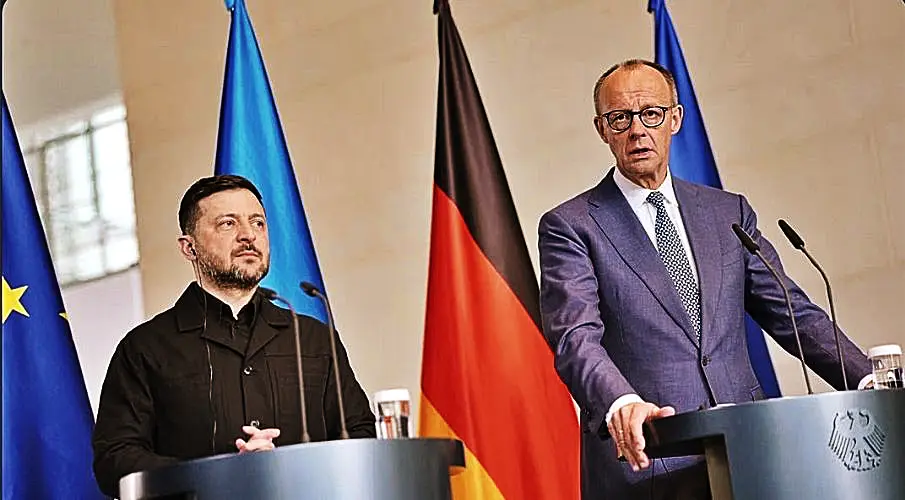
Today, in Berlin, a sentence is spoken that carries more weight than any delivery before. Volodymyr Zelenskyy and Friedrich Merz are no longer talking about weapons, they are talking about building them together. Drones, missiles, software, systems that are not produced for stockpiles, but created under the conditions of an ongoing war. What begins here is not a project, it is a transformation.
Zelenskyy speaks calmly, almost matter of fact, when he says that Ukraine has proposed a comprehensive drone agreement to Germany. The work has begun. Behind that sentence stands a country that has learned to supply itself because it had to. Air and sea drones, systems that can reach targets up to 1,750 kilometers away, machines deployed where soldiers are missing. Ukraine is no longer just a recipient. It produces, develops, tests under pressure, every day.
And that is exactly where Germany steps in. Merz frames it as reliability, as support that will not diminish. But the real step lies deeper. Those who produce together assume responsibility for what is produced. That is a different level than delivery. It is participation.
At the same time, Zelenskyy openly shows where the limit lies. Not in technology, not in capacity, but in money. Ukraine could double its military production. It does not, because the funds are missing. “We simply do not have enough money,” he says. No paraphrasing, no cushioning, just that one sentence. The answer to that lies in Brussels. A European Union loan of 90 billion euros could unlock exactly that production. So far blocked, primarily by Viktor Orbán. His possible departure changes more than a personnel decision. It determines whether this industrial rearmament gains momentum or continues to be slowed.
While calculations and planning take place in Berlin, the focus shifts in Washington. The war with Iran absorbs attention, resources, priorities. Tammy Bruce says before the United Nations that work continues toward a negotiated end. In practice, however, diplomacy is losing space. For Kyiv, this means uncertainty, because without American intelligence and air defense, many of these new systems are not sufficient on their own.
On the battlefield itself, a contradictory picture emerges. Russia holds around one fifth of Ukraine, including Crimea, which has been under its control since 2014. At the same time, Kyiv manages to strike targets deep inside Russian territory with its own weapons. Refineries, production facilities, infrastructure. Attacks that no longer just disrupt, but hit. The fact is: Ukraine is militarily better positioned than at any earlier point in this war. More drones, more missiles, more initiative. A reality that creates hope in Kyiv and likely resistance in Moscow.
But this development comes at a cost. The Ukrainian army is under pressure in terms of personnel. Around 200,000 desertions, about two million men evading conscription. Numbers that do not simply disappear. “Germany is supporting Kyiv in encouraging conscription age Ukrainians abroad to return - a domestically sensitive issue that also raises moral questions.”
While the larger lines shift, the war remains concrete. In Dnipro, people die in a missile strike, in Kherson a drone kills a woman. These are not side notes, they are the daily reality of this war that accompanies every strategic decision. At the same time, interest from abroad is growing. States from the Middle East, Southeast Asia, and Africa are asking for cooperation. Not out of political alignment, but because of the experience embedded in these systems. Turkey and Iraq are also part of these discussions.
Berlin has thus become more than a place for talks. Decisions are being made here on whether Europe is prepared not only to finance this war, but to help shape it. Not at some point, not cautiously, but with direct influence over production, pace, and impact. The second front does not run along a line on a map. It begins in the factories.
Updates – Kaizen News Brief
All current curated daily updates can be found in the Kaizen News Brief.
To the Kaizen News Brief In English


Ich bewundere Selensky und die Ukraine.
Sie bleiben standhaft.
Aber nicht nur das.
Sie werden innovativ und „plötzlich“ zu einem interessanten Partner in militärischen Fragen.
Sie verhandeln Partnerschaften.
Das sie Geld brauchen ist unbestritten.
Und ich hoffe, dass die Hilfen mit Magyar schnell frei gegeben werden.
Mit jeder Innovation, mit jeder Partnerschaft, mit jedem Vertrag stärkt die Ukraine ihre Position.
Und das ist gut und wichtig.
Auf die USA ist, auch aufgrund der Russlandnähe, kein wirklicher Verlass mehr.
…absolut richtig so !!!