
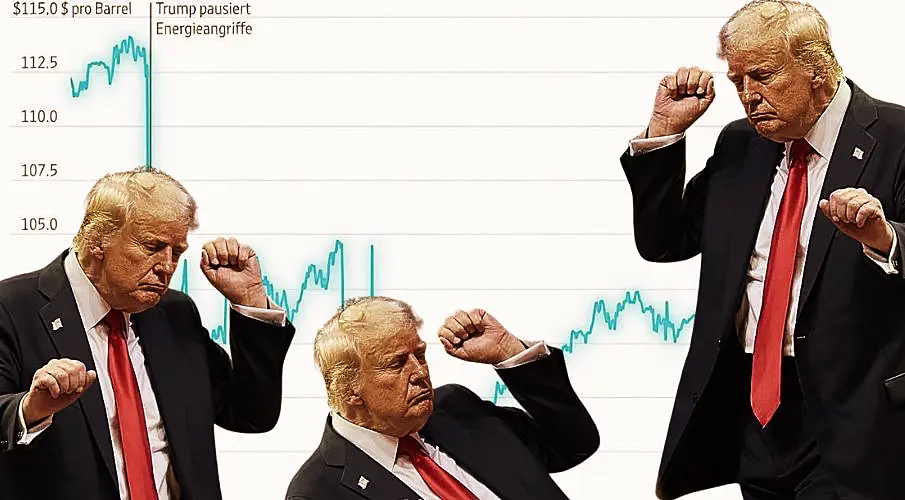
The nervousness is back, but this time it feels different. For weeks, prices held surprisingly steady, even as missiles flew and drones moved through one of the most sensitive energy regions in the world. Now that calm is visibly breaking. The S&P 500 has fallen for five consecutive weeks and is at its lowest level since August. The Dow Jones and Nasdaq have each lost more than ten percent from their recent highs. This is no longer a short term reaction, but a clear shift in sentiment.
The markets are no longer trading on hope, but on risk. What was previously ignored is moving to the forefront. The war with Iran is no longer seen as a limited event, but as an open scenario with global consequences. Even signals from Washington are no longer enough to counter it. When Donald Trump hinted at possible ways out of further escalation on Friday, oil prices remained unmoved. For traders, this is a clear sign: words are losing their impact, facts are gaining weight.
At the Pentagon, it is being reviewed whether up to 10,000 additional troops should be sent to the region. At the same time, talks with Tehran are ongoing. This mix of military preparation and diplomatic engagement creates uncertainty, not relief. Investors are responding by pulling back. They are reducing risk and drawing on experience from past conflicts, from the Iraq War to the Russian invasion of Ukraine.

Dan Alamariu, chief geopolitical strategist at Alpine Macro, puts it succinctly: the real panic is yet to come. Markets cannot calculate panic because by definition it is irrational. That is exactly what is now becoming visible. The movements are no longer cleanly explainable, but follow a sense that something is building. The decisive factor is oil. The Strait of Hormuz is effectively blocked. Iran reports restrictions for ships from countries considered supporters of the United States or Israel. At the same time, data from MarineTraffic shows that even large cargo ships are turning around. Two vessels from China’s Cosco Shipping were turned back on Friday. Traffic through the strait, through which around ten million barrels of oil flow daily, has been reduced to a minimum.
This makes energy the central lever of this conflict. The United States is trying to stabilize prices. Iran is acting precisely there to build pressure. For the markets, this creates a tension that can no longer be politically categorized. Max Meizlish of the Foundation for Defense of Democracies sees advantages for Washington in the information battle, but that matters little on trading floors. Traders are paying less attention to statements and more to troop movements, tanker positions and actual supply volumes.
Oil prices are not rising because of headlines, but because reality is asserting itself. Producers are already securing higher profits for the coming months, but are deliberately holding back reserves. No one seriously believes this conflict will be over in a few weeks. On Friday, Brent crude reached 112.57 dollars per barrel, the highest level since July 2022. At the same time, oil prices and stock markets are moving almost in mirror opposite directions. In twelve of the last thirteen trading days, one went up while the other went down. This inverse dynamic shows how strongly energy is currently setting the direction.
The losses in the stock markets are accordingly significant. The Dow Jones fell by 793 points, a decline of 1.7 percent. The Nasdaq lost 2.1 percent, the S&P 500 also 1.7 percent. Five consecutive weeks of losses were last seen when the war in Ukraine shook the markets. At the same time, demand for hedging against further losses is increasing. Options betting on falling prices are in greater demand. An indicator called skew, according to Citadel Securities, is at one of its highest levels in the past five years. Investors are no longer expecting stability, but further setbacks.
The economic starting position in the United States is actually solid. But without a clear development in the conflict and without stabilization of energy prices, the foundation for rising markets is missing. Mark Hackett of Nationwide sees exactly this as the problem. As long as these two factors remain unresolved, any recovery remains fragile. Attention is now turning to details that previously played little role. Satellite images of tankers, inventories of oil and gasoline, supply chains of individual regions. Many tankers have already delivered their cargo. New deliveries are not coming. The buffer that has so far cushioned price spikes is disappearing.
The consequences extend far beyond the energy market. Inflation expectations are rising again, and rate cuts are moving further away. In the United States, the average gasoline price, according to AAA, is around four dollars per gallon. This primarily affects low income households, but increasingly also wealthier groups whose assets are heavily tied to the stock market. A survey by the University of Michigan shows that economic sentiment deteriorated noticeably in March. Particularly striking is the decline among higher income groups. There, the drop in stock markets directly affects the sense of security.
The markets have thus reached a point where multiple risks are reinforcing each other at the same time. Energy prices, military decisions, disrupted supply chains and growing skepticism toward political statements are intertwining. The phase in which investors relied on quick solutions is over. Now the assessment is how long this conflict will last and how deeply it will impact the global economy.
Updates – Kaizen News Brief
All current curated daily updates can be found in the Kaizen News Brief.
To the Kaizen News Brief In English


Danke für die tiefgehende Hintergrunddarstellung.
gerne und vielen dank
Solch Zusammenhänge, gut recherchiert und erklärt, sind so wichtig.
Aber sie erreichen weder MAGA, AfD und sonstige Extremisten.
Die Weltwirtschaft ist extrem eng verzahnt.
Man kann solch Probleme bicht isoliert betrachten.
Aber das begreift Trump nicht.
Er tanzt und verweist auf die „Goldene Ära“ in den USA.
Seine Sekte, die MAGA, glaubt und folgt ihm.
Trotz hohem Benzinpreis, teurere Lebensmittel.
Das ist die Schuld der Demokraten.
Trump wird es natürlich gerade biegen.
Bis dahin sterben US-amerikanische Soldaten in einem unnötigen Krieg.
Wissen Familien in den USA nicht, wie sie morgen Essen auf den Tisch bringen sollen
Verlieren Farmer ihre Ranches.
Dennoch hat Trump immer noch gut 38% der US Amerikaner hinter sich.
Quasi 1/3 😞
👍