
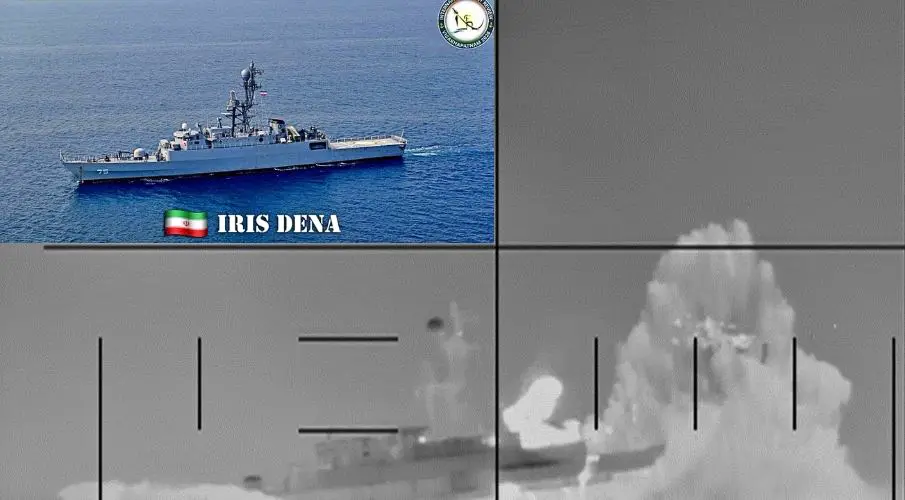
The war between the United States, Israel and Iran has reached another threshold. An American submarine sank an Iranian warship with a torpedo in the Indian Ocean. US Defense Secretary Pete Hegseth confirmed the attack at the Pentagon. According to him, it was the first attack of this kind against an enemy warship since World War II. The ship sank off the coast of Sri Lanka. The navy of the island state reported that at first only oil traces and life rafts were visible on the water when their ships reached the location. Survivors were found drifting in the sea. Later authorities confirmed that 32 people could be rescued. At the same time 87 bodies were recovered.
The chairman of the US Joint Chiefs of Staff, General Dan Caine, explained that an American attack submarine had sunk the Iranian frigate Dena with a single Mark 48 torpedo - the first torpedo attack by the US Navy against an enemy warship since World War II. President Donald Trump also said that one of the central goals of the American military strategy is the destruction of the Iranian navy. Dena mit einem einzelnen Torpedo vom Typ Mark 48 versenkt – der erste Torpedoangriff der US-Marine auf ein feindliches Kriegsschiff seit dem Zweiten Weltkrieg. Präsident Donald Trump sagte zudem, eines der zentralen Ziele der amerikanischen Militärstrategie sei die Zerschlagung der iranischen Marine.

The attack is directly connected to the ongoing military offensive by the United States and Israel against targets of the Iranian security apparatus. While American and Israeli forces carry out airstrikes against military infrastructure, Iran responds with missiles, drones and attacks on regional energy supplies. Pete Hegseth said the United States would deploy additional forces to the region. Fighter aircraft and bombers are already on their way. At the same time he made clear that Washington is under no time pressure. The United States will take “as much time as necessary to succeed.”
The chairman of the American Joint Chiefs of Staff, Dan Caine, said that American ammunition stocks are sufficient. At the beginning of the operation especially precise weapons were used. Now the military is increasingly turning to conventional bombs after American and Israeli forces achieved control over large parts of Iranian airspace. The conflict is developing simultaneously on several levels. In Israel sirens have been sounding repeatedly for hours. In Jerusalem, Tel Aviv and in the north of the country drones and missiles have been reported. Some of the attacks come from Iran, others from Lebanon. Hezbollah entered the war already at the beginning of the week with rockets and drones, to which Israel responded with airstrikes in Lebanon.
Other states are also increasingly drawn into the vortex of the confrontation. An Iranian ballistic projectile approaching Turkish airspace was intercepted by NATO defense systems before it reached the country. The Turkish Ministry of Defense confirmed the interception. Debris fell in Hatay province near the Syrian border. The list of affected states continues to grow. Impacts or debris have now been recorded in Israel, Saudi Arabia, Kuwait, the United Arab Emirates, Jordan, Qatar, Iraq, Bahrain, Syria, Oman, Cyprus and now also in Turkey.
The war is also reaching deeply into the global economy. The Strait of Hormuz, through which about one fifth of global oil trade is transported, has practically come to a standstill. Shipping data shows that tanker traffic through the strait has declined by about ninety percent. Shipping companies are avoiding the route out of fear of attacks. The consequences are immediately visible. Oil prices have risen sharply. Stock markets worldwide are reacting nervously because rising energy prices could further burden the already fragile global economy.
The energy sector itself is also becoming a target. The state company QatarEnergy declared “force majeure” for its supply contracts because of the war situation and temporarily halted the production of liquefied natural gas. Earlier Iranian attacks on facilities in the industrial centers of Ras Laffan and Mesaieed had been reported. The Iranian Revolutionary Guards responded with the sharpest threat since the beginning of the war. In a statement on state television it said that the attacks on Iran would lead to the “complete collapse of the military and economic infrastructure of the region.”
At the same time it is becoming clear that Iran is also under pressure. Western security officials assume that at the current launch rate the country has only a few days of larger stocks of operational ballistic missiles remaining. The number of attacks has already declined. It is also possible, however, that Iran is deliberately holding back part of its stockpiles. Another sign of escalation is the digital isolation of the country. The organization NetBlocks reports that Iran has been practically without internet connection for around four days. According to its data network activity is now only about one percent of normal levels. The government had already ordered a similar shutdown during the nationwide protests in January.
The war is already demanding a high price. According to Iranian authorities more than a thousand people have been killed. American losses have also become known. Six American soldiers were killed in an Iranian drone attack on an operations center in a civilian port in Kuwait. Military cooperation between the United States and Israel is meanwhile running at full speed. An Israeli military representative spoke of four to five thousand coordination calls daily along the military chains of command of both countries. Planning for the first wave of attacks had already begun three weeks before the start of the operation.
While military planners talk about targets, ammunition and the duration of operations, international concern about the legal and political consequences of this war is growing. Canadian Prime Minister Mark Carney warned that the world order is coming increasingly under pressure. States are acting more and more without regard for international rules and laws, he said during a speech in Sydney. The influential Shiite cleric Ali al Sistani in Najaf in Iraq also sharply condemned the attacks on Iran. To attack a state militarily without the consent of the United Nations is a violation of international law, he declared. Such a war would bring chaos and instability across the entire region.
While politicians warn and generals plan, the conflict continues moving toward an open regional confrontation. The sunken warship in the Indian Ocean is only a single incident in a war that has long been spreading across borders. The question is no longer whether the war will grow larger. The question is how many countries will still be drawn in.
Updates – Kaizen News Brief
All current curated daily updates can be found in the Kaizen News Brief.
To the Kaizen News Brief In English


Das klingt jetzt vielleicht zynisch, aber da der Iran seine Drohnen jetzt selbst braucht, können sie keine mehr an Russland liefern. Gut für die Ukrainer, vielleicht 🤔
zynisch, aber im Kontext nicht abzustreiten
Im indischen Ozean, ininternationalen Gewässern.
Einfach ein iranisches Kriegsschiff versenkt.
Solche Angriffe gibt es im Krieg!
Nicht, wenn man mit einem Land bicht im Krieg steht.
Es gibt keine UN Charta die all die Angriffe legitimiert.
Aber das interessiert die USA nicht.
Sie bombardieren mit Israel den Iran.
Der Süden des Libanons ist Ziel.
Immer mehr Länder werden hineingezogen.
Angriffe, Opfer, Schäden.
In 4 Wochen wird Trump verkünden, dass er die Mullahs besiegt hat, das iranische Volk befreit und die Region befriedet hat.
Ach ja und das er dafür den Friedensnobelpreis verdient.🤬
ja, dem ist kaum etwas hinzuzufügen, was hier als notwendiger krieg verkauft wird, ist ein klarer verstoss gegen das völkerrecht, auch wenn das regime im iran menschenverachtend war und ist