
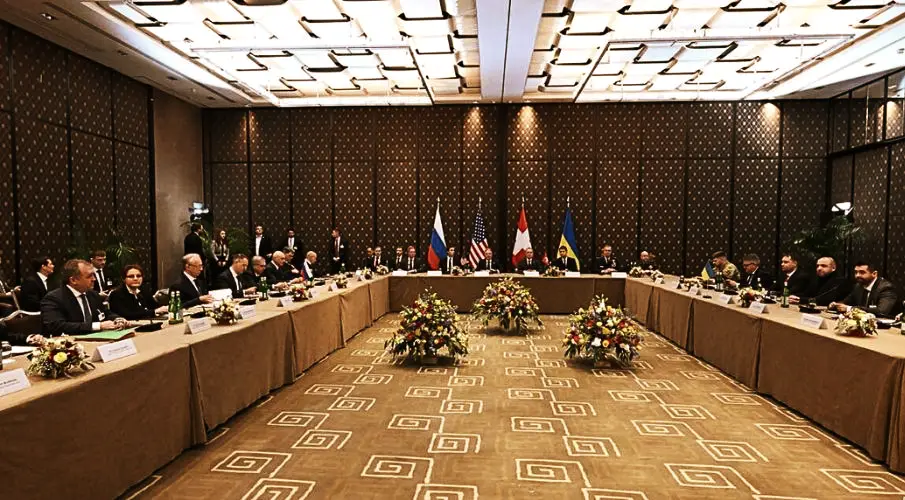
Delegations are once again seated at a table in Geneva, and yet almost everything suggests that the distance between the positions has hardly narrowed. Ukrainian and Russian representatives began a new round of talks on Tuesday, mediated by the United States and scheduled to continue through Wednesday. It is already the third meeting in this format within about three weeks. Officially, the talks are again described as "constructive," just as after the two previous rounds in the United Arab Emirates. That is no longer credible. The sober outcome then was an exchange of prisoners of war. Nothing more. While negotiations take place in Geneva, the war continues, and the facts on the ground are driving expectations downward.
On Tuesday alone, Ukraine reported a massive attack on its energy system: nearly 40 missiles and around 400 drones are said to have been deployed. The country is on the verge of entering its fifth year of war. Russian strikes on the power grid are not a side issue, but the deliberate continuation of a strategy aimed at daily life, supply, and the functioning of the state. That is precisely why every conversation about peace sounds hollow as long as the decisive questions are not addressed or are only "addressed" in a way that buys time.
The central lines of conflict are clear. Russia demands that Ukraine cede the part of the eastern Donetsk region that Kyiv still controls. It concerns an area of about 2,000 square miles, roughly the size of Delaware. For Moscow this is not one of many demands, but a matter of principle. For Ukraine, this is precisely what has so far been unacceptable. President Volodymyr Zelensky warned immediately before the talks began against letting the aggressor "take something." That is not merely a phrase, but a red line charged with domestic political and historical weight. At the same time, Kyiv knows that a war that drags on continues to wear the country down. In recent months Zelensky has repeatedly suggested that there could be forms of compromise thinking, without uttering the word cession. At one point the idea of a demilitarized zone in the Donetsk region was floated, in which both sides would pull back to the same extent. Such approaches reveal the dilemma: Ukraine is seeking ways to stabilize the front without surrendering its state integrity.
The second major block is at least as explosive: security guarantees after a possible ceasefire. For Ukraine this is insurance against a repetition of the war. For Russia it is the point at which any deal becomes a question of spheres of influence. Moscow demands that guarantees not include Western troops in Ukraine. Kyiv is pressing for the United States to work seriously on precisely these guarantees. This is exactly where many in Ukraine mistrust the talks: A ceasefire without credible safeguards would in this logic be merely a pause that Russia could use.

The composition of the delegations reinforces the skepticism. On the Ukrainian side, Rustem Umerov, secretary of the National Security Council, is leading the talks. At his side are senior representatives, including military leaders from Zelensky’s inner circle. Across from them sits the Russian delegation, including Vladimir Medinsky, a close Kremlin adviser who has previously served as chief negotiator. His return is a signal. Medinsky is regarded as someone who does not see negotiations as a path to mutual concessions, but as a stage for a hard line, accompanied by historical lectures and the message that Russia can "fight as long as necessary." He was not present in the talks of recent weeks; at that time Russian representatives from the security apparatus and military intelligence were involved. Ukrainian officials described the atmosphere then as more factual, less shaped by ideological speeches, more focused on technical issues. Now, as territorial questions are apparently more central in Geneva, Medinsky is back. The Kremlin made no secret of it: The focus has shifted, therefore the "chief negotiator" is needed.

The role of the United States also appears unusual, and therein lies another part of the political sensitivity. Instead of classic diplomacy, a duo from Trump’s inner circle has moved to the forefront: Steve Witkoff, a special envoy, and Jared Kushner, Trump’s son in law, without an official government post. On the same day in Geneva, both first held talks with Iran and then shifted to the Ukraine file. It is the visible result of a line pursued in Washington for months: The State Department and the National Security Council are not treated as the center of crisis management, but pushed to the margins. This is not a matter of style, but changes the way negotiations are conducted, with what priorities, with what institutional memory, with what oversight.

The reasoning from the government’s circle is roughly this: One needs "deal makers," not bureaucracies. The tone is transactional, less legal and values based, more oriented toward deals. That is precisely what states that are unimpressed by Western lectures on values welcome. Russia, for example, appreciates that Witkoff presents himself as friendly and enthusiastic, even though in the Kremlin there are at the same time doubts about how reliable his role as a messenger is and how deep his understanding of the fault lines runs. Kushner, in turn, is considered in Russian circles to be more structured. Still, this style of negotiating creates a new problem that cannot be smoothed over. The more informal the structure, the greater the risk of vagueness, side arrangements, conflicts of interest, unclear responsibilities.
These questions become sharper when one considers that both - Witkoff as well as Kushner - operate in areas where economic interests and geopolitical talks are close to one another. Witkoff’s son runs a Trump aligned crypto company; an investor from the Emirates is said to have taken a stake. Kushner, after Trump’s first term, raised billions from abroad, including from sovereign wealth funds in Saudi Arabia, Qatar, and the Emirates, states that also play a role in the current crises. Supporters say that those who are wealthy are harder to buy. Critics say that those embedded in such entanglements never negotiate in a vacuum.

European representatives are also present in Geneva: from the United Kingdom, France, Germany, and Italy. Yet according to all that is known, they are not negotiating directly with the Russian delegation. That is more than a footnote. The war is taking place on European soil, yet Europe is pushed to the margins while Washington leads the process. This not only weakens European agency, it also shifts responsibility: Who is to provide guarantees, who is to pay, who is to secure the long term outcome. If Europe is barely involved in this form, the debate over burdens will be all the harsher later. The decisive question will be when Europe pushes back against being sidelined in the negotiations. At the same time this reveals how weak or divided many governments currently appear. Such phases of political weakness have in history not infrequently led to changes of power, and only few of those later found a place on the right side of the history books.
Behind all of this stands a strategic logic that looks different in Moscow and in Tehran, but has a common denominator: time. Russia has reasons to remain in talks without delivering. Those who believe they are winning rarely sign quickly. Russian leadership circles apparently assume that the slow territorial gains at the front, combined with attacks on infrastructure and the wear on Ukrainian society, improve their negotiating position. Every week without an agreement can from Moscow’s perspective be an advantage if it creates additional leverage. The problem in the Ukraine question is that Washington is not increasing military pressure in the same way, but in part reducing it. Direct supply of weapons to Ukraine has been slowed. At the same time pressure is being applied elsewhere, for example through measures against the Russian shadow fleet in oil trading and through the idea of offering economic rapprochement or investment if a deal can be announced. This is a risky mix: less support for Kyiv on the battlefield, combined with the expectation that Ukraine will yield on political questions, while Russia uses the advantage of time.
In Ukraine the impression is therefore growing that pressure is distributed unevenly. Ukrainian officials speak of Washington wanting to see concessions in order to be able to present a conclusion by early summer. Russia, in this logic, must above all do one thing: remain at the table, appear friendly enough not to be seen as a blocker, and at the same time continue to apply pressure in the field. That Ukraine is trying to raise the costs of Russian advances is evident in local counterattacks, for example along natural barriers such as river lines in the east, where Ukrainian units are said to have recently regained positions. These are tactical successes. They do not replace strategic safeguards.
In the end there is a truth that no one in Geneva needs to say aloud, because it resonates in every line: The greatest distance lies not between formats of talks, but between goals. Russia wants territory and influence. Ukraine wants protection and reconstruction without renewed subjugation. The United States wants a deal that can be sold domestically as a success. Europe wants stability, but is not treated as an equal actor. As long as these interests do not openly collide and are cast into concrete, credible agreements, talks remain talks.
And as long as in the same night missiles and drones strike the power grid, Ukrainian skepticism remains not cynicism, but experience. Geneva is a place for paper. In Ukraine it is still the winter, the electricity, the water, the air defense, the exhaustion that decide. Anyone who wants peace must work on the points that hurt: territory, guarantees, enforceability, control. Everything else is postponement.
Updates – Kaizen News Brief
All current curated daily updates can be found in the Kaizen News Brief.
To the Kaizen News Brief In English


Die Ukraine werden von wirklich Allen im Stich gelassen.
Russland bombt und tötet Zivilisten
Die USA wollen Deals, vor allem für Trumps Tasche.
Wieso hakt Niemand in den USA nach, wieso Kushner, nicht gewählt, ohne Regierungsaufttrag diese „Verhandlungen“ führt?
Europa lässt sich an den Rand drängen.
Die Empörung dazu hält sich in Grenzen 😞
Und das Die Gespräche für die USA kein solch Gewicht haben, sieht man daran, dass im Akkord auch mit dem Iran verhandelt wird.
Trump bekommt seine Deals… entweder mit der Ukraine oder eben mit Russland.
Ich habe keine Lösung für die Ukraine.
Und diese Hoffnungslosigkeit für die Ukrainer ist furchtbar 😞
…bei der politischen lage wird es kaum eine lösung geben, weil keiner ein zulassen möchte …und daher ist der weg russland zu sanktionieren, das es kracht