
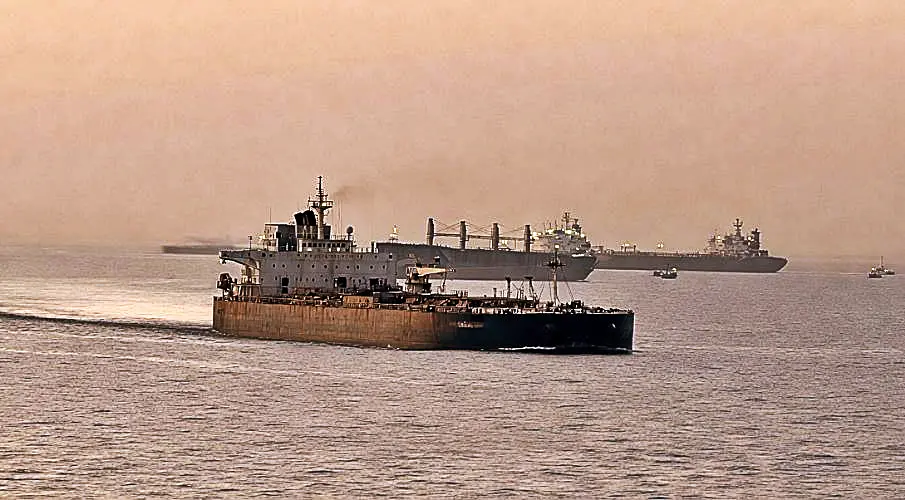
The numbers are laid out in the open, and that is exactly where the problem lies. Since the announcement of the ceasefire, Iran has fired at commercial vessels nine times, seized two container ships and attacked US forces more than ten times. General Dan Caine deliberately does not classify any of this as major combat operations. The line is clearly drawn: as long as a certain threshold is not crossed, the war is officially considered frozen.

Pete Hegseth confirms this interpretation at the Pentagon without any limitation. The ceasefire has not ended. At the same time, US forces are described as ready for action, while more than 100 military aircraft circle the Strait of Hormuz around the clock. More than 1,550 ships with about 22,500 seafarers are stuck in the Persian Gulf, unable to pass the route. Traffic is blocked, the economic consequences are already unfolding.
Washington is trying to force movement with a new security zone. Under the name Project Freedom, ships are to be guided along a southern route through Omani waters. Iran does not accept this. Analyst Torbjørn Soltvedt describes the situation soberly: without an agreement between the United States and Iran or without a significant weakening of Iran’s attack capabilities, the strait will not reopen. Insurers and shipping companies are waiting, no one wants to take the risk.

At the same time, Tehran is maintaining its own system. Anyone using the northern route must submit to inspection and in some cases pay fees, monitored by the Revolutionary Guard. This creates a situation in which two competing transit models exist side by side, both with political weight and military backing.

Meanwhile, the situation in the region continues to escalate. The United Arab Emirates report attacks with missiles and drones, a fire at a major oil facility, injured civilians. Two cargo ships are burning off the coast. India condemns the attacks, Pakistan and Saudi Arabia follow. Abbas Araghchi openly warns against being drawn into another war.
Read also our article: Sirens over the Gulf - how Hormuz is becoming an open battlefield
Diplomatically, everything remains stalled. Emmanuel Macron announces a conversation with the Iranian president and calls for an end to all hostilities as well as the full reopening of the Strait of Hormuz without fees or leverage. At the same time, Iran in its proposal demands an end to the US blockade, the withdrawal of troops and the lifting of sanctions, without making its nuclear program part of the negotiations. Donald Trump expresses skepticism that an agreement can emerge from this.
Domestically, the situation is also intensifying. Marco Rubio travels to Rome and the Vatican to ease tensions with Pope Leo XIV. Trump publicly accuses the pope of endangering Catholics and indirectly supporting Iran. In fact, Leo is calling for negotiations and criticizing threats against civilians.

At the same time, Hegseth maintains the justification for new strikes. Despite earlier bombardments, Iran’s intent to build a nuclear weapon is said to have remained. The timeline for a possible nuclear program is still estimated at nine to twelve months, even after the attacks.
At present, the situation is one that is neither peace nor open war. Attacks are taking place, ships are being stopped, soldiers are on standby, yet officially everything is considered controlled. This construct allows Washington to keep the conflict politically contained while remaining militarily present. For the region, this means stagnation under tension. Any movement can tip the balance.
Updates – Kaizen News Brief
All current curated daily updates can be found in the Kaizen News Brief.
To the Kaizen News Brief In English


Der Krieg, der gerade keiner ist… Auf dem Papier.
Eine Waffenruhe, die löchriger als ein Schweizer Käse ist.
Hauptsache man umgeht die Zustimmung vom Kongress.
Wenn Oman mit den USA eine südliche Route akzeptiert, kann das dazu führen, dass der Oman mehr zum Ziel wird.
Ob und wie es womöglich weiter eskaliert kann man mit diesen unberechenbaren Beteiligten nicht voraus sagen.