
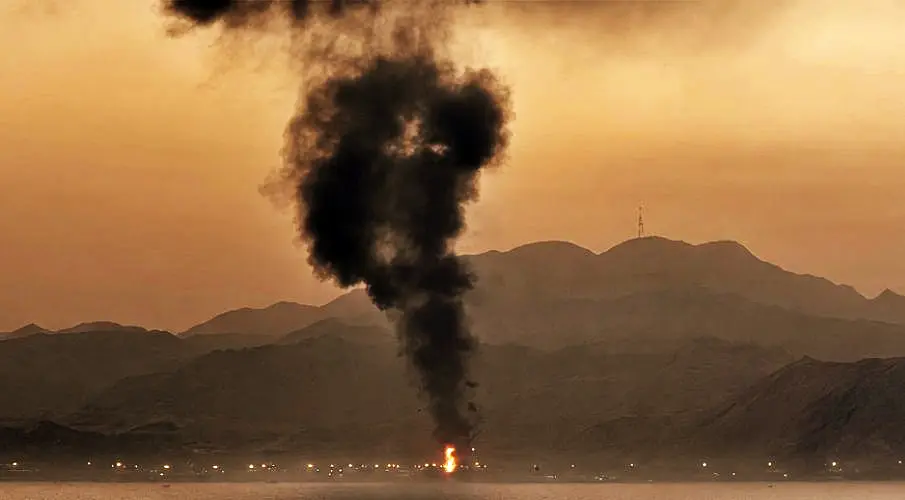
In the Persian Gulf, the situation is visibly tipping and no longer gradually. In the United Arab Emirates, sirens sound multiple times, the airspace is almost completely empty by evening, while warnings of drone attacks are issued. In Fujairah, an Iranian drone strikes a central oil facility, a fire breaks out, three Indian workers are injured. Shortly after, the British military reports a cargo ship off the coast of the Emirates with its engine room on fire, the crew remains unharmed. At the same time, further missile warnings are triggered without authorities initially explaining what exactly has happened. Minutes later, the all clear follows. This sequence alone shows how unstable the situation has become.

On the water itself, a military confrontation is unfolding in parallel that can no longer be hidden. Admiral Brad Cooper, commander of US Central Command, publicly states that Iran has used cruise missiles, drones and fast boats against commercial vessels under protection of the US Navy. Every single threat has been repelled. Six Iranian boats that were deliberately targeting civilian ships were sunk by US helicopters. At the same time, the US military establishes a secured corridor through the Strait of Hormuz, which according to its own statements is free of Iranian mines. Above this corridor is a military shield of fighter jets, helicopters and warships intended to secure traffic.

This operation is running under extreme pressure because the Strait of Hormuz is one of the most important lifelines of the global economy. Around twenty percent of global oil and gas transport passes through this route. Any disruption has immediate effects on energy prices, supply chains and availability. Iran is deliberately using exactly this pressure. Control over traffic through the strait is being used as a strategic tool to maintain influence over the global situation despite military inferiority.

The Iranian side is holding its line and intensifying its threats. General Ali Abdollahi states on state broadcasting that any foreign military presence, especially that of the United States, attempting to enter the Strait of Hormuz will be attacked. Ships must coordinate with Iran, anything else will be treated as a hostile act. At the same time, Tehran is signaling through its own maps and statements that it views the region as a controlled space in which it sets the rules.

While shots are already being fired at sea, a diplomatic effort is unfolding in parallel to influence the situation. Mike Waltz, US ambassador to the United Nations, announces that the United States, together with Bahrain and other Gulf states, is preparing a resolution in the Security Council. Iran is to be required to immediately stop laying mines, disclose already placed mines and end all transit fees. The demands directly address Iran’s current practice of allowing ships to pass only under conditions. How this resolution is to be enforced remains unclear. A comparable initiative was blocked by China and Russia just weeks ago.

Saudi Arabia and the United Arab Emirates stand behind this line because their own economic existence is directly affected. Their oil and gas exports depend on open sea routes. At the same time, the Emirates condemn attacks on civilian targets as a dangerous escalation and explicitly reserve the right to respond. This makes clear that the conflict is no longer limited to two states but has spread across an entire region.
In Oman, a residential building for workers in the coastal town of Bukha was struck on Monday. According to the defense ministry, two foreign workers were moderately injured, four vehicles were damaged and windows of a nearby house were shattered. The building belongs to a company in the Tibat district on the Musandam peninsula, directly at the southern edge of the Strait of Hormuz. Authorities have so far named no cause and no responsible party, an investigation is underway. This brings violence into a region that had previously been on the margins and is now visibly drawn into the dynamics of this conflict.
The United Nations is also reacting, though cautiously. Spokesperson Stéphane Dujarric states that the situation is currently unclear and that there are conflicting reports. Reports of shelling and missiles are concerning. At the same time, he warns against a return to open hostilities and recalls a principle that has applied in this region for centuries. Freedom of navigation. That principle is now at risk.
Donald Trump is pushing his line forward at the same time. He publicly calls on South Korea to join the mission in the Strait of Hormuz. The trigger is the attack on the South Korean cargo ship HMM Namu, which came under fire in the strait. This fully internationalizes the conflict. It is no longer only about American or regional interests, but about the security of global trade routes used by industrial nations such as South Korea. At the same time, the United States is further increasing its military presence and is already escorting commercial vessels through the region.
At the same time, massive economic pressure is building in the background. Since mid April, the United States has enforced a blockade of Iranian ports and forced numerous commercial ships to turn back. These measures directly hit Iran’s oil exports and cut off urgently needed revenue. At the same time, pressure on global energy prices is rising. Europe and Asia feel the effects immediately because they depend heavily on supplies from the Persian Gulf.
Israel is closely monitoring developments and remains on heightened alert. Military authorities are tracking the situation in the Gulf without tightening rules for the domestic population. This also shows how tense the situation is without any clear next step emerging. Everyone is waiting, no one controls the full course.
There is also a second layer that repeatedly creates new momentum. Iranian media report attacks on US warships, while American officials reject these reports. At the same time, it becomes known that US forces are stopping, escorting or forcing Iranian ships to turn back. Pakistan is organizing the evacuation of crews from seized vessels and at the same time trying to restart talks between both sides. Even such measures, intended as confidence building, show how deeply the conflict is already affecting international processes.
And that is exactly where the real danger lies. The situation is not a single conflict, but several layers at once. Military attacks, political initiatives and economic pressure are intertwined. Every reaction on one level triggers reactions on the others. An incident, a misinterpreted attack or a miscalculation can be enough to further escalate the situation.
The Strait of Hormuz is therefore no longer a normal sea route. It has become a place where multiple states act simultaneously, interests collide and every decision has immediate global consequences.
Updates – Kaizen News Brief
All current curated daily updates can be found in the Kaizen News Brief.
To the Kaizen News Brief In English


Ich komme kaum noch mit 😞
Jeden Tag etwas Neues, teilweise im Widerspruch zum Vortag.
Es passieren Schiffe, es werden Schiffe angegriffen.
Trump droht und eskaliert.
Iran bleibt ebenfalls hart.
Die Anreiner schauen mehr oder weniger zu.
Verurteilen die Zngriffe, werden selber aber nicht tätig.
Eine furchtbare Situation für alle betroffenen Menschen 😞