
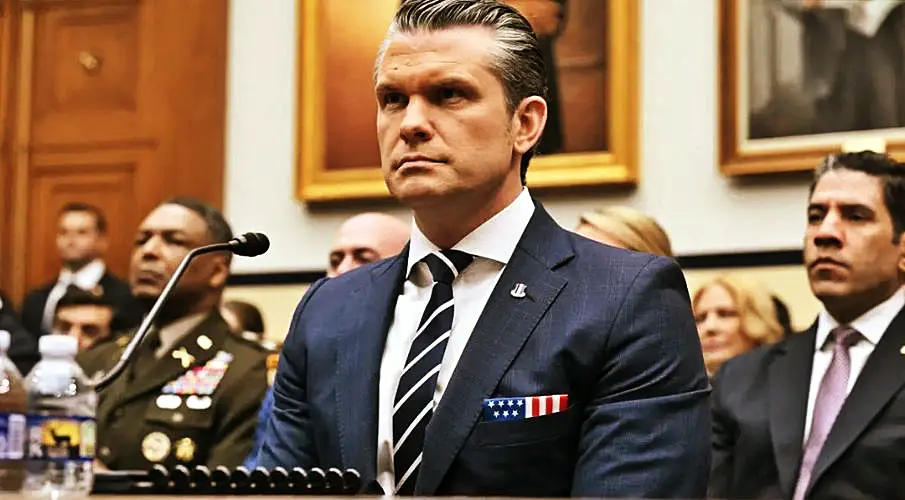
The hearing before the Armed Services Committee lasted more than four hours. With each additional round, it became clearer what was missing. Pete Hegseth did not answer key questions. He deflected, interrupted, reacted irritably. When Democratic Representative Chrissy Houlahan asked him how long the operations against Iran would continue, there was no concrete answer. Hegseth said they would not give an adversary timelines. When asked what additional financial burdens were expected, there was no response. The question remained hanging in the room.
Then the focus shifted to the dead. Six American soldiers stationed in Kuwait were killed by an Iranian drone. Pat Ryan asked the question at the center of it all: was it known that this location was at risk. Was it a target. Were soldiers sent there even though the risk was known. Ryan quoted survivors who said they were not prepared, that they did not have sufficient defenses against drones. Hegseth responded evasively. He spoke of protective measures, of daily remembrance of the fallen. There was no clear assessment of the allegations. When Ryan pressed further and asked whether the surviving soldiers were lying, the moment visibly escalated. Hegseth began to respond, was interrupted. Ryan cut him off and accused him of implying exactly that.
RYAN: Are you saying that these soldiers, our soldiers who survived this terrible attack, are lying?
HEGSETH: Before the conflict began …
RYAN: I reclaim my time. Stop. You just said that what they said is wrong.
HEGSETH: This is about a much bigger overall picture.
Another issue remained unresolved. The attack on a school in Iran in which more than 165 people were killed, many of them children. Two months after the attack there is still no final explanation. Ro Khanna confronted Hegseth with the consequences of that strike and asked how it could have happened. Hegseth stayed on message, saying the incident was under investigation. He refused details, referred to ongoing inquiries, and declined any assessment. At the same time, he emphasized that the US military does not target civilians.

The military situation was also addressed, more concretely than before. Several lawmakers wanted to know how prepared the armed forces were for drone attacks. The background is that Iranian drones reached targets despite existing systems. General Dan Caine said there are clear procedures by which soldiers review and execute orders. He spoke of established processes and checklists. He did not address the specific question of how effective the defenses actually were and why drones got through.
The pressure did not come only from Democrats. Republicans also spoke up. Don Bacon openly criticized the dismissal of several senior military leaders. Austin Scott questioned the decision to remove General Randy George. Both made clear that these decisions have not only political but also military consequences. Hegseth stuck to a brief justification. The Defense Department needed new leadership. He did not explain why. Repeated follow ups from Chrissy Houlahan also produced nothing concrete.
DELUZIO: Is your guidance that if a foreign enemy is surrendering and laying down their arms, they are to be given no quarter and killed?
HEGSETH: My commanders know exactly what the guidance is for each and every mission.
Another point of conflict ran deeper. Chris Deluzio raised the question of how soldiers should handle orders when there are doubts about their legality. The background is a debate from last year in which lawmakers publicly emphasized that soldiers must refuse unlawful orders. Hegseth replied briefly that soldiers follow lawful orders. There are clear rules for that. A further explanation of how this review works in practice did not follow.
While the hearing was underway, new political signals emerged from the White House. Donald Trump rejected an offer from Tehran to reopen the Strait of Hormuz if the blockade were lifted in return. At the same time, he spoke with Vladimir Putin. Putin offered that Russia could play a role in handling Iran’s enriched uranium. Trump said publicly that he sees that as less of a priority than ending the war in Ukraine.
The atmosphere in the room shifted over the course of the session. Hegseth became increasingly irritated, interrupting questions, deflecting, or answering with counterattacks. Mike Rogers, the committee chairman, eventually intervened and called for a respectful tone. He reminded members that they have their time and can expect answers.
In the end, there was no clear picture of how this conflict is to be carried forward. There were no timelines, no concrete assessment of the military situation, no answer to the question of responsibility. What became visible was something else. A defense secretary who leaves central issues open. A Congress that demands answers and does not get them. And a crisis that continues while the unanswered questions grow.
Updates – Kaizen News Brief
All current curated daily updates can be found in the Kaizen News Brief.
To the Kaizen News Brief In English


Ein Merkmal der Trump Regierung.
Viel reden, aber nichts von Belang sagen
Ausblenden von unbequemen Fragen.
4 Stunden Zeitverschwendung, weil es keine Konsequenzen für Hegseth geben wird.
So läuft es in der Zwischenzeit in den USA.
Anhörungen sind nur noch pure Augenwischerei, weil die Republikaner nichts anderes zulassen.
… und mit beiden tagen 7 stunden, ich müsste schmerzensgeld verlangen