
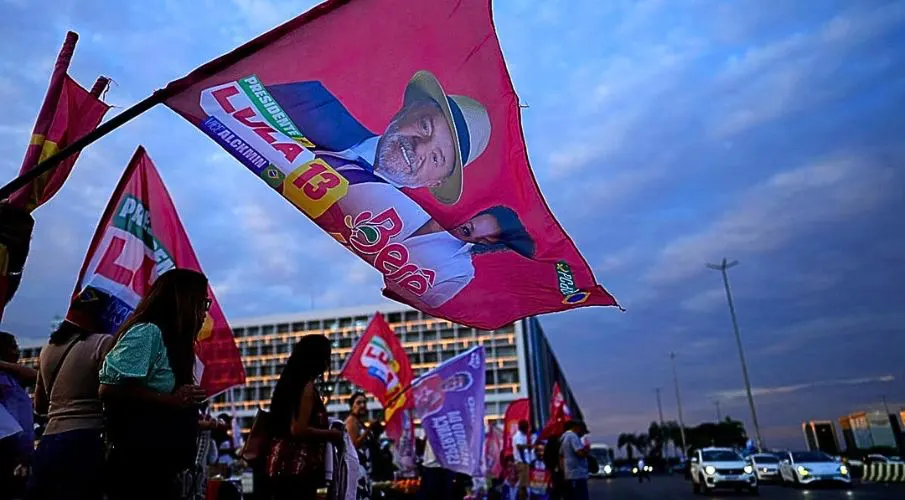
Washington has noticeably stepped up its interference in Brazil’s election. With sanctions and tariffs, the Trump administration is trying to push Flávio Bolsonaro ahead of incumbent President Luiz Inácio Lula da Silva, and it is not holding back on the political messaging either. Flávio is the son of Jair Bolsonaro, the right-wing hardliner who was convicted of treason. And it is precisely this family that is getting the affection from the White House. The irony is laid on thick. A government that calls every election result at home a conspiracy the moment it does not like the outcome is openly fighting in Brazil for the side that already tried once to stay in power through violence. The father was convicted over exactly that attempt, and now the son is supposed to inherit.

This had been prepared for a long time. The administration threatened Brazil with military means. It began classifying Brazilian criminal groups as terrorist organizations. And it sent State Department officials into the country to cast doubt on the election system. The consulate in São Paulo invited pro-Bolsonaro social media influencers to a closed-door roundtable. Interference rarely wears a uniform these days. It runs through reach and algorithms, and the consulate provided the host. A government that complains at home about foreign election interference is practicing it elsewhere on a large scale. Classifying the groups as terrorist organizations was never just a label. It would have given Washington leverage, from sanctions to pretexts for hard intervention, right in the middle of the internal affairs of a sovereign country. Sovereignty ends where a stronger state decides it is negotiable.

On July 17, 2025, Trump did not send Jair Bolsonaro a greeting from Washington. He sent him an intervention. On White House letterhead, the U.S. president threw his support behind the former Brazilian president, called his legal treatment “terrible” and the proceedings unjust. It had to end immediately. Bolsonaro, he wrote, was a strong, respected leader. The sentence sits there like a political blank check. Then Trump tightens the screws. Brazil, he says, is attacking free speech, persecuting political opponents and needs to change course. The fact that he explicitly points to his tariff policy makes the letter especially explosive: personal backing for Bolsonaro and economic pressure on Brasília suddenly sit in the same document. Foreign policy as leverage for a political ally.
The final sentence needs no explanation: “I will be watching closely.” That is hardly presidential language anymore. It reads like a message from a man telling another government that its domestic political decisions may have consequences if they do not suit him.
Bolsonaro’s other son Eduardo made clear just how far that claim goes. He floated the idea that the Trump administration could simply refuse to recognize the result if Lula wins. We know that script from Washington itself, and now Brazil is getting a demonstration of it. The idea that a foreign president would presume to decide whether a Brazilian election is valid would have been unthinkable just a few years ago. The intention is out in the open. Brazil did not want the United States to impose this classification on the criminal groups, said James Green, professor of Portuguese and Brazilian studies at Brown University, because it would have opened the door for the Trump administration to reach deeply into Brazilian domestic politics. Without ever explicitly saying Flávio was its candidate, Washington had made clear through everything it did who it wanted to see elected. It is hard to package partisanship more clearly without simply saying the name out loud.

But the calculation may not work. Pressure from outside rarely produces gratitude in a proud country, more often defiance. Every threat and every tariff reminds voters who is barging into their affairs uninvited. A people being lectured and threatened draws its own conclusions. Many may vote on Sunday less about Lula than about the question of whether Brazil is going to let itself be governed from Washington.
The numbers are against the maneuver anyway. Lula’s approval is around 50 percent, higher than Trump’s numbers on any day of his second term. The man trying to help govern Brasília is less popular in his own country than the man he wants pushed out of office. Even so, a close result is expected, and voting begins Sunday. If Lula wins, Washington may have handed him his best campaign helper: itself.
Updates – Kaizen News Brief
Alle aktuellen ausgesuchten Tagesmeldungen findet ihr in den Kaizen Kurznachrichten.
To the Kaizen News Brief In English


