
On Thursday, Donald Trump traveled to Texas and Oklahoma, two of the safest Republican strongholds in the country, and asked for votes from people who have long been his. “Pretend I’m running, please,” he said in Durant. “If we don’t win, they’ll end up impeaching me.” A president asking his most loyal supporters for help against impeachment reveals more about his situation than any poll ever could.
“Pretend I’m running, please. Just pretend. ’Cause I am on the ballot. And if we don’t win, they’ll end up impeaching me.”
He no longer has to win anything for himself, his name is not on any ballot. Still, he is touring as if everything depended on it. “We have to win in those 35, maybe you could even say 40 places, 40 races,” he admitted, and almost in the same breath: “I feel a little silly. I keep saying go vote, and they’re going to win by a landslide anyway.” Claiming danger and certain victory at the same time requires an audience that does not recognize reality.
The centerpiece of the appearance was a Donald Trump brand promise: $5,000 for every adult American if Republicans hold their majority in November. It got the loudest applause of the night and produced the most expensive line. Those checks would cost the country more than $1.3 trillion. Where would the money come from? From “investment returns,” Trump mumbled before jumping to the next image. “Republicans can do it. Democrats can’t.”


Earlier that day in Denton, at a truck factory, he played the economic savior. “Factories are being built all over the country. Manufacturing is coming back.” Rising wages, tens of thousands of new jobs, a surge in heavy-truck production, he took credit for all of it. Peterbilt, founded in 1939 and the largest manufacturer in the county, had recently hired 1,000 people, while parent company Paccar had hired another 2,000, according to the White House. Company executives dutifully said the growth was thanks to his tariffs.
Last November, Trump imposed a 25 percent import tariff on medium and heavy-duty trucks, against the explicit advice of the U.S. Chamber of Commerce. The country’s 5 largest truck suppliers were all allies and posed no security threat, it had warned. Trump still called the tariff protection from “unfair foreign competition.” To celebrate loosened fuel regulations, he poured a cup of water onto the floor in front of the audience to show how little was lost. “I did it for the trucking industry.”
His numbers only knew one direction. “We have literally the greatest numbers.” More people working than ever before, the lowest poverty in history. That sits badly with the fact that most Americans disapprove of his performance in office, especially because of rising gas and food prices, which are widely blamed on his tariffs and the war against Iran. His presentation ranged from the military operation in Venezuela to the data centers fueling fights over electricity and water in Texas. “These things make a fortune,” he raved, while local residents are expected to shoulder part of the cost.
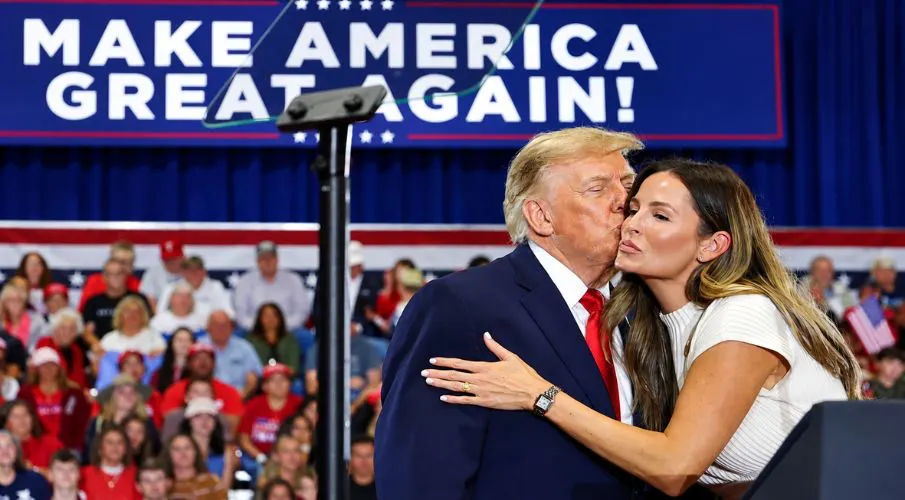
That evening in Durant, inside a casino hall, the campaign turned into a variety show. He played news clips, showed charts about the success rate of his endorsements and brought former basketball star Dennis Rodman to the front. He pulled a young White House aide toward him, praised her looks and loyalty, looked at her parents and said: “She’s a beautiful woman inside and out. Look at this. Her mom and dad are here. Hello, mom and dad. I see why she’s good looking actually, you know, I believe in the racehorse theory. Fast horses, right?” The most powerful man in the country, classifying a woman like breeding stock in front of running cameras. (The video above is 2:14 minutes, be patient or skip ahead)
Dennis Rodman on Trump’s campaign stage: of all people, the former NBA star who has personally known Kim Jong Un for years, publicly called him a friend and even held Kim’s daughter Ju Ae as a baby in 2013. Trump himself said in Denton that Rodman “knows Kim better than anybody.”
Trump had avoided appearances like these for a long time. Between wars abroad and the construction of a White House ballroom, there no longer seemed to be any reason, and his advisers saw no election left for him personally to run. He still goes looking for the applause, as if he needs it like a drug, and the tighter things get, the more urgently he seems to need it.
Trump was most open when talking about one of his own. He called Ken Paxton, his Senate candidate in Texas, “one of the most loyal people” and, to be honest, “a pain in the ass sometimes.” “Is he here, by the way? Oh, there he is. Good. I didn’t even know if he’s here. I don’t care!” In Durant he went further, saying Paxton was “a little controversial, just slightly,” but “the best attorney general in the entire United States of America.” The condescension only gets its flavor from the background. A leaked recording had recently surfaced in which Paxton complained that the Republican midterm convention on September 9 and 10 in Dallas had hurt his numbers. “All the numbers dropped. Right now, not good.” His camp blasted the reporting as “manipulated nonsense.”
Trump: “We will win the war on corruption and fraud.” (Then he should resign - Editor’s note)
“These people came out of Somalia. They stole billions. They robbed us like we’re a bunch of fools. They robbed our country blind.”
He is still needed. Trump’s committee MAGA Inc. has already put $20 million into Paxton, another committee close to Senate leadership plans to spend at least another $100 million, while fellow Republicans such as Senator John Cornyn are refusing to help the scandal-plagued candidate. In the polling average, Paxton trails Democrat James Talarico 45 to 48 percent, and the race is considered open. To paper over the private attacks, Trump played a clip in Durant from a right-wing network in which two supporters said they did not care about Paxton’s comments, then brought the two “studs” onstage. You just wanted to give them a kiss, he added, though of course he was not physically attracted to them.
„The two guys that came up here, I wanted to give them a big kiss, and I’m not at all physically attracted to them, although they’re very handsome people.”„
For the rest of his endorsements, the enthusiasm did not extend all the way through his own ranks. Mike Mazzei, his candidate for Oklahoma governor, got reviews from attendees like “a little goofy” and “a little shady,” held together only by the sentence: “But if Trump trusts him, I have to trust him.” Mazzei himself had previously distanced himself from Trump’s beef imports. Trump nevertheless took credit for getting him into the runoff, saying he “was down by 22 points, and he ended up winning.” For Oklahoma’s open Senate seat, he campaigned for Representative Kevin Hern against Democrat N’Kiyla Jasmine Thomas, whom he smeared as a “socialist.” He endorsed 4 congressional candidates by name. He left out Representative Stephanie Bice, whose district is considered vulnerable and who has also been caught on recordings criticizing the war against Iran and mocking “Trump fatigue.”
In between, Trump sprinkled in local issues. For a planned aluminum smelter in the town of Inola, which has raised environmental concerns locally, he promised a fortune in jobs and went after Canada, which has been “ripping us off for years.” He greeted oil magnate Harold Hamm and the outside group Club for Growth, which had poured money into ads against Mazzei rival Gentner Drummond during the primary. “Where the hell is Byrd?” he shouted, looking for his candidate for state treasurer. “She’s fantastic.” That is how small politics can get when the big issue is missing.

Trump left the harshest rhetoric to his Homeland Security secretary. Markwayne Mullin, a former Oklahoma senator, told the overwhelmingly white crowd that Democrats wanted to destroy the country by letting immigrants in. “They have to create chaos” and “change the demographics.” “That’s how you end up with a communist country.” The response was chants of “USA, USA, USA.” The fact that this administration’s deportation machinery has turned deadly did not come up inside the hall. Immigration officers have shot people across the country, and reports of inhumane conditions are coming out of detention centers. Voters see it anyway. In one poll, most likely voters disapproved of Trump’s immigration policy, including 64 percent of independents, while 52 percent said they trusted Democrats more on the issue.
Trump sold his visit as a thank-you to Oklahoma, which he said had voted for him in all 77 counties three elections in a row. The host was the Choctaw Nation, a major Republican donor that said it had merely rented out the hall. Outside stood Elisa Standridge, a Choctaw citizen. “He’s already been convicted of serious crimes and is being investigated for more,” she said. “We’re red with rage, not Republican.”
The reality outside fell short of the words. Trump claimed another 20,000 people were waiting to get in, the kind of exaggeration that has become routine for him. The 4,900-seat hall was full, but there were no tens of thousands standing outside. Inside, some had spent 9 hours on their feet, one attendee called the evening disorganized and disappointing. Another said everything Trump said was honest and that he loved it. The entire evening sits between those two sentences.

In the crowd stood Teri Tulane, 60, a retired teacher who had been standing in the rain since early morning. She said she was paying more for beef but was happy about cheaper eggs, and on Iran she wanted less restraint. “Wipe ’em out.” Trump served exactly that mood, praising the end of taxes on tips and overtime and selling tariffs and war as gains for the years ahead.
On the military, he praised himself, saying it had been “knocking the hell out of Iran” and that the war would soon be over. The $1,776 checks he sent to service members cost around $2.6 billion and came from money intended for their housing. “I never fail people. I always come through.” He spoke of the previous administration as if it were a hellhole the country could never return to, while claiming the border had gone from the weakest in history to the strongest.

On Friday, the trip continued to Mobile, Alabama, for the first time since 2016 and to the place where his first mass rally had taken place more than a decade earlier. Around 30,000 people were said to have packed a college football stadium back then, proof that the celebrity candidate could become a serious contender. Trump himself gave the reason for returning as he departed. “You have to give back to these states that are 1,000 percent behind you,” he said. “I’m going there because they want to see me.” A president who only travels where he is loved has already written off half the country. Right-wing activist Laura Loomer was aboard Air Force One.
Trump, Harp and Loomer board Marine One. Laura Loomer, a woman who openly spreads conspiracy theories about 9/11, smears George Soros with antisemitic stereotypes and racially attacks Kamala Harris, has risen to become one of the most powerful women in America - not through elections, not through competence, but through the perfect fusion of fanaticism, blackmail and digital violence. She comes and goes at the White House and the Pentagon. Democracy does not die under the roar of cannons, but under the clatter of smartphone keyboards. At the center of this maelstrom sits Laura Loomer, the failed journalist from Westchester whose racism is so blatant that even her own supporters sometimes recoil.
Trump: “A great Republican strategist, a great person, a killer. When she’s angry at you, it’s a very terrible situation, Laura Loomer. Thank you. She’s great.”
Read also our article: https://kaizen-blog.org/en/die-hexenmeisterin-aus-westchester-laura-loomers-aufstieg-zu-einer-der-gefaehrlichsten-frauen-amerikas
The crowd math did not work out here either. The Mitchell Center at the University of South Alabama holds around 10,000 people, but the crowd was counted at roughly 4,500, with rows of empty seats in the upper sections. While the audience waited, of all songs, “Time to Say Goodbye” played, a farewell song, before “God Bless the USA” finally called him to the stage. The fact that this man, who feeds on huge numbers, was performing to a half-full arena in a stronghold says more about his diminished pull than any campaign video.
At every entrance ramp, at every bridge between Sherman, Oklahoma and Durant, Highway Patrol officers stood ready, as if it were not a politician moving through the region but a state ceremony on wheels. Even the rain did not keep his supporters away. The packed parking lot became a trap for that political worship in which barricades, escorts and lies have long since become part of the production.

As the MAGA faithful gathered in Alabama to cheer Trump, Trump opponents protested in Mobile: “Their time is coming to an end.”
Hundreds stood outside, at least 300 students and protesters. Former Senator Doug Jones held his own rally in the city at the same time. Three university students were arrested after allegedly making threats against Trump online. A 22-year-old called the appearance a “last desperate attempt” to boost the morale of Republican voters.

Two buses filled with police officers in full riot gear had arrived on the University of South Alabama campus. Even before Donald Trump showed up, the state had prepared for protest. Anyone who had to gear up like this for a campaign appearance supplied the image along with it: political theater behind police lines.
Inside, loyalty hung on sentences that betrayed their own logic. A 27-year-old from Huntsville said higher prices did not bother him as long as his children were safe and Iran did not get a nuclear bomb. A 73-year-old with “Bikers for Trump” put it even more openly. “We don’t dictate to him and we don’t hold him accountable, even when something goes wrong.” Loyalty without any accountability, that is exactly what this president builds on. Even among the faithful, the cost was starting to bite. A 64-year-old from Citronelle talked about friends being hit hard by record diesel prices. “They love Donald Trump. They just want diesel prices to come down.” Trump must have been a little nervous, he said, otherwise he would hardly be coming to a place where people already still want to see him.
Trump: “The brand new bridge project connecting Mobile and Eastern Shore.... Maybe they’ll name the damn bridge after me. Then I’ll say have all the overruns you want, make it just absolutely make it the greatest bridge in the world.”
The choice of location is its own confession. A tour that begins in deep-red states with barely competitive races and postpones the close contests in Ohio and Texas is not looking for votes. It is looking for applause. The numbers support the suspicion. In a poll this week, only around 3 in 10 American adults approved of his performance in office, while a majority blamed him for rising prices. He brushes aside concerns about costs and gasoline while his unpopular war against Iran drags on.
Inside the arena, Representative Barry Moore, who is aiming for Tuberville’s Senate seat, handled the liturgy. He asked who had already been there in 2015. “Are you still standing with him today? Let him know that we love him, that we need him, that we’re not going to let him down.” What this is really about shows up on the map. Mobile borders Alabama’s 2nd Congressional District, where Democratic Representative Shomari Figures is fighting off a Trump-backed challenger. The district boundaries were redrawn to make them more Republican, part of a broader effort to hold the House. A Supreme Court ruling this year made that possible by severely weakening protections under the Voting Rights Act. Figures was elected in 2024 and gave Alabama two Black members of Congress for the first time in its history.
Trump fantasizes during a rant about sending “the gays” to Palestine. “I don’t even want to say what they do to them over there. Let’s send them.”
The names change, the principle stays the same. Tommy Tuberville wants to become governor and is running against Doug Jones, Moore wants to move up to the Senate. Across the bay, Florida’s Panhandle is hoping for a boost as well, including Representative Byron Donalds, who is also running for governor. The newly approved bridge over the Mobile River, at $3.2 billion the largest transportation project in state history, is supposed to be called the “Donald J. Trump Bridge” under Moore’s proposal. The tribute is already in place before the concrete is dry.
Tuberville: “Can you imagine if your kid would come home one day and say, ‘I’m taking these drugs. And I’m getting ready to have surgery because my teachers and my principal say I can.’”
By November 3, Trump plans to hit 35 places, almost one a day, as his chief of staff Susie Wiles told Republican senators, with Grand Island, Nebraska, next.
He had to get this one out again in Alabama: Trump: “The guy in Texas who is a vegan but now he’s eating meat like a pig. He’s a vegan. He wears a mask. He likes lettuce. Give him a little piece of lettuce and he’s happy. The little guy.” He was talking about Democratic Senate candidate James Talarico of Texas.
What remains from these days is a man traveling through the safest states because the uncertain ones are no longer listening to him. He promises money the budget does not have. He counts crowds that are not there. And he campaigns for a victory for someone who is not even on the ballot. Behind all the cheering stands one sober sentence he said himself. If they lose, they impeach him. Everything else on this trip was noise against that one fear.
Updates – Kaizen News Brief
Alle aktuellen ausgesuchten Tagesmeldungen findet ihr in den Kaizen Kurznachrichten.
To the Kaizen News Brief In English


