
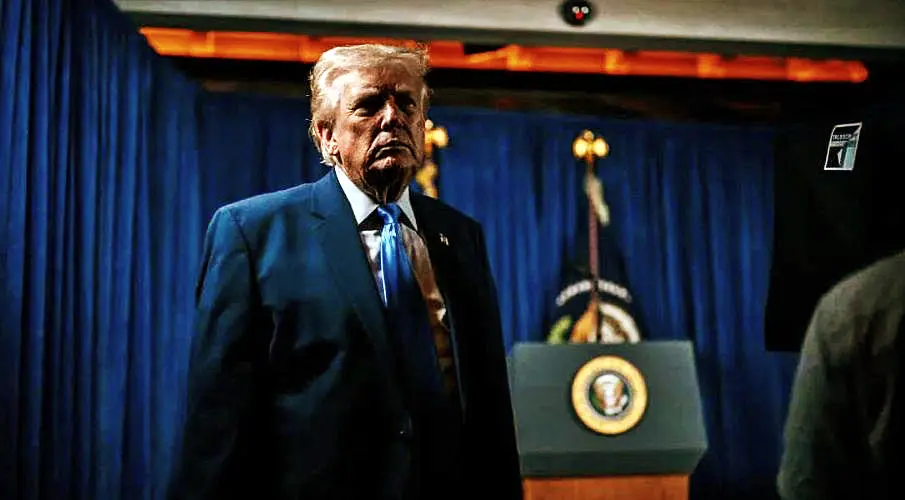
Donald Trump is no longer waging his war against the media merely through insults, exclusions or lawsuits. Behind the scenes, something far more dangerous has long been unfolding. According to information from the Wall Street Journal, Trump personally pressured the Justice Department to target journalists who had reported on internal deliberations surrounding the Iran war. At the center of this stands Todd Blanche - formerly Trump’s criminal defense attorney, now the Attorney General of the United States. According to several government officials, Trump allegedly handed him a stack of newspaper articles after the war began. On a yellow sticky note was written just one single word: “Treason.”

What followed appears like an attempt to place investigative reporting directly under state pressure. The Justice Department reportedly began aggressively pursuing suspected informants - while simultaneously going after journalists themselves. One step against the Wall Street Journal is especially explosive. The newspaper already received grand jury subpoenas on March 4 relating to journalists and their communications data. The background was a February 23 article reporting that General Dan Caine and other military officials had warned Trump about the risks of a prolonged war with Iran. Only five days later, the war actually began.
Dow Jones, the publisher behind the Wall Street Journal, responded unusually sharply. Communications chief Ashok Sinha declared that the subpoenas were an attack on constitutionally protected journalistic work. The company would fight them with full force. Other media outlets had reported similarly at the time. But inside the White House, the anger appears to have focused especially on reports showing how chaotic and internally disputed the decisions surrounding the war allegedly were.
According to government officials, Trump was reportedly particularly enraged over a New York Times report published on April 7. The article described in detail how Israeli Prime Minister Benjamin Netanyahu had pressured Trump to attack Iran. The report outlined discussions inside the White House Situation Room and also described doubts among American intelligence officials regarding Israel’s plans. Trump now apparently no longer views such insights as normal press work, but as a threat.
At this point, the issue is no longer only about informants inside government agencies. Over recent months, the Justice Department has reportedly sent subpoenas to media companies, journalists, phone providers and email services. The apparent goal was to expose contacts between the press and their sources. For decades, very high legal thresholds existed for such actions in the United States. Especially in sensitive leak cases, journalists were supposed to remain protected so investigative reporting on government conduct could continue to exist at all. Former federal prosecutors explain that subpoenas against media organizations were normally used only as a last resort - not merely days after publication.
Bruce Brown of the Reporters Committee for Freedom of the Press therefore openly warned of a dangerous break with previous standards. Theodore Boutrous Jr., a prominent media attorney, declared that such subpoenas directly attack the relationship between journalists and their sources. Yet that exact relationship is necessary for the public to learn what governments are actually doing.
The foundation for the harsher approach had already been laid earlier. Pam Bondi, while serving as attorney general last year, rolled back protections introduced during the Biden administration. Those rules had made it significantly more difficult for prosecutors to pressure journalists through subpoenas or searches. Officially, investigators are still required to exhaust other options first. But under Todd Blanche, that boundary now appears to be eroding dramatically. Blanche himself barely hides his position. He publicly declared that Donald Trump not only has the right, but even the duty, to influence Justice Department investigations. For many former legal officials, that alone represents a massive attack on the agency’s independence.

How far this development has already gone became visible in early April after an American jet was shot down over Iran. Two crew members were temporarily considered missing and a large rescue operation began. Shortly afterward, Trump publicly announced plans to move against media outlets that had reported on the mission. He literally stated that authorities would go to media companies and say: “National security - hand it over or go to jail.” Todd Blanche openly defended that line. If reporters endangered lives through their reporting, then the Justice Department had to act. And if that meant issuing subpoenas against journalists, then that is exactly what they would do.
Particularly alarming is the fact that the Justice Department now apparently seems prepared to go significantly further than before. Already in January, the home of Washington Post journalist Hannah Natanson was searched. The background was a case against an engineer working for a government contractor who was accused of unauthorized possession of classified documents. Several former prosecutors said they were shocked by the action because, in their assessment, authorities already had sufficient evidence against the engineer at that point. A federal judge later halted parts of the seizure and ruled that the court itself would oversee the review of confiscated devices.
A climate is therefore now emerging in Washington that many journalists say reminds them of far darker periods. If reporters must fear that phone records, emails or confidential conversations could suddenly become part of government investigations, then the work of sources inevitably changes as well. People inside government speak less. Tips disappear. Information remains hidden. That is exactly the point American press freedom organizations have been warning about for months.
And that is precisely why this goes far beyond a dispute over leaks. The real question is whether a government still accepts critical reporting as part of a democracy - or whether it begins treating journalism itself as a hostile act.
Updates – Kaizen News Brief
All current curated daily updates can be found in the Kaizen News Brief.
To the Kaizen News Brief In English


Ein weiterer, sehr großer Schritt, in Richtung autokratie/Diktator.
Die Medien bedrohen, juristische Schritte einleiten und quasi jeden Artikel, der nicht regierungstreu ist, auf die Vorladungsliste setzen.
In solch einem Klima wird ehrlicher und investigativer Journalismus immer schwieriger.
Aber genau in solchen Zeiten ist er wichtiger denn je.
Danke, dass Ihr weiter macht!