
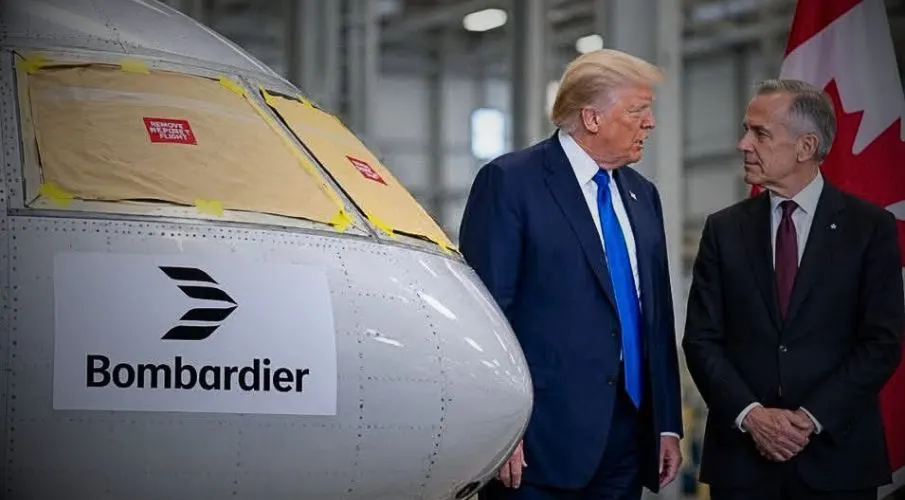
Donald Trump wanted to hit Canada. Now Republican politicians in Kansas are sitting there trying to stop their own president from hitting 1,500 jobs in their state along with it. Trump's threat to shut Bombardier out of the U.S. market is landing very differently there than it is in the White House. Bombardier may be Canadian, but it employs around 3,500 people in the United States. More than 40 percent of them work in Wichita. So for Kansas, Trump's announcement is not just some new blow against Ottawa, but the very concrete question of what happens to 1,500 American jobs.

Republican Senator Dr. Roger Marshall has apparently understood just how dangerous Trump's Bombardier threat could become for him just weeks before his reelection. He says he will fight for the 1,500 jobs in Kansas and has already personally taken the issue into the Oval Office. Still, nobody should read too much newly discovered social conscience into that. Marshall used to be a doctor himself and during that time sued around 700 patients over unpaid bills. Eighty-one of them were even arrested in connection with those debts. The claims routinely carried 18 percent interest, and some patients had their bank accounts garnished. Today, that same Roger Marshall presents himself as a fighter for the economic security of 1,500 families in Kansas.
His Republican colleague Jerry Moran has also gone to the Trump administration. He wants to make sure the president even understands how much Bombardier matters to the Kansas economy. So two Republican senators are now having to explain to their Republican president what his own threat could do in a Republican state. And that's not all. Ron Estes, a Republican congressman from Kansas, is also opposing the policy. He rejects tariffs on the aviation industry and reminds Trump that Bombardier supports a major American supply chain, operates maintenance and repair facilities in the United States and even has aircraft used for important U.S. national security missions. The announced strike against a Canadian company therefore turns pretty quickly into a strike against American workers, American suppliers and parts of the American aviation industry.
Bombardier depends heavily on the U.S. market. Around half of the company's sales go to the United States. If Trump actually followed through on his threat, that would be serious enough for the manufacturer. But for Republicans in Kansas, there is something else on top of that: Democrats do not even have to make the issue complicated. Adam Hamilton, who is running against Marshall for the Senate seat, puts it simply: Bombardier provides good jobs for 1,500 families in Kansas - and now the president is trying to take exactly that away.

That puts Marshall in a situation Trump probably did not want to write into his campaign for him. He has to remain a Republican, avoid openly making Trump his opponent and explain to his voters why he is fighting in the Oval Office to keep Trump from carrying out a measure he has already announced. This is no longer some theoretical trade dispute. In Wichita, names, paychecks and families are tied to it. The whole thing gets even stranger because to this day nobody can clearly explain how Trump would even throw Bombardier out of the American market. Three aviation lawyers say it is unclear how the administration could stop deliveries of business jets that have long been approved by the U.S. Federal Aviation Administration, the FAA. The White House has not explained any of that so far.
David Hernandez, an attorney at Vedder Price in Washington, puts it without any detour: "This makes no sense." One of his clients is supposed to receive a Bombardier jet at the end of October and has already asked him whether Trump's threat could now become a problem. No aircraft has been blocked yet. Still, customers once again have to wonder whether an order that is valid today will still be allowed to be delivered a few weeks from now. "Once again" really does fit here. Trump had already threatened Bombardier back in February. At the time, in a dispute over certification of aircraft made by U.S. competitor Gulfstream Aerospace, he wanted to strip Bombardier planes of their U.S. certification. Nothing came of it. Transport Canada later approved the American jets, and the threat fizzled out. But the uncertainty for buyers and companies had still been there beforehand.
IAM, the largest North American aerospace union, wants nothing to do with shutting Bombardier jets out either. On the buyer side, nobody appears to be panicking so far. Canadian aviation lawyer Ehsan Monfared says he currently sees no pullback among American buyers of used Bombardier business jets from his Canadian clients.

Monfared brings up another point that the White House probably does not find entirely uninteresting either. Bombardier does not sell compact cars. The customers for these kinds of business jets are wealthy, and among them are likely supporters and major donors of the Trump administration. An actual ban could therefore mess up aircraft orders for exactly the kind of people Trump would probably prefer to keep happy politically. Monfared therefore believes too many orders from that circle could be affected for the threat to actually be carried out in the end. He considers the legal basis questionable anyway.
The stock market did not wait to find out whether Trump means it this time. Bombardier initially lost 6.4 percent after trading began. Later, the stock was still down 3.6 percent. The trigger lies in the increasingly bitter dispute between Washington and Ottawa. Canada has imposed retaliatory tariffs on around $20 billion worth of American goods, and Trump responded in part with his Bombardier threat. Aviation had been hit far less by his trade war so far than industries such as autos. Now he is dragging that into it too.
The only problem is that this time Trump picked a target whose American employees happen to be sitting in Kansas. And that is why Roger Marshall, Jerry Moran and Ron Estes are no longer standing behind him, but are trying to slow him down. Three Republicans from Kansas are defending a Canadian aircraft manufacturer against the president of their own party because 1,500 American jobs are on the line. That is exactly where "America First" suddenly turns into a pretty uncomfortable bill for Americans themselves.
Updates – Kaizen News Brief
Alle aktuellen ausgesuchten Tagesmeldungen findet ihr in den Kaizen Kurznachrichten.
To the Kaizen News Brief In English


Es ist unglaublich, wie wenig Dachverstand und logisches Denken, vorhanden ist! Wut macht blind!
sehe viele Parallelen zur AfD und ihre
„Streich- Liste“! 90% nicht umsetzbar,
weil diese dem Land selber schadet oder
gegen Gesetzte verstößt!
Aber egal, Hauptsache man kann
rumpöbeln
… Trump dreht mehr und mehr durch und natürlich ist es leicht in zu beeinflussen, da er nicht smart ist. vieles ist haltlos und man sichwie immer vor gericht wieder
Trump selbst ist jenseits von gut und böse, aber dass die republikanische Partei nichts gegen ihn unternimmt, würde mich als Amerikaner unheimlich wütend machen.
…die sind mittlerweile abhängig von ihm