
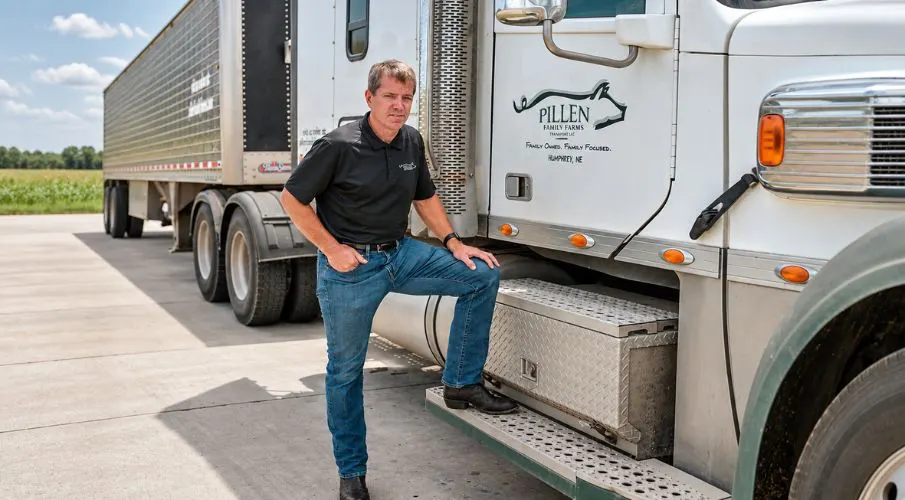
Governor Jim Pillen's fortune was built in the hog barns, and the hands that helped make it belonged in many cases to people he now calls “the worst of the worst.” The Republican governor of Nebraska backs Donald Trump's hard-line immigration policy without reservation, at every rally and in every speech. But his multimillion-dollar hog farming business grew, according to consistent reports, on the backs of Hispanic workers without legal immigration status. The loudest voice against people without papers spent years needing them most in his own business. A man can campaign against something and live off it at the same time, as long as he talks loudly enough to keep one separate from the other. For him, the distance between the pulpit and the ledger is short and brightly lit.

As governor, Pillen has closely tied the state's law enforcement agencies to Immigration and Customs Enforcement, ICE. He had a former prison converted into an immigration detention center and gave it the almost cheerful name “Cornhusker Clink,” as if it were a tourist attraction rather than a place where people are locked up. He calls people without legal status “criminal illegal aliens.” The language does its work before the officers even arrive, turning neighbors and coworkers into a group to be sorted. The word “criminal” gets the deportation out of the way in advance and saves anyone from having to ask who these people actually are beyond their immigration status. The anger toward them, however, ends right where those same people start adding to the profits.

At his own company, their employment was an “open secret,” according to weeks of reporting. At least 20 of the farms are said to have employed workers without legal status. David Armendariz, a former worker from Mexico without papers, says the company accepted his fake ID without a problem. “Everybody knows that's not your name, but they don't ask you what your real name is,” he says. Over the years, according to his account, more and more Hispanic workers arrived, many of them without legal status. Nobody openly lied, but looking the other way together was part of the deal. The company doesn't need a fake document that fools anyone. It only needs one that nobody dares to check.

Employing people without papers hardly happens by accident. It follows a process with clear rules. No questions are asked and nothing is checked. Whatever is put on the table is accepted. The rest is treated as the worker's problem. That creates an employment relationship that can be denied at any time because, officially, nobody knew anything. The paperwork checks out, reality does not. The gap between the two is built in. The business gets willing hands at low wages, the worker gets permission to stay as long as he remains invisible. Silence is the real contract between the two.
The meat industry in this country has long rested on people who are hard to replace and easy to fire. Fear of deportation keeps wages low and resistance small, because someone who can disappear at any moment rarely insists on taking a break. That fear is exactly the raw material businesses like Pillen's turn into an advantage, long before a governor turns it into politics. The fence he builds for some keeps the others compliant at the same time.

The agency Pillen now deploys against others as governor left his own company alone for years. ICE said, in response to an inquiry, that it had neither audited nor inspected the farms for 15 years. The company only got stricter when Pillen went after the governor's office in 2022. From that point on, it hired Mexican immigrants with their own visas. Enforcement in this country is a matter of will, and that will rarely turns against its own cash register. The diligence arrived with the campaign, not a day earlier.
The most revealing thing is a date. On the very day Pillen began his first campaign for the state's highest office, Pillen Family Farms joined E-Verify, the government system that checks workers' employment eligibility. Registration records confirm that the two happened on the exact same day. A coincidence is possible, but it would have picked the least likely day imaginable. A system meant to prevent illegal employment entered the building the moment that employment became a campaign risk. Order had been optional as long as nobody was looking, and overnight it became a duty when the public spotlight drew closer.
The records go further than the accounts of individual workers. A 2021 federal lawsuit against Pillen Family Farms carries the most weight. A former human resources employee accused the company of knowingly employing people without legal status and changing names in its records. The allegations also included manipulated employment records. The company denied the accusations. In 2022, both sides ended the case without a court ruling on the allegations, so they remain unproven. A settlement closes the door to the courtroom where the truth would formally be established, and both sides know why they prefer to keep that door shut.
Alongside the lawsuit are the cases against the workers themselves, and this is where the imbalance comes into plain view. Between 2015 and 2024, according to court records, at least 12 of them were charged over false or stolen identities. Nine were convicted, three failed to appear in court. Pillen Family Farms itself was not in the defendant's chair in any of those cases. The punishment hits the hand that presents the fake ID and spares the house that knowingly accepts it. At Wholestone Prestage, in which the Pillen family holds a minority stake, at least 56 workers have been charged since 2019 over false identity documents. Those cases cannot be attributed to the family's company, but they paint the same picture of an industry that lives off these people while leaving them exposed to the danger.

Pillen himself denies knowing about the illegal employment. His spokesman says the governor never knowingly hired anyone without legal status and even went beyond what the law required when it came to verification. That statement claims more than the record supports, because a company that did not join E-Verify until the day the campaign began can hardly be said to have been ahead of the legal requirements. The same spokesman praises Pillen's record as the strongest in Nebraska history and points to the state's help to the federal government in deporting nearly 1,000 people. The number is supposed to show strength, but it counts people whose labor supports the same economy that casts them out. Lynne Walz, the Democratic candidate for governor, argues that in four years Pillen has mainly shown that what he says and what he does are two different things. The price is always paid by the same people, the workers and the families without campaign checks.
Pillen is not alone in his party when it comes to this hypocrisy. For many, toughness against the weakest is displayed in the front window as policy, while the same labor is needed out back at their own businesses or by their donors. The deportation of nearly 1,000 people is presented as an achievement, while the source of their own wealth remains in the shadows. Toughness quietly makes an exception for itself, and that exception almost always bears the name of its own house. This arrangement divides people without papers into the good ones who work and keep quiet and the bad ones who are paraded around as a warning. They are the same people, just seen on different days.
The case does not stand alone. Immigration and the labor market are tightly bound together, and many businesses knowingly employ people without papers from Mexico and the rest of Latin America because cheap labor with little oversight boosts profits. For people like Pillen, that calculation is what matters most, while the workers themselves carry the risk of prosecution that the owner is spared. The worker risks criminal charges and deportation, the owner risks, at worst, an uncomfortable headline. That is exactly where the political explosiveness lies: Today Pillen has Nebraska working with ICE and calls people without status “criminal illegal aliens,” while a long trail of records and witnesses shows that those very workers were employed in his business orbit. To be clear, the records available so far do not prove that Pillen personally and knowingly ordered the illegal employment. Between what he says about other people and what happened in his barns lies the career of a man who only ever holds the measuring stick up to his neighbors.
But the story does not end with Pillen
The same split, just one look across the Atlantic is enough, sits right there in the AfD's own parliamentary motions in Germany. Publicly, the party wages the hardest fight against immigration, but in its own Bundestag documents it calls for foreign workers while at the same time wanting to keep them cheaper than German workers. What happens in Nebraska as a quiet reach for foreign labor is written down in black and white in Germany.

In the spring of 2020, when the COVID rules closed the borders, Stephan Protschka, the agricultural policy spokesman for the AfD's parliamentary group, demanded that Eastern European seasonal workers be allowed back into the country and in greater numbers. Without the experienced harvest workers from Eastern Europe, he said, a large part of the harvest, from fruit to hops, was at risk. Nearly 280,000 such workers came to Germany's fruit and vegetable harvest every year, he calculated, and the permitted 40,000 per month were not enough. The special entry permits needed to be expanded significantly. He also pointed to the hop harvest and welcomed the government's decision when it actually allowed harvest workers from Eastern Europe back into the country. The party that usually preaches fences was explicitly asking for the gate to be opened here.

Four years later, the tone changed. In June 2024, the AfD parliamentary group around Frank Rinck and Stephan Protschka introduced motion 20/11940, declaring that farms were heavily dependent on foreign seasonal workers while at the same time demanding an exemption from the statutory minimum wage for short-term workers whose main residence was abroad. The reasoning gives the game away: Such an exemption, it said, would not hurt seasonal workers because they were free to decide whether they wanted to come and for what wage, and could negotiate their own pay. The freedom being offered to them amounts to working for less or not working at all.

On July 2, 2025, AfD lawmaker Gerrit Huy gave the argument a headline, declaring that Germany's minimum wage would mean the downfall of the country's fruit and vegetable farmers. For foreign seasonal workers, she said, working abroad remained extremely attractive even at lower wages, otherwise they would not come. The actual line was not drawn until the parliamentary group's September 9, 2025 motion led by Bernd Schattner and René Springer: Foreign seasonal workers were to be taken out of the minimum wage system and paid only 70 percent of the prevailing rate, while the 70-day rule would be extended to 115 days. The unequal treatment was justified by the lower cost of living in the workers' home countries. Their wages would therefore be measured against hardship back home, while the work performed on German soil remained exactly the same.
The Bundestag rejected the motion on November 6, 2025, with every other parliamentary group voting against it. On January 23, 2026, the German government stated that a separate, lower minimum wage applying only to short-term seasonal workers would constitute unlawful discrimination under both German and European law. The proposal that was supposed to help farmers ended as a lesson in exactly who the party imagines as second-class workers. The contradiction is sitting there in plain sight. A harvest that would be lost without foreigners sits badly alongside a wage that places those same people below everyone else. One person's need becomes another person's discount, and the business saves money exactly where the worker has the least power to fight back. And that is exactly what the party then calls protecting the homeland.

Even more serious, though it has to be considered separately, is the case of Saxony state lawmaker Jörg Dornau. On August 7, 2024, the presidium of the Saxony state parliament found that he had failed to disclose on time his stake in the Belarusian company Zybulka-Bel and his role as its director, and imposed a fine of 20,862 euros, which the Leipzig Administrative Court upheld on December 10, 2025. An independent Belarusian outlet reported in September 2024 that political prisoners had worked on that onion farm. For one prisoner, 30 Belarusian rubles per day were reportedly paid to the prison, about 20 of which were supposed to go to the prisoner, around 5 euros in total, and a former prisoner said he had personally seen Dornau there.
Whether that work was forced has not been conclusively proven, and the accounts differ. The first prisoner explicitly described it as voluntary and said he preferred it to the conditions inside the prison, while another described it as effectively involuntary and said that on one occasion he had been chained to a radiator. Leipzig prosecutors did not open a case on December 20, 2024. They made clear that this did not disprove the employment, only that there was no initial suspicion of an offense that could be prosecuted in Germany. Since February 4, 2026, prosecutors have been investigating him in a separate matter over possible circumvention of EU sanctions involving exports to Belarus, and they had premises and vehicles searched as part of that investigation.
There is an ocean between Nebraska and Saxony and not much difference. Here as there, the right that rails loudest against the foreigner lives off his cheap and quiet labor, Pillen wants him deportable and cheap, the AfD wants him let in and paid below the going rate. The enemy at the microphone and the hand in the field are the same person, and both sides know it.
Updates – Kaizen News Brief
Alle aktuellen ausgesuchten Tagesmeldungen findet ihr in den Kaizen Kurznachrichten.
To the Kaizen News Brief In English


Das kommt mir doch sehr bekannt vor. Der Schweizer Ex Bundesrat Blocher (SVP), beschäftigt bis heute ausländische billiglohn Arbeiter. Er und auch seine Tochter haben ihren Reichtum auf deren Buckeln aufgebaut. Und ja, sie schreien und hetzen am lautesten gegen Ausländer. Jede Iinitiative, die angeblich Schweizer Arbeiter schützen soll, wir von Blocher finanziell unterstützt. z.B. die Neutralitätsinitiative welche am 27. September zur Abstimmung kommt.
Ich frage mich wie solche Menschen noch ruhig schlafen können.
…leider können die das sehr, sehr gut, auch das zeichnet die Rechten aus und die Kontakte zu Staatsbediensteten besonders Ermittlungsbehörden. Darüber können wir Bücher schreiben, und nicht nur in den USA oder der Schweiz