
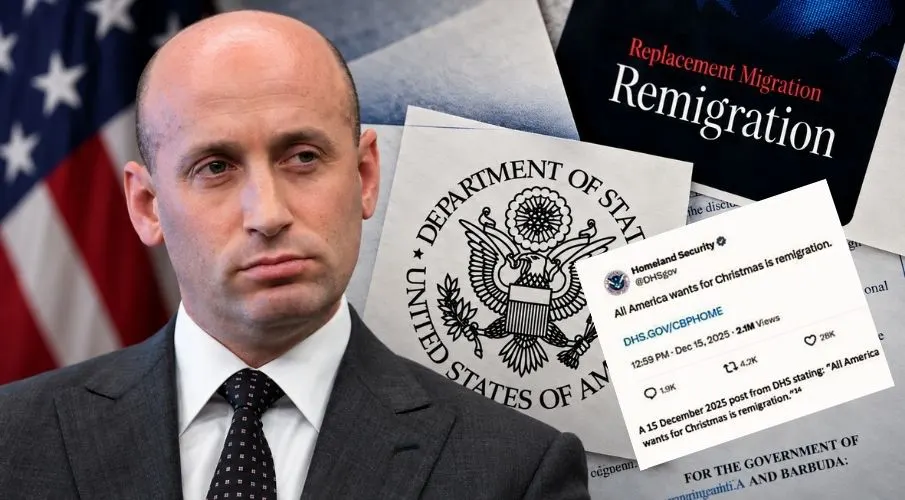
A name is a promise you don’t take back. When the U.S. State Department named its new office, senior officials reportedly warned against the word. “Remigration” came from the vocabulary of white nationalists, and one of them had openly spoken of “ethnic cleansing.” They had objected again and again. Each time, the same answer had come down from above: The name would stay. So a U.S. government office now bears the title “Office of Remigration,” named after a term far-right extremists use to mean the mass expulsion of nonwhite immigrants from “Western” countries, in the name of an ethnic purity that has never existed. Back in Germany, a jury had already named the word its Un-word of the Year. In Washington, it became a nameplate on a door.

The term comes from Europe. Germany’s AfD has long since made it one of its favorite expressions. Trump himself spoke last year of “reverse migration,” making the idea acceptable in the American right. The office is housed in the State Department, where roughly 15 employees work anonymously inside a vast bureaucracy, barely noticed by most Americans. Since then, it has helped carry out mass deportations through methods that don’t stand up well to scrutiny. Until now.

Leaked documents and months of investigative reporting are dragging its work into the light. At the direction of Stephen Miller, the White House deputy chief of staff, the office is reportedly paying foreign governments huge sums of taxpayer money to accept deportees from third countries: people who, for various reasons, cannot be returned to their countries of origin. More than $400 million has reportedly been authorized or pledged across more than 30 countries, primarily in Africa and Latin America. Taking people in becomes a service with a price tag. These arrangements dump people in countries they have never had any connection to. They are structured to get around the human rights safeguards that normally come with American foreign aid. There is little oversight of where the money goes or how the deportees are treated, even though some of the recipient countries are ruled by authoritarian governments. The State Department itself has condemned some of these governments for serious human rights abuses. Some deportees are already reporting that they are living in terror. The files read like a ledger of people nobody wants back. Washington is paying for what its own State Department has condemned.

Liberia is just one part of a much larger American deportation policy. Washington has also signed agreements with the Democratic Republic of the Congo, the Central African Republic, Equatorial Guinea, Cameroon, Ghana, and Sierra Leone. This means people deported from the United States can be sent to countries where they do not even hold citizenship. For the Trump administration, that opens up additional destinations for deportations when sending someone directly back to their country of origin is difficult or politically impossible.
A federal court has, for now, ruled that deportations to third countries are unlawful because they violate the affected people’s right to due process. The case will likely end up before the Supreme Court. At that point, anything is possible.
The irony has a mailing address. The office belongs to the Bureau of Population, Refugees, and Migration, the State Department division that spent decades bringing people fleeing horrors abroad into the United States. The same officials are now supposed to persuade foreign governments to take in deportees who have no connection whatsoever to their new country, with the arrangement paid for using foreign aid money. Some are speaking out about their dismay. Jeremy Konyndyk, president of Refugees International, says this is a perversion of the entire purpose of refugee assistance. Saving people became deporting them, and asylum became a fee. The rescue boat is now heading in the opposite direction.

These days, almost the only refugees being admitted are white South Africans, justified by a fabricated white genocide. Trump and Miller hardly care about their suffering. The message is aimed at the entire world: The only people worthy of compassion are the imagined victims of anti-white persecution. That is American government policy today.
They Carried Me Like a Corpse
The WRAP - mockingly called "the burrito" or "the bag" by ICE officers - is the product of a bureaucracy that confuses the concept of security with total control. Originally developed as an emergency measure to calm violent individuals, it has now become an integral part of American deportation routines. People who neither resisted nor posed any threat were restrained in it for hours. They could neither eat nor drink, some could not breathe. And while the government defends its use as "standard procedure," international law speaks a different language: Article 5 of the Universal Declaration of Human Rights prohibits any treatment that is "cruel, inhuman or degrading."

The leaked photo from Chula Vista, California, shows a detainee completely strapped into the restraint system "The WRAP," the head covered under a dense fabric hood. Human rights lawyers classify such scenes as serious violations of international protection standards. The use of combined restraint and breathing barriers can, under Article 7 of the International Covenant on Civil and Political Rights (ICCPR) and Article 3 of the European Convention on Human Rights (ECHR), be considered inhuman or degrading treatment. Article 1 of the UN Convention Against Torture (CAT) also prohibits any act by which severe physical or mental suffering is intentionally inflicted on a person to punish or intimidate them. Since the image was leaked from internal law enforcement sources, it raises the question to what extent such methods - officially declared as "security measures" - are applied systematically and outside any legal control.
Read also our article: They carried me like a corpse - ICE straps refugees into full-body restraints and calls it security
For ethnonationalists like Miller, this office handles far more than immigration. Parts of the New Right are pursuing a “civilizational grand strategy,” political scientist Leonard Schuette explains: They want to defend the “ethnoreligious” foundations of the West and fortify the “Western Hemisphere” against “alien cultures.” History, understood this way, becomes a border drawn with deportation flights. Remigration becomes a mission to save a civilization. Human beings are treated as contaminants to be rounded up and dumped beyond the borders of their own hemisphere, in countries Trump calls “shithole countries.” The fear this creates is considered a benefit. The whole thing is driven by delusions, above all the delusion of world-historical grandeur.
U.S. Deports 2 Cubans to Central Africa - Without Papers, They Cannot Leave
Yasmany Moreno de Armas thought he was once again being transferred somewhere inside the United States. The 32-year-old Cuban had lived in the country for around 10 years, including for a time with his family in Miami, and after other forms of immigration relief were denied, he had tried to secure legal status through asylum. He had been in immigration detention since May. In Louisiana, he was put on a plane. Only around 2 hours after takeoff did he learn where he was going: the Central African Republic. He has no connection to that country. He is not a citizen there and had never lived there.

Aristides Fernandez Garcia was deported with him. The men say they arrived without passports or other necessary documents. Fernandez Garcia says he has neither a visa nor sufficient papers and therefore could not leave even if he had the money for a ticket. “We are prisoners here,” he says of their situation. They are not simply allowed to leave. Then comes the sentence that hardly needs any explanation: “I feel kidnapped.” Moreno de Armas describes the experience as a nightmare and says they face risks every day.

What makes the case especially bitter is the U.S. government’s own assessment. The Department of Homeland Security describes the Central African Republic as a “safe country” for these deportations and says it is applying the law. At the same time, the State Department places the same country at its highest Level 4 warning and explicitly tells Americans not to travel there. The department points to a serious security situation and the risk of kidnapping. It also says the U.S. government can provide only limited help to American citizens there. Apparently, that warning does not apply to the men who were deported.
Cut Off the Deportation Office’s Funding
If Democrats take control of the House or the Senate next year, this office belongs under the harshest possible spotlight. As many Americans as possible should find out what their government is doing in their name. According to sources on the House Appropriations Committee, Democrats are already looking for ways to expose these operations or shut them down entirely. A Democratic majority in the House could cut off all funding for the office. That would be legally tricky, and if the measure made it through the Senate, Trump would veto it. They should try anyway, so Trump and Miller have to defend these operations in public. Deporting people to countries they have no ties to is unconscionable, says Representative Lois Frankel, a senior member of the Appropriations Committee. Congress must use its power of the purse to stop foreign aid from being used as a financial incentive to get countries to take in third-country nationals under the banner of “remigration.”

For every Venezuelan deported, the Trump regime pays money to El Salvador - dollars that flow directly into Bukele’s system. Yet a large share of those imprisoned, most of them people with no criminal record
A law could block taxpayer money from being used for deportations to third countries without the express consent of those affected, following the example of a recent amendment from Frankel that established precisely that restriction. Legal hurdles loom here, too; at least the public would find out where lawmakers stand. The State Department could also be required to disclose every agreement to Congress, including the exact sums paid and the conditions of the deportations. Most of it remains hidden. Finally, Democrats reportedly want to summon the officials responsible and question them aggressively. Congress must demand answers from those who divert taxpayer money meant to protect persecuted people to some of the world’s worst despots, for purposes that clearly violate human rights, says Aaron Reichlin-Melnick of the American
Bounty
The Trump administration has built a system that can, without exaggeration, be described as a state-funded bounty hunt. An internal financial document from the immigration enforcement agency ICE shows in black and white how local police departments across the country are being paid to arrest migrants. Not as a national security measure, not as neutral law enforcement - but as a politically driven system built around financial incentives, deliberately established in Trump-loyal states while leaving all the others out.

The document shows internal performance and compensation descriptions for so called task force officers working with ICE. Specifically, it outlines that these officers are paid for their involvement in enforcing immigration laws - including salary, overtime and additional benefits. Notably, payments are made monthly and include quarterly bonuses. These bonuses are tied to specific requirements, targets and performance metrics set by ICE or ERO.
Part of the rules explicitly includes operations involving unaccompanied minor migrants, highly sensitive cases. This makes clear that financial incentives are directly linked to operational enforcement actions. From a critical perspective, the document shows that not only base salaries but also performance based bonuses play a role - raising questions about motivation, pressure and potential perverse incentives. Overall, this provides a rare insight into the financial structure behind concrete enforcement actions in US immigration policy.
The program operates under the name 287(g), based on a 1996 law. Local police officers are authorized to act as ICE agents and can enforce federal immigration law. What is new is the scale and the payment structure. An internal chart makes it unmistakably clear: Officers qualify for allowances and salary supplements only after their first arrest. The document calls that moment “operational,” meaning ready for duty. The first person an officer arrests marks the moment the money starts flowing. That is not just a bureaucratic term. That is an incentive.

The office announces its agenda in its very name, loudly and without shame. Naked ethnonationalism has become the foundation of American government policy, and the nameplate is meant to tell the world exactly that. That is precisely why it was put up. Democrats should shine a light on it and then tear it down. A name is a promise. This one sounds like a threat, and that is exactly how it is meant.
Updates – Kaizen News Brief
Alle aktuellen ausgesuchten Tagesmeldungen findet ihr in den Kaizen Kurznachrichten.
To the Kaizen News Brief In English


