
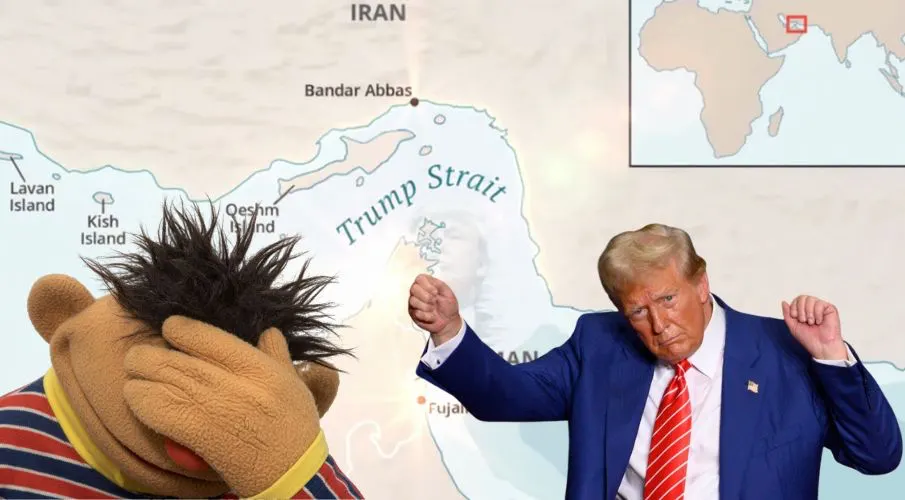
The government now runs the country like a television show with a souvenir shop attached, and every week brings a new episode. This week, Donald Trump wants to name the Strait of Hormuz after himself, a body of water over which the United States has no sovereignty. From the ocean to the coin, soon everything will carry the same name, as if a country were a corporate logo that only needs to be repeated often enough. The show has no closing credits, only the next idea, and this time that idea is to stamp his own name onto a sea. Governing and advertising have become the same activity in this White House. Every week a new headline, every headline a product, and the audience applauds because it believes it is watching politics. The seriousness of the office has become a prop.

On Wednesday morning, he proposed on his platform that the Strait of Hormuz be renamed “TRUMP STRAIT.” Now that it is under control, it would, like America itself, be “hotter” than ever before, he wrote, politely thanking everyone for their attention to the matter. Two things spoil the picture: The United States has no sovereignty there whatsoever, and Iran can still throttle shipping through the strait. One morning post is enough, and half the world is talking about the name of a sea instead of the war on its shores. Outside his base, the proposal finds little support, and even there it amounts to applause. An emperor names a body of water that does not obey his commands. If he is serious, the next comparison will be with rulers who named seas and cities after themselves before both eventually cast them off again.

The idea is part of a long line of them. Last week, an executive order renamed Lake Ontario “Lake America,” unpopular with Canadians and many Americans alike, and yet Google and Apple bowed and changed their maps. A mapping service that follows a whim turns a post into a fact, and reality adjusts itself to the loudest user. Trump has renamed many things during his second term, from buildings to aircraft carriers, and he has even set his sights on New York’s Penn Station. Florida just renamed Palm Beach’s airport after him, officially the “President Donald J. Trump International Airport,” complete with the code DJT. This is how a man sees the world when he mistakes the map for a mirror, and history has known such namers before, usually with a bad ending. A name code above an airport is not a monument, it is a bill that others have to pay. What he does not own, he names anyway, and what he names, he considers conquered.

The timing for the joke is bad. Trump says he is seeking a deal with Iran, but renaming the strait would ruin any prospect for peace. Taking the name of his sea from the opponent at the negotiating table at the same time does not pave the way to an agreement. Oman and the United Arab Emirates are unlikely to be thrilled either. Peace is negotiable in this house, the brand name is not. Where a handshake would be needed, a label appears instead, and the region remembers both.
While the maps are changing, the government itself is becoming a television show, literally. The Small Business Administration announced that its “Million Dollar Pitch Competition” will end on September 18 with a live finale in Washington. Five small manufacturing companies are competing for shares of one million dollars, provided by payment company Clover Network. Economic development becomes entertainment, a government agency becomes a broadcaster. Imagine a well-known startup competition show, only much more boring and with an official government seal. Five companies fight over one million dollars in one evening, while the agency that is supposed to support entrepreneurs hands out airtime.
The lineup says everything about the taste of the house. Nicki Minaj sits on the judging panel, having moved to the right when her vaccine skepticism won applause in the MAGA movement, alongside Grant Cardone, a get-rich-quick influencer accused of misleading investors. Then there is Joe Gebbia, co-founder of Airbnb, who now leads a DOGE team handling federal websites. A jury of supporters and accused figures is thus deciding over money for the little guys. The whole thing is hosted by Dean Cain, once Superman on television, today a glowing supporter of the president. This is already the second time the administration has ventured into the reality-TV business, after Transportation Secretary Sean Duffy flopped with his travel show, and like that one, the new show will probably quietly disappear into the internet. Governing as casting, that is the idea, and the ones who lose will be those who actually wanted to build a business.

At the same time, the president’s face is being sold. The U.S. Mint is offering one-dollar commemorative coins with Trump’s portrait for the country’s 250th anniversary, $61 for 25 coins or $154.50 for 100. That means a one-dollar coin in the small package costs more than two dollars, and demand is so high that a digital waiting room was set up. 250,000 of the coins carry a “July 4” mark. His official White House portrait appears on the coin, something the Presidential $1 Coin Act should prohibit, since it bans images of living presidents or presidents who have been dead for less than two years. A law only applies, apparently, until someone waves around his own likeness. The agency responsible for the purity of the nation’s money is now stamping the face of its boss onto it.

Read also our article: A Signature for a Thousand Dollars – Trump's Most Expensive Gospel
The gold is not gold either. According to the Treasury Department, the coins merely have a gold-like finish, and the government argues that the anniversary allows the issue despite the ban on living faces in the 2020 redesign law. His supporters do not seem to care, they buy almost anything he offers, from golden sneakers to Bibles made in China. There have also already been ugly watches and overpriced fragrances bearing his name. In 2025 alone, Trump reported income of more than $2.2 billion, most of it from cryptocurrency, and now even the U.S. Mint is stamping his image onto real money. The state becomes a sales shelf, and the president stands at the cash register. From religious symbols to sneakers, everything becomes part of the collection, and the loyalty of his supporters is the most reliable currency.
And so this week’s episode fits into the larger picture. A president who names a sea after himself, turns the government into a show and sells his own face has turned the office into a brand and the country into its customer. The souvenir shop in the White House never closes, and the only open question is what can be sold next. Comparisons with the great renamers of history are hard to avoid, and none of them are flattering. As long as the cash register keeps ringing, every embarrassment is just the next advertisement, and the rest of the world watches, half amused, half alarmed. He has already given it the name, what remains is the sea that refuses to carry him.
Updates – Kaizen News Brief
Alle aktuellen ausgesuchten Tagesmeldungen findet ihr in den Kaizen Kurznachrichten.
To the Kaizen News Brief In English


Als ich diese Goldmünze sah, war mein erster Gedanke:
Hammar und Amboss!
…der knallt mittlerweile stündlich mehr und mehr durch