
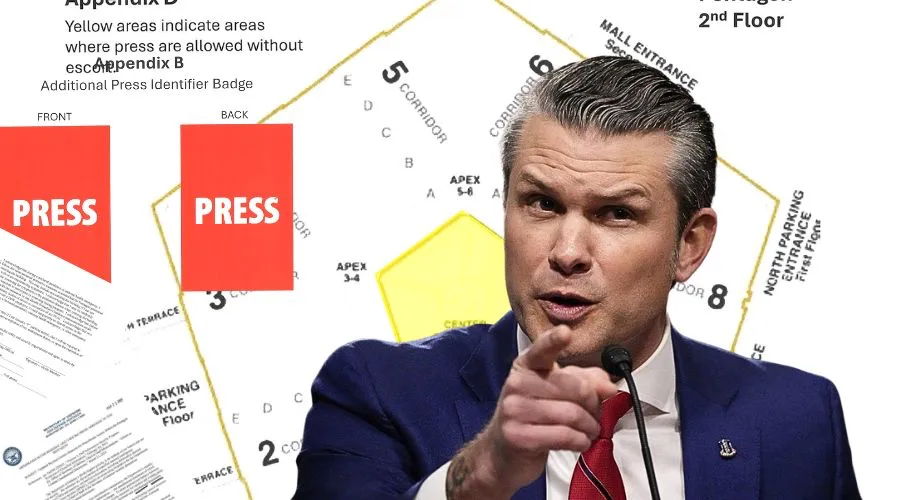
The Pentagon is drawing consequences from a defeat in court – but not in the way many had expected. Instead of fully restoring journalists’ access, the Department of Defense is moving them out of the building. The so-called “Correspondents’ Corridor,” for decades the workplace of the press inside the Pentagon, is closed. In the future, journalists are to work in an external facility on the premises. No one says when it will be finished.
The trigger is a ruling by federal judge Paul L. Friedman. He had decided that the new media policy of the Department of Defense violates press freedom and the rule of law. Among those affected were the New York Times and many journalists from other media outlets. The court ordered that access be restored. That is not happening now in its previous form.

Dozens of journalists handed in their access badges on October 16, 2025, and left the Pentagon – in protest against new government requirements that were set to restrict their work.
Pentagon spokesperson Sean Parnell stated that the ruling would be implemented, while at the same time an appeal would be filed. At the same time, he cited security concerns. The building could not be adequately protected if journalists worked there. That is the reason for the decision to relocate the press. Access to the Pentagon itself is being further restricted. Anyone who wants to enter will in the future require an escort by authorized personnel, and that outside of scheduled appointments such as press briefings or interviews.
The new regulation is meeting massive resistance. The Pentagon Press Association speaks of a clear violation of the wording and the spirit of the ruling. Especially at a time when the United States is militarily active – with regard to Venezuela and the war against Iran – free access to information is crucial. The New York Times has also announced that it will return to court. Spokesperson Charlie Stadtlander makes it clear that the new measures continue to represent unconstitutional restrictions.

The withdrawal of the media on October 16, 2025
The conflict goes back to a rule introduced in October. Journalists were supposed to sign that their accreditation could be revoked if they obtained information that was not approved for publication – even if it was not classified as secret. Many major media organizations, including the New York Times and the Washington Post, refused to sign and returned their badges. Others, predominantly conservative media, accepted the conditions.
The new daily reality at the Pentagon: conservative and far-right journalists in the Pentagon shaping global reporting, such as Laura Loomer or representatives of the distinctly right-wing America-Voice outlet, to name just a few. Many international media organizations did not do this to the same extent. They often remained more pragmatic, bent to keep access and scraps. That drew heavy criticism from American and investigative journalists.
Aus Sicht von Journalisten vor Ort ist das Sicherheitsargument vorgeschoben. James LaPorta von CBS News weist darauf hin, dass Hintergrundüberprüfungen längst Standard sind und das Gericht dem Verteidigungsministerium keineswegs die Möglichkeit genommen hat, echte Risiken auszuschließen. Meghann Myers von Defense One formuliert es noch deutlicher: Journalisten wurden nicht wegen Sicherheitsproblemen eingeschränkt, sondern weil sie versucht haben, an Informationen zu kommen, die über offizielle Verlautbarungen hinausgehen.
From the perspective of journalists on the ground, the security argument is a pretext. James LaPorta of CBS News points out that background checks have long been standard and that the court did not in any way remove the Department of Defense’s ability to exclude real risks. Meghann Myers of Defense One puts it even more clearly: journalists were not restricted because of security concerns, but because they tried to obtain information that goes beyond official statements.
Updates – Kaizen News Brief
All current curated daily updates can be found in the Kaizen News Brief.
To the Kaizen News Brief In English


Es war ein gutes Urteil. Ein wichtiges Urteil.
Aber wie so oft findet Trump einen Weg es zu umgehen.
Bis vor einem dreivierteljahr gab es im Pentagon nie echte Sicherheitsbedenken bezüglich des Pressecorps.
Aber jetzt ist die Sicherheit nicht mehr gewährleistet? Was für ein Unfug.
Und die Presse soll außerhalb arbeiten? In einem Gebäude was bicht fertig ist?
Gilt das dann für alle Medien?
Oder nur die nicht Genehmen?
Das Widerspruch eingelegt wird, war klar.
Wahrscheinlich geht auch das bis zum Supreme Court.
Und bis dahin stehen die Journalisten im Regen, im wahrsten Sinne des Wortes.