
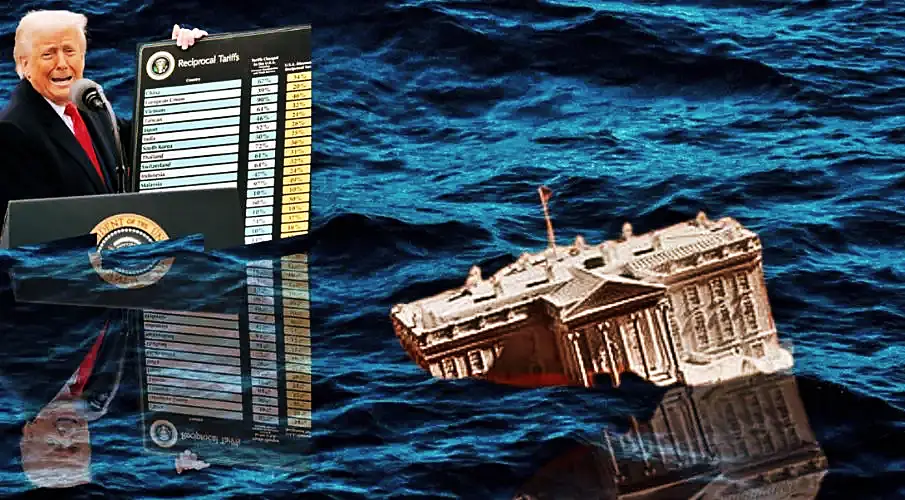
Donald Trump likes to call himself "Mr. Tariff." For a long time, it sounded like a badge of honor within his party. After the devastating defeat in the midterm elections, even Republican lawmakers are suddenly discovering that tariffs cost American families money. Rising living costs have turned voters against the party. The very lawmakers who have largely gone along with Trump's trade policies until now are beginning to consider rolling some of them back. Democrats could find some unexpected allies in the process.
The president is sticking to his approach. Just on Wednesday, his administration proposed new tariffs targeting China and the European Union, along with Japan and South Korea, Taiwan, and nine other major trading partners. Since the beginning of his second term, Trump has promised that import tariffs would revive American manufacturing. So far, there's little convincing evidence that they've delivered on that promise. Higher costs, meanwhile, are reaching consumers. A tax doesn't stop being a tax just because the president slaps it on foreign goods.

Republican Senator Todd Young of Indiana is now calling for a rethink. Tariff policy should do more to protect consumers, he argues. Young believes some tariffs on China make sense, but criticizes how broadly they've been applied. They're hurting factories and farms, as well as small businesses and family budgets. Tariffs should be predictable and specifically aimed at bringing strategically important manufacturing back to the United States. Young is up for reelection in 2028.
Tariffs on Canadian goods are coming under particular scrutiny. Senator John Kennedy of Louisiana said they made no sense to him, although he continues to support tariffs on China. The Republican also faces voters again in 2028. Young favors negotiations between the administration and Congress as part of renewing the North American trade agreement, known as the USMCA. Congress shouldn't be treated like a child who needs a pat on the head.

Michael Guest of Mississippi can also envision working with Democrats. He opposes a blanket restriction on presidential tariff powers but is willing to consider individual proposals. Senator Mike Rounds of South Dakota goes further. Over the decades, Congress has handed considerable authority to the executive branch, he said. Now lawmakers could examine whether those powers should be restricted or taken back. The U.S. Constitution gives Congress authority over tariffs. For years, handing that power to the president was politically convenient. Now the price is becoming clear.
Steve Womack of Arkansas says businesses in his district are paying higher prices for goods they can't source domestically. Josh Hawley of Missouri, meanwhile, worries that his party could swing too far in the opposite direction after its election defeat. Republican unity is beginning to crack, although nobody yet knows how deep those cracks go. The doubts already extend beyond trade. Republicans are questioning a sudden $50 billion request for the nation's air traffic system after air travel was briefly halted. Widespread technical outages are also drawing their attention. Trump's intervention to return Jensen Huang to the top of Nvidia is facing resistance as well. What was obediently accepted before the election suddenly demands an explanation.
Republican voters, however, remain divided. About half believe Trump's tariff policies have helped the national economy, while three in ten say they've caused harm. Roughly one-quarter see no difference. When it comes to their local economies, the verdict is less favorable: Only three in ten see benefits, while about one-quarter see negative effects. Four in ten say the tariffs have made no difference. Democrats want to capitalize on these growing doubts. Ron Wyden of Oregon, the incoming chairman of the Senate Finance Committee, sees repealing the tariffs on Canada as a possible first victory. Other tariffs could follow. Richard Neal, who is set to chair the powerful House Ways and Means Committee, is calling for a broader review of trade policy. Trump has used tariffs as a punishment, he argues.
The administration disagrees. Spokesman Matthew Middleton insists it will continue fighting to lower costs and create better economic opportunities for American families. But even an agreement between both parties would face one enormous obstacle: Trump's veto. Overriding it would require 67 votes in the Senate. Democrats will hold 56 seats. Senator Rand Paul, a staunch opponent of tariffs, therefore believes repealing them would only stand a chance if attached to legislation the president absolutely needs. Trump would simply veto a standalone bill, he argues.
The administration disagrees. Spokesman Matthew Middleton insists it will continue fighting to lower costs and create better economic opportunities for American families. But even an agreement between both parties would face one enormous obstacle: Trump's veto. Overriding it would require 67 votes in the Senate. Democrats will hold 56 seats. Senator Rand Paul, a staunch opponent of tariffs, therefore believes repealing them would only stand a chance if attached to legislation the president absolutely needs. Trump would simply veto a standalone bill, he argues.
Updates – Kaizen News Brief
Alle aktuellen ausgesuchten Tagesmeldungen findet ihr in den Kaizen Kurznachrichten.
To the Kaizen News Brief In English


