
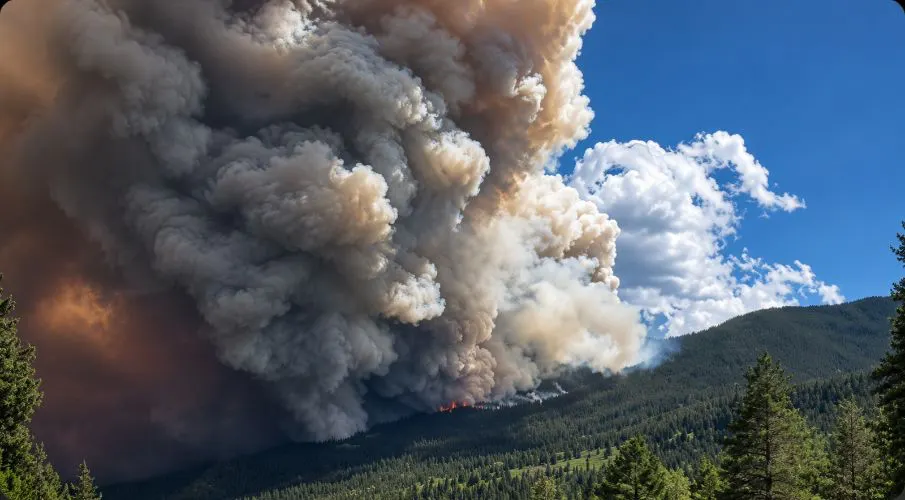
21 firefighters have died fighting wildfires in the United States this year. While families mourn their dead, the Trump administration is pushing ahead with an overhaul of the country's federal wildfire response system. Michael Boren, the Undersecretary of Agriculture for Natural Resources and Environment who oversees the U.S. Forest Service, spoke at a conference in San Francisco in early November about what could happen as a result. His words could have come straight out of a report on a disaster. Instead, he was talking about decisions that haven't even been made yet.

"We’re going to have to make decisions, some of which will be wrong. And some of those wrong decisions will lead to catastrophe," Boren said on November 4, speaking to around 100 people during a private session at the Red Sky Summit. "That’ll lead to big costs, big disruption in people’s lives and deaths. And we’re going to have to recover from those and not let that debilitate us." Death was already being treated as part of the administrative plan.
The rush is coming from the top. Interior Secretary Doug Burgum wanted the reorganization completed within five months, Boren explained. President Donald Trump wanted it done even faster. They were working with limited information and extremely little time. What exactly the five-month deadline referred to remained unclear, since the overhaul had already been underway for longer than that. The Agriculture Department didn't clarify the matter when asked. Apparently, there was room for a deadline. Less room for knowing what its consequences might be.
Meanwhile, firefighters are enduring one of the deadliest wildfire seasons in recent years. The 21 deaths make 2026 the third deadliest year since at least 2016, according to an analysis of federal data. A record number of acres have also burned, fueled by parched landscapes and unusually low snowpack. In the middle of fighting those fires, federal agencies are having to reorganize their responsibilities. They're already short-staffed after the administration's campaign to shrink the federal workforce eliminated numerous positions.

Until now, federal firefighters have been spread across several agencies. The U.S. Forest Service has provided the largest share. For decades, staffing shortages and pay problems have made the job harder, along with bureaucratic obstacles. In January, the administration established the United States Wildland Fire Service, a unified agency for fighting wildfires. Firefighters are supposed to be separated organizationally from the management of public lands. Major parts of the overhaul still require further study and congressional approval, however.

Under the new system, leaders of the unified service would make decisions about firefighting operations and prescribed burns, its director, Brian Fennessy, explained during the conference's public session. Land managers could explain which resources were at risk. But the final say on firefighting operations would rest with fire service professionals. Lori Moore-Merrell, a former U.S. Fire Administrator, also took part in the discussion. The officials defended an approach aimed at putting out fires as quickly and completely as possible: Fires that weren't intentionally set to reduce combustible material, and that occurred at the wrong time of year, would be extinguished. Boren also acknowledged that the agencies had not yet been fully brought together. Nevertheless, he insisted things were going well, even if they didn't look that way from the outside.
The private session followed that public discussion. The meeting operated under a rule allowing participants to describe what was said without identifying the speakers. Boren's remarks later became known through a transcript and accounts from people who attended. Several participants saw them as a rare acknowledgment from a senior administration official of the potentially deadly consequences of the overhaul. One attendee noted the absence of any empathy for those who had already died, or any explanation of what safeguards might prevent further deaths.

Riva Duncan, president of Grassroots Wildland Firefighters and a former Forest Service official, generally supports creating a unified firefighting agency. But she said prioritizing an arbitrary deadline over human lives and knowingly making bad decisions was unconscionable. Neither firefighters nor ordinary citizens should have to pay for a rushed overhaul with their lives. Another attendee questioned when dead firefighters had become an acceptable price to pay for fighting wildfires. The people who would eventually stand on the fire line were the ones facing that calculation.
Boren later said that "the loss of even one life to wildfire is one too many." Protecting firefighters and the public was the highest priority, he maintained. His remarks at the conference, he said, concerned the responsibility to learn from losses. Unifying the agencies was supposed to improve safety by giving firefighters more control over operations and better information. Conference founder Bill Clerico also pointed to the open exchange of views among roughly 600 leaders.

Boren's own past raises further questions. The rancher and technology executive owns extensive landholdings in Idaho, including a ranch inside the Sawtooth National Recreation Area. His use of that land brought him into conflict with the very agency he now oversees. This summer, he asked for an escalated response to a small fire near his property. Aircraft were diverted from other fires as a result. At the time, the Agriculture Department said he had neither pressured officials nor ordered additional firefighting resources.

Boren came into office promising to clarify who makes the decisions when wildfires break out. Four firefighters died in Colorado this year, and those deaths were also discussed at the conference. Young people wanted to do this work, he said, and the risks they faced had to be reduced. Yet the administration continues to demand speed. Between the promises of safety and the acknowledged possibility of more deaths lie five months, perhaps less. Outside, the forest is already burning.
Updates – Kaizen News Brief
Alle aktuellen ausgesuchten Tagesmeldungen findet ihr in den Kaizen Kurznachrichten.
To the Kaizen News Brief In English


Aha, wenn du mächtig bist, dann wird dir geholfen…..
Wenn nicht, dann versuch dein Haus mit dem Gartenschlauch zu löschen.
🤔 Habe ich das richtig verstanden?
…ja, teilweise ist das so und auch bereits passiert …
Mein Mann war Feuerwehrmann und bekommt bei diesen Aussagen regelrecht eine Schnappatmung.
Da gibt es mutige Männer und Frauen, die bei jedem Brand, jeder Katastrophe ihr Leben riskieren.
Um andere Leben zu retten, das Hab und Gut von Familien.
Die Bezahlung ist schlecht.
Die Ausrüstung ift veraltet.
Aufgrund von Kürzungen fehlt es an Personal.
Die Waldbrandsaison wird immer länger und heftiger.
Mit der ganzen Trumpschen Politik kann die US-Feuerwehr nicht mehr darauf hoffen große Unterstützung aus dem Ausland zu bekommen.
So wird künftig wohl Schutz nur noch für die Wohngegenden von reichen Republikanern, deren Häusern, deren Land gewährt.
Andere Reiche können sich vielleicht eine private Feuerwehr leisten.
Dem Rest brennt alles unterm Hintern weg.😢
Und so ein Brand eröffnet natürlich auch perfekte Bedingungen für den Bau von Datencentern.
Abgebrannte National Forests werden ihren Schutzstatus verlieren, weil man keine verkohlten Bäume schützen muss.
Der Weg ist vorgezeichnet.
Es liegt an den Demokraten da hart einzugreifen.