
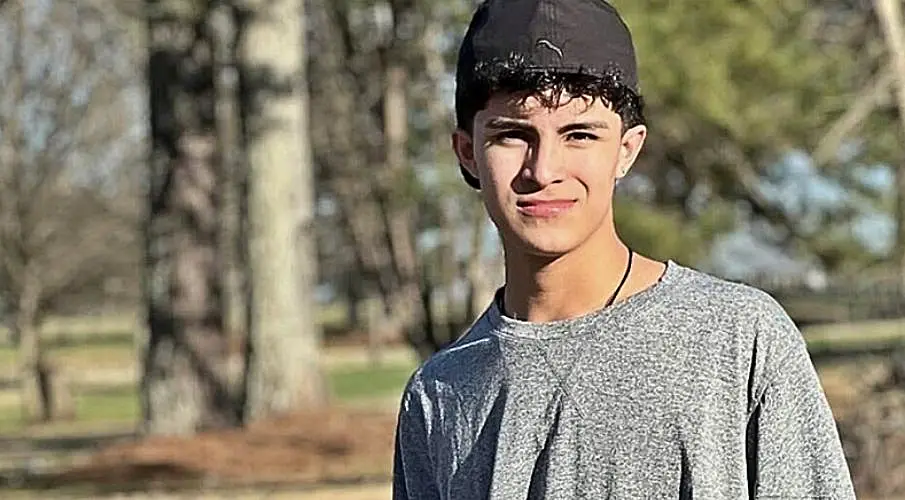
Elder Chavez-Carranza was a high school junior in Alabama when a speeding stop became the beginning of months in detention. The now 18 year old attended Asbury High School in Albertville and was in his junior year when a police officer pulled him over in December. Chavez-Carranza says he was driving 52 instead of the posted 45 miles per hour when the officer asked for his identification and then where he was from. What should have ended as an ordinary traffic violation instead became the beginning of an immigration case that has kept him away from his family, classmates, teachers and community ever since.
Chavez-Carranza says he showed ICE officers documents confirming that he had been granted Special Immigrant Juvenile Status. This form of protection, created by the U.S. Congress, is intended to protect children who have been abused, neglected or abandoned by a parent. According to his account, his own parents left him behind in Honduras when he was an infant. In 2022, he came to the United States to live with his sister in Alabama. The officers ignored the documents entirely and took him into custody.
The Department of Homeland Security defended the detention by stating that Chavez-Carranza had entered the United States through the southern border in 2022. That explanation does not answer the central question raised by this case. How can a teenager who says he holds a child protection status spend months in detention simply because he was speeding? The mechanism is simple enough to demand public scrutiny. A high school student was stopped for speeding, questioned about where he came from and placed in immigration detention despite presenting documents showing a protected status. The damage is not an administrative matter. It is the interruption of a young life.
Before his arrest, Chavez-Carranza had built a life in Albertville. He attended school, took welding and carpentry classes, lived with his sister and, like any other teenager his age, followed the ordinary rhythm of life among classmates and teachers who knew him as a student. Since his detention, he has missed prom, the birth of his nephew and months of school. His English teacher, Carmen Bahena, describes him as kind and hardworking. After a recent video call, she said she still recognized the same student she had known, even though he remained behind bars. Her description matters because ICE cases are often reduced to file notes, legal categories and official statements. The people who know Chavez-Carranza instead describe a young man with a school, a family and a community before the government removed him from all three.
The idea that ethical responsibility begins when we encounter another human being face to face, as described by the philosopher Emmanuel Levinas, captures this case more accurately than any bureaucratic language. Levinas wrote that the face of another person makes a demand that cannot be reduced to paperwork, files or legal categories. That is precisely the demand an official statement fails to meet when it reduces a human being to the date of his arrival while leaving out his story, his school and the protection he says he had already been granted.
Chavez-Carranza is being held at the Winn Correctional Center, where he complains about poor food and inadequate medical care. In June, the Office of Inspector General of the Department of Homeland Security released a report following an unannounced inspection of the facility. The report found deficiencies in 9 areas: sanitation and safety conditions, food service, use of force, medical care, detainee classification, access to legal counsel and legal materials, communication between staff and detainees, and out of cell recreation for detainees housed in the segregation unit.
Since April, 2 detainees have died at Winn, one of them shortly after the inspection report was released.
The urgency of Chavez-Carranza's case therefore stems not only from his claimed protected status, but also from the fact that federal inspectors recently found serious deficiencies at the very facility where he is being held, including medical care and food service. If a teenager says he held protected status and nevertheless remains confined for months inside such a system, public attention must consider both facts together.
Chavez-Carranza says he feels betrayed because his protected status was granted during the Trump administration before that same government later placed him in detention. A child protection status is supposed to recognize that a young person has already survived abandonment, neglect or abuse and should therefore be protected from being treated as nothing more than an administrative case.

Detention has removed him from the life he was building. His classmates continued through the school year. His family welcomed a new baby. Prom took place without him. His carpentry and welding classes continued without the student who had hoped to return. Detention does not simply hold someone in place. It removes a person from the everyday moments that make up a young life. His community responded by organizing. Family members, teachers, friends, former detainees and supporters began working to bring attention to his case and demand his release. They eventually gained access to the facility, an attorney is now handling his case, and Carlos Della Valle, a former ICE detainee who met Chavez-Carranza at Winn, says the teenager reminded him of his own son. After his own release, Della Valle and his wife helped organize letter writing campaigns, support for the family and a prayer vigil.
Around 45 people gathered at Mosaic Family Church in nearby Gadsden to pray for Chavez-Carranza's release. His sister, Mayuri Chavez, struggled to hold back tears as she thanked those who had come to support her brother. The vigil matters because the community understood that a young man had been stripped of the life he was trying to build, not because prayer can undo what months of ICE detention have already done.
The symbol of the case became a chair. Chavez-Carranza built it in his carpentry class at Asbury High School. Supporters now use an image of that chair on coloring pages bearing the words "Bring Elder Home," turning a school project into a public call for his release. The chair stands as proof of a student who was learning, building and planning for the future before detention interrupted his life in the middle of a sentence.

Chavez-Carranza says that if he is released, he wants to return to school and continue his carpentry and welding classes. If he is deported, he has an aunt in Honduras, but he does not want to go back there. He wants to return to his family and friends in Albertville.
The Department of Homeland Security provided an explanation of how Chavez-Carranza entered the United States, but ICE's account leaves out the rest of the public record: that he was a high school student, that he says he held Special Immigrant Juvenile Status, that the authorities ignored those documents according to his account, and that months of his life have passed inside a detention system with documented deficiencies.

A speeding stop should not lead to months of detention for an 18 year old high school student who says he holds child protection status. An official government statement should not replace the full story when teachers, family members, former detainees and an entire community say that his life has been put on hold. Chavez-Carranza left Honduras as a child, abandoned by his parents according to his own account, and came to live with his sister. He built a life in Alabama, found his place in school and began learning skilled trades that could have shaped his future. ICE detention has brought that future to a halt while the people who know him continue fighting for his return.
For Chavez-Carranza, what ultimately matters is not what the files say, but whether he returns in time to a life that has long since continued without him.
To be continued ...
Updates – Kaizen News Brief
All current curated daily updates can be found in the Kaizen News Brief.
To the Kaizen News Brief In English


Alabama… ein tiefroter Staat, der den Vorgaben Trumps nur all zu willig folgt.
Hier arbeiten alle Polizeibehörden mit ICE zusammen.
Nur durch diese Zusammenarbeit wird aus einer Geschwindigkeitskontrolle eine Haft.
Niemand ist in den USA sicher, der nicht weiß und Staatsbürger ist und natürlich kein Trump Kritiker ist.
Und leider gibt es keine Konsequenzen für das Correctional Center.
Trotz massive Beanstandungen in grundlegenden Bereichen.
2 Personen sind gestorben.
Auch das hat wahrscheinlich nur wenig Konsequenzen 🤬
Hoffentlich kommt der Junge und die viele unrechtmäßig Einsitzenden frei.