
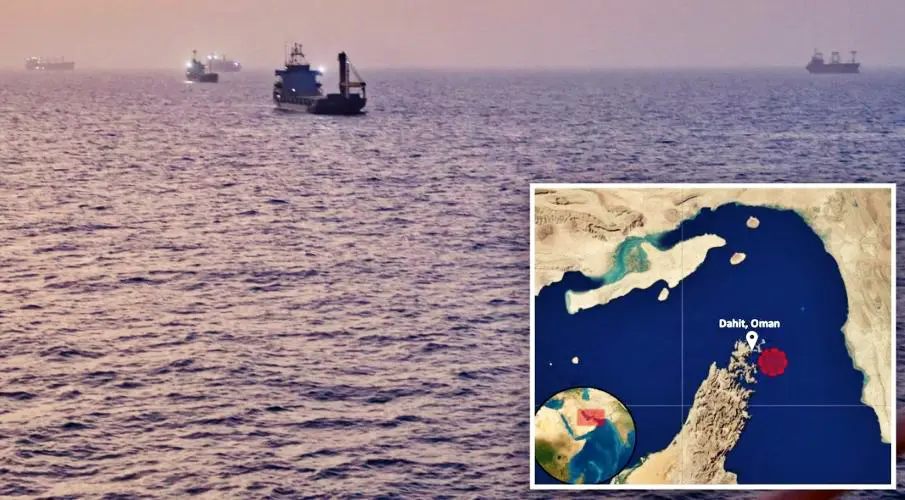
Donald Trump had assured the world that the Strait of Hormuz was open again. He had declared that Iran did not control the waterway. On Thursday, while Secretary of State Marco Rubio was in Bahrain negotiating security guarantees with the Gulf states, Iran's Revolutionary Guard fired on a container ship passing through the Strait of Hormuz. The vessel, Ever Lovely, belongs to Taiwan based Evergreen Marine and, according to both U.S. and Iranian officials, was struck by a drone. The bridge sustained damage. No one was injured. Shipping traffic through the strait came to a halt.
The Ever Lovely had taken the route along Oman's coastline - the corridor Oman had offered as a temporary alternative to the regular shipping lane, coordinated with the International Maritime Organization. That was precisely the route Iran had previously declared unacceptable. In a statement released by Iran's Tasnim News Agency early Thursday morning, the Revolutionary Guard said, "This route is unacceptable and extremely dangerous." All vessels, it said, were required to coordinate with the Revolutionary Guard Navy. Those who failed to do so would face consequences. Hours later, the Ever Lovely was hit. Brent crude oil rose more than 2 percent after the attack to around $75 per barrel. West Texas Intermediate, the U.S. benchmark, also climbed more than 2 percent to roughly $72. The International Maritime Organization suspended its plan to evacuate seafarers from the hundreds of vessels stranded in the Persian Gulf. Maersk, the Danish shipping giant, had successfully guided two of its stranded vessels through the strait as recently as Wednesday after conducting security assessments and coordinating with regional security partners. Three additional Maersk ships are expected to follow.
Trump is telling American farmers that Iran - the country he just bombed - is about to become their next dream customer. Iran has not commented so far, presumably because it is still busy attacking ships passing through the Strait of Hormuz.
Trump to farmers: "We have a new market coming up, and that's called the lovely country of Iran. It's a beautiful place. Would anybody like to go there? They're having a hard time with food, and we're going to be taking some of their money, we're going to spend it here, and we're going to be buying wheat, soybeans, and corn - a lot of it. That process is going to be starting very soon. It's going to be big."
The attack comes at a time when negotiations between the United States and Iran over the administration of the strait and Iran's nuclear program are already deadlocked on several key issues. The provisional ceasefire agreement of June 14 guarantees freedom of navigation but does not specify who controls maritime traffic. According to Jakob Larsen, Head of Maritime Safety and Security at BIMCO, the world's largest shipping association, that issue is "not sufficiently clear." Iran insists that coordination with the Revolutionary Guard is mandatory. Speaking in Bahrain, Rubio said that international waterways belong to no nation. "It is a fundamental principle of the modern world, without which the world would descend into total chaos." Only hours earlier, Iran had demonstrated the opposite in practice.
Trump: “Iran wants to make a deal with us very badly. We probably will. I think we will. The Strait is open”
Editor's Note: Iran attacked a commercial ship in the Strait of Hormuz today. They’re laughing at Trump.
An Iranian official, speaking on condition of anonymity, said Oman's offer of an alternative shipping corridor had angered Tehran because it undermined Iran's control over the strait. Oman, the official said, finds itself in a difficult position. It is working with Iran on a joint management system for the waterway while simultaneously facing American pressure to reject any form of monetization and keep the passage open. Without Iran, Oman cannot provide security guarantees for commercial shipping, the official said. And Iran will not tolerate intervention by third parties. Iran wants "this navigation system to function according to its own terms." That is not a new realization. It is the central problem Trump's ceasefire agreement failed to resolve and instead postponed.

Rubio was on a three day tour of the United Arab Emirates, Kuwait, and Bahrain in an effort to reassure the Gulf states. The provisional agreement with Iran addresses neither Iran's missile and drone program - which Tehran used during the war to attack countries hosting American military bases - nor the question of control over the Strait of Hormuz. Rubio assured the Gulf Cooperation Council that the interests of America's partners would be considered in every decision. The agreement, he said, must not "undermine the security, stability, or prosperity of any of our partners in the Gulf region." The Gulf states have broadly welcomed the peace effort but remain deeply skeptical of an agreement that leaves their core security concerns unresolved. Before the war, 130 or more ships passed through the Strait of Hormuz each day. On Wednesday, the busiest day since March 1, there were 70 vessels, including 29 tankers. Since May, the U.S. military has escorted more than 500 ships and 250 million barrels of crude oil through the strait. The attack on the Ever Lovely demonstrates just how fragile that arrangement remains.
What is unfolding in the Strait of Hormuz is not a negotiation between equal parties. It is a struggle over whose rules apply. Through the ceasefire agreement, Trump gave Iran a seat at the table overseeing the Strait of Hormuz. Iran is now using that seat to demonstrate that it intends to exercise it - with threats, with demands for transit fees, and now with a drone strike against a ship using a route Iran had not approved. Rubio's statement that international waterways belong to no nation is legally correct. It simply does not describe the reality Iran's Revolutionary Guard created on Thursday.
The war has exposed an on off switch controlling the world's most important energy shipping route. Trump did not remove that switch. He turned it into a subject of negotiation. The Ever Lovely shows whose hand is still resting on it.
Updates – Kaizen News Brief
All current curated daily updates can be found in the Kaizen News Brief.
To the Kaizen News Brief In English


Die Golfstaaten sind weder blind noch dumm.
Ob Rubio beruhigt und versichert oder nicht.
Die Realität steht vor der Tür und wer sieht und spürt es besser als die Golfstaaten.
Sie tun gut daran sich nicht mehr auf die USA zu verlassen. Nicht mit Trump, nicht mit MAGA.
Neue Bündnisse müssen geschmiedet werden.
Was ich nicht verstehe, Länder die so reich sind, haben sich nicht um ihre Verteidigungsfähigkeit gekümmert.
Es den USA überlassen.
Das viele Geld haben sie lieber in ihren dekadenten Luxus gesteckt. Jahrzehntelang.
Jetzt kommt die Quittung.
Der Iran (nicht die Bevölkerung) steht besser da, als vor Kriegsbeginn.
Dank Trump 🤬