
There is one sentence Donald Trump once uttered that says more about his presidency than any political analysis ever could. In early May, after American forces seized an Iranian tanker in the Strait of Hormuz, the president beamed at reporters like an excited child. "Who would have thought we could do something like this? We're practically pirates."
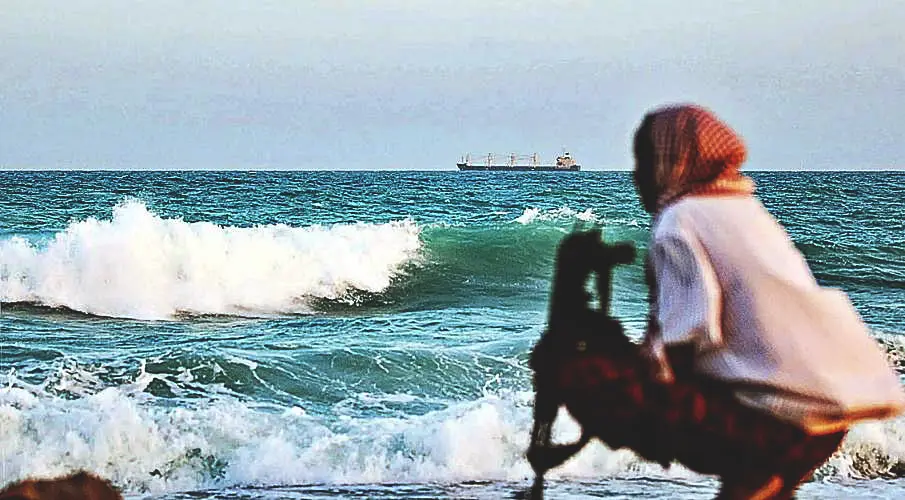
He did not realize how accurate those words were, and he certainly did not realize the irony behind them. Iranian officials did not describe the United States as "practically pirates" after that incident and similar seizures. They called America exactly what they believed it had become - sea raiders violating every accepted norm by capturing foreign ships and taking their cargo. Iran itself, meanwhile, has long been accused of terrorizing vessels operating near its own territorial waters. For both governments, seizing commercial ships became another instrument of war, an extension of military conflict. But that conflict awakened the real pirates, the men whose only profession is robbery at sea. Off the Horn of Africa, a thousand nautical miles from Trump's warships, men long believed to have disappeared raised their heads again. It is a chain of cause and effect that begins with Trump, even though he never laid eyes on a single pirate.
Where the State Disappears, the Sea Returns to Its Ancient Laws
To understand why piracy is returning, one first has to understand why it emerged in the first place. Somalia is one of the poorest countries on earth, torn apart by separatists, jihadists, and armed groups with no clear religious or political identity. The United Nations still classifies it among the world's least developed nations. In the 1990s, as Somalia descended into a civil war that claimed at least half a million lives, conditions were even worse. The government fled. The armed forces simply ceased to exist. Some soldiers and officers deserted. Others joined militias or criminal gangs. The Somali navy disappeared as well. Some of its ships were cut apart for scrap metal. Others were sailed by their crews into ports in Yemen and Kenya.

Into that vacuum stepped European and Asian industrial fishing companies. They sent massive factory trawlers into Somali waters that no longer belonged to anyone and stripped them without quotas or restraint. They did something else as well. They dumped waste there, often toxic waste that poisoned marine life. Somali fishermen watched foreigners steal their catch and pollute their waters, leaving them and their families with empty nets and hunger. Looking back, this is one cause many people prefer to ignore because it is deeply uncomfortable. Piracy did not begin as organized crime. It began as a response to a crime that had no name because it was committed by the wealthy against the poor.
In December 1991, Somali attackers seized the slow-moving cargo ship MV Naviluck, executed three Filipino crew members, and set the vessel on fire. It was not yet piracy in the modern sense because no ransom was demanded and no cargo was taken. It was a warning that almost no one noticed. The first genuine act of maritime piracy came in September 1994, when Somalis captured the cargo ship MV Bonsella, which was carrying medical supplies. They attempted to use the vessel to seize additional ships, discovered it was too slow for that purpose, and abandoned it after several days, but only after taking all the cash, valuables, and part of the cargo, exactly as pirates had done for centuries. From that moment on, such attacks became increasingly common.
The self-appointed authorities that emerged in the various parts of what had once been a united Somalia tried to control both the foreign fleets operating in their waters and the local fishermen who had taken up arms. They sold fishing licenses and quotas to one side, while hiring private security companies to protect foreign vessels from the other. But events unfolded very differently than planned. In March 2005, Somali security guards assigned to the Thai fishing trawler Sirichai Nava 12 mutinied after their wages went unpaid. They took the crew hostage and demanded $800,000. A few days later, British and American forces overpowered the so-called guard pirates. It was one of the first attempts to seize a ship not for looting but for extortion, and it ended in complete failure. Yet the very next successful operation, only two weeks later, proved that the idea had enormous potential.
From Hunger to a Profession
On April 10, 2005, armed men hijacked the Hong Kong gas carrier MV Feisty Gas off the Somali coast. The vessel was transporting liquefied petroleum gas from the United Arab Emirates. The pirates demanded half a million dollars and eventually accepted $315,000 in cash delivered to Somalia. The era of Somali piracy had begun. One successful hijacking alone, however, does not create an era. What transformed piracy into a force that shook global shipping and ultimately altered the entire architecture of international maritime security was the convergence of several disasters.

One of them arrived in the most literal sense of the word. The devastating Indian Ocean tsunami of 2004 sent massive waves crashing into Somalia's coastline, destroying fishing boats and tearing apart nets. Even worse, the waves broke open barrels and containers of toxic waste that had been dumped offshore for years. An environmental catastrophe followed. Fish stocks collapsed, and even fishermen who had managed to save their boats found themselves unable to sell their catch because people feared contaminated seafood. In a country with virtually no legal opportunities for survival, where many men possessed military experience and access to weapons, desperation became an industry.
Somali pirates hijacked more than a dozen vessels in 2005. By 2008, that number had climbed to forty-two. Not every attack succeeded. In 2011 alone, there were 237 reported attacks off Somalia, of which only twenty-eight ended successfully for the pirates. But ransom payments exploded. By the early 2010s, many Somalis likely looked back at those who had released the Feisty Gas for a mere $315,000 as men who had given away a fortune. The Guinness World Records even devoted an entry to the year with the highest ransom payments. In 2010, shipowners paid pirates a combined $238 million, averaging $5.4 million per vessel, with the overwhelming majority flowing into Somalia. The indirect costs to the global economy, however, from rerouted shipping lanes, soaring insurance premiums, and armed security teams, reached tens of billions of dollars between 2005 and 2012.

The idea that desperate, unemployed fishermen alone managed to shake global commerce has always been an attractive story, but it is only part of the truth. Once the first operations succeeded, former soldiers and experienced seamen joined the pirates. Field commanders and clan elders followed, supplying weapons, ammunition, satellite phones, powerful boat engines, and intelligence on passing merchant ships obtained through corrupt officials in Somalia and neighboring countries. Behind those commanders stood investors and financiers, wealthy Somali expatriates living in Kenya, the Persian Gulf, and Europe, willing to fund the training and arming of pirate groups in exchange for a share of future ransom payments from captured tankers and cargo ships.

For the men who actually boarded the ships, only a relatively small portion remained after so many others claimed their share. Of the $1.6 million ransom paid for the release of American journalist Michael Scott Moore, as much as ninety percent ultimately went to officials, clan elders, field commanders, and foreign investors.
The Man Who Saw What Was Hidden Behind the Stereotype
Michael Scott Moore traveled to Somalia in early 2012 to investigate a group of Somali pirates who were standing trial in Hamburg. Two years earlier, they had been captured while attempting to hijack the German cargo ship MV Taipan. It was the first piracy trial held on German soil in more than four centuries. Moore, who worked for Spiegel Online in Berlin and held dual American and German citizenship, traveled using his German passport together with filmmaker Ashwin Raman. Their security arrangements had been made through a Somali elder living in Berlin, Mohammed Sahal Gerlach, who maintained close ties with influential elders of the Sa'ad clan in the region.

Inside the Hamburg courtroom, several defense attorneys portrayed their clients as poor fishermen who had been forced into piracy against their will. The image of the Somali pirate as nothing more than a desperate fisherman proved remarkably effective before a European court, where almost none of the defendants' stories could be independently verified. When Moore arrived in Somalia, he discovered the same narrative repeated everywhere. In Hobyo, one of the country's best-known pirate strongholds, he met a commander who identified himself as Mustaf Mohammed Sheikh. His face remained hidden behind a cloth as he declared himself to be at war with the powers of the West. White people, he said, had attacked Somalia by emptying its coral reefs and dumping toxic waste along its shores. Some of those accusations were justified. Illegal overfishing and toxic dumping remain major problems along the African coastline. But pirates throughout history have often wrapped themselves in noble causes, and the Somalis were no exception. "They just want to buy khat," Gerlach later remarked, only half joking, referring to the mildly stimulating plant chewed by many pirate fighters.
After ten days, Moore believed his work was almost complete. Against his own instincts, he accompanied Raman to the airport because the road was considered dangerous. They traveled in a vehicle belonging to the regional president, accompanied by an armed Somali guard. None of it mattered because the pirates had already identified him. They had found Moore's author photograph in an old New York Times interview. They knew he was an American writer regardless of the passport he carried. On the return journey, along a dusty road lined with graves from Somalia's civil war, a pickup truck armed with a heavy machine gun waited for him. Around a dozen men jumped from the vehicle, fired into the air, smashed his wrist with Kalashnikov rifles, dragged him from the car, and beat him over the head. His glasses shattered in the dust. Because he was severely nearsighted without them, he spent the next two and a half years of captivity in an almost permanently blurred world, living in what was effectively near blindness.
During the first two months alone, he lost nearly forty pounds while surviving on bread, water, and canned tuna. For a time he shared captivity with Rolly Tambara, a man in his sixties with whom he formed a close friendship. One afternoon, nearly two years into his captivity, Moore noticed his guard's rifle lying unattended on a mat and briefly considered grabbing it. His guard Bashko, chewing khat, casually picked up the rifle, smiled broadly, and said almost cheerfully, "Michael, if the Americans come, you'll be killed." Moore already knew that. He later recalled that the men holding him eventually received so little money themselves that a dispute over the ransom ended in a gunfight in which five pirates were killed by their own comrades. It was an image that stripped away every illusion - greed consuming itself from within. After 977 days, Moore was finally released.
Every Victory Carries the Date of Its Own Expiration
Defeating the pirates was difficult precisely because there was no single headquarters, no Somali Tortuga whose destruction would have brought the entire enterprise to an end. The pirate groups were scattered across dozens of small coastal villages and floating bases, using large mother ships from which attack skiffs were launched whenever a suitable target appeared on the horizon. And targets appeared every day. One of the world's busiest maritime corridors runs through Somali waters, linking Europe with the ports of Asia, Australia, and East Africa through the Suez Canal and the Red Sea.

The pirates forced the global shipping industry to rewrite its own rules. Merchant vessels began crossing the waters off the Horn of Africa at much higher speeds. Crews built fortified citadels inside their ships, protected by reinforced walls and break-in resistant doors where sailors could barricade themselves during an attack. The United Nations established legal procedures allowing suspected pirates to be prosecuted in the courts of the Seychelles, Mauritius, and Kenya. That last step proved decisive because, before then, captured pirates were often simply released. No one could agree on who had jurisdiction over citizens of a country that barely possessed a functioning national criminal code.

Beginning in 2008, the European Union and NATO deployed naval forces off Somalia's coast. In January 2009, the multinational Combined Task Force 151 was established with a mandate specifically designed to combat piracy, a mission later reaffirmed under United Nations Resolution 2608 in 2021. Its ships and aircraft patrolled the region around the clock, with command rotating every three to six months among participating nations including Bahrain, Brazil, Denmark, Japan, Jordan, Kuwait, Pakistan, the Philippines, New Zealand, South Korea, Singapore, Thailand, Turkey, the United Kingdom, and the United States. Pakistan ultimately commanded the task force eleven times, more than any other participating country. Alongside it operated the European Union's Operation Atalanta, launched in 2008 in response to the unprecedented Somali piracy crisis. The mission protected the internationally recommended transit corridor and coordinated operations with organizations working inside Somalia, including the United Nations World Food Programme. Neither mission functioned as a permanent escort service. Both patrolled enormous areas of ocean.
Merchant vessels themselves adopted a comprehensive security doctrine known as Best Management Practices, eventually reaching its fifth edition. It required continuous twenty-four hour watches, immediate reporting of suspicious activity, removal of boarding ladders, reinforcement of vulnerable access points, installation of deck lighting, protective netting, razor wire, electric fencing, high-pressure fire hoses, evasive maneuvers at maximum speed during attacks, convoy operations whenever possible, and the deployment of privately contracted armed security teams aboard commercial vessels.
The American military presence in Somalia, numbering roughly seven hundred personnel, fought not only against jihadist organizations but also trained local security forces that confronted pirate groups on land and at sea. At the same time, hundreds of millions of dollars in annual American humanitarian assistance gave many potential recruits an alternative to piracy by providing basic survival without forcing them onto the ocean. Taken together, these efforts struck piracy so hard that in 2022 the International Maritime Organization announced its intention to remove Somali waters from the list of high risk maritime zones. It marked the formal recognition of a victory. The last successful hijackings had occurred in the spring of 2017. Before that, one had to look all the way back to 2012. Only one unsuccessful attack had been reported in April 2019 before incidents began reappearing in November 2023, with the assault on the MV Vela in August 2024 marking the latest attack of the old wave.
Make Piracy Great Again - What Is No Longer Fed Returns Hungry

Anyone paying close attention could already see the first cracks appearing. In 2021, during his first presidency, Trump withdrew all American troops from Somalia as part of the America First policy that sought to reduce the United States' global military presence. Piracy did not return overnight, but the withdrawal added another layer of instability to a country that had never truly recovered. Crime thrives where instability grows. In 2023, Trump's successor Joe Biden shifted part of the American naval presence away from Somalia toward Yemen, where the Houthi rebels were launching ballistic missiles at Israel, a close American ally.
Then Trump returned. One of the first decisions of his second administration in 2025 was dismantling USAID and rewriting America's entire humanitarian policy. The consequences are reflected in numbers that speak for themselves. American aid to Somalia fell from $476 million in 2024 to $70 million in 2025 and to just $3 million during the first three months of 2026. One of the poorest populations on earth became even poorer. For years Washington had deliberately funded development projects in Somalia's coastal communities to reduce poverty and keep young men from joining pirate gangs. That money disappeared almost overnight. Under the new administration, nearly all nonsecurity development assistance was suspended while Washington focused almost exclusively on direct counterterrorism operations against the Islamist group al-Shabaab. Where piracy had once been fought with bread, the conditions that created it were allowed to grow again.
That same year, years of international efforts to preserve Somalia's unity were effectively thrown aside. Trump first announced that his administration was considering recognition of the breakaway region of Somaliland. A few months later, on December 26, 2025, Benjamin Netanyahu's government in Israel formally recognized Somaliland as an independent state, becoming the first United Nations member to do so.

To understand the forces this decision unleashed, one must first understand Somaliland itself. The region declared independence in 1991 and has spent thirty-three years seeking international recognition while holding elections and maintaining relative internal stability. But a territory does not become a sovereign state simply because it declares itself one. Until the United Nations recognizes its independence, Somaliland remains, under international law, part of Somalia. Israel's calculation was strategic. It sought a foothold at the Horn of Africa along one of the world's most important shipping routes, an opportunity to monitor the activities of the Iranian backed Houthi movement across the Gulf of Aden in Yemen, establish an early warning system, and counter the growing influence of Turkey and Saudi Arabia in the region. For Israel, it was a calculated risk based on the belief that the strategic advantages outweighed the diplomatic costs.
Ethiopia has also increased Somaliland's strategic importance. Since Eritrea gained independence in 1993, Ethiopia has been landlocked and heavily dependent on Djibouti for access to the sea. Somaliland's port of Berbera offers a politically stable and geographically favorable alternative. That is why Ethiopia signed a memorandum of understanding with Somaliland in January 2024. Little of the agreement has actually been implemented, but it returned Somaliland's ambitions to the center of international attention. Even so, Ethiopia has remained cautious because of regional tensions, separatist movements within its own borders, and its close ties with China and Turkey, both of which firmly support Somalia's territorial integrity. The United States, despite repeated speculation, has not recognized Somaliland and officially continues to support Somalia's unity, largely because of its counterterrorism partnership with the federal government in Mogadishu, even though Israel's decision has reignited debate inside Washington.
Yet the image of Somalia as a failed state and Somaliland as a democratic oasis is far too simple. Unlike many separatist movements, Somaliland is not an entirely new political entity, and beneath its apparent stability lie deep historical divisions. Hargeisa does not control all the territory it claims. The eastern regions have never fully accepted its authority. That conflict erupted into violent fighting in Las Anod during 2022 and 2023, where local militias seized control and established what is now regarded as a separate federal state within Somalia. Here the story circles back to piracy. Neighboring Puntland, itself lacking international recognition, has long disputed several border regions with Somaliland. In the past, portions of Puntland's military spending were financed through revenues generated by piracy that local authorities quietly tolerated. Anyone who reignites this conflict also reignites piracy. It is one of the quiet lessons of this geography that, where no universally recognized authority exists, legality rarely governs. Utility does. Stability becomes a commodity that can be bought and sold, if necessary through the hijacking of foreign ships.
Attention Is Finite. The Ocean Is Not.
The war against Iran ultimately opened the gate. It shifted the attention of American and later European security forces almost entirely toward the Persian Gulf. Naval vessels that had once protected commercial shipping from piracy were reassigned there, while surveillance assets focused almost exclusively on that single region, often at the expense of others. At the same time, another factor was already reshaping global shipping. Even before the latest escalation involving the United States, Israel, and Iran, nearly half of all vessels traveling from Asia and the Persian Gulf to Europe had stopped using the Red Sea and the Suez Canal because of repeated Houthi attacks. Fearing strikes near the Bab al-Mandab Strait, the narrow gateway between the Red Sea and the Gulf of Aden, major shipping companies diverted their fleets around southern Africa, adding two to three weeks and thousands of nautical miles to every voyage. That route takes them directly past Somalia's coastline, through the very waters where piracy once reached its peak.

Now piracy is returning with force. During the three weeks leading up to May 8, 2026 alone, three commercial vessels were hijacked off Somalia and neighboring Yemen. Tim Walker of South Africa's Institute for Security Studies says the pirates once again sense that deterrence has weakened along Somalia's 3,300 kilometer coastline, the longest on the African continent. According to Lloyd's List Intelligence, at least two well equipped pirate organizations, operating primarily out of Puntland, are now active. They have seized large traditional dhows, the wooden sailing vessels used for local trade and fishing, converted them into mother ships, and now remain at sea for weeks at a time, launching attacks against merchant traffic far from shore. Troels Burchall Henningsen of the Danish Institute for Strategy and War Studies describes these operations as requiring significant investment, navigation equipment, weapons, boarding gear, and logistics. This has nothing to do with the image of a desperate fisherman drifting in a small boat. One tanker bound for Mogadishu was seized near the coast at the point where it was most vulnerable.

At present, the pirates are holding three vessels together with their crews: the tankers Honour 25 and Eureka and the cargo ship Sward. Loaded fuel tankers have become the most valuable targets at a time when the same war with Iran has pushed fuel prices to record highs. The higher oil prices climb, the higher the ransom demands become. The story of the Togolese flagged tanker Eureka illustrates the point perfectly. The pirates initially demanded $3 million. Frustrated by slow negotiations, they later increased their demand to $10 million. The soaring oil prices driven by the conflict in the Persian Gulf only fueled their appetite.
At the height of the previous piracy crisis in 2011, the global economic damage was estimated at roughly $7 billion annually. Only a tiny fraction of that amount, about $160 million, actually reached the pirates in ransom payments. The rest disappeared into military operations, longer shipping routes, higher fuel consumption, additional security equipment, and armed protection teams. Even today, the conflicts across the Middle East have already driven insurance premiums sharply higher while adding approximately $1 million in fuel costs to many commercial voyages. A full scale resurgence of Somali piracy would push those costs even higher and place additional strain on global trade. Henningsen summarizes the most effective defense against piracy in a sentence that sounds almost too simple to be true. Not a single merchant vessel carrying armed security personnel on board has ever been successfully hijacked off Somalia.
Power Rarely Lands Where It Is Aimed
In the end, the American government faces a contradiction that will be difficult to escape. It is increasingly unlikely that the conflict with Iran can honestly be presented as a victory. The overthrow of the Ayatollah regime remains improbable. Tehran will retain both its armed forces and its extensive network of regional proxy groups. However this war ends, it will be far removed from anything resembling Iran's unconditional defeat.

Most likely, it will conclude with Iran agreeing to reopen the Strait of Hormuz to international shipping and once again promising not to develop a nuclear weapon. Yet before the war, no one had blocked the Strait of Hormuz, and Tehran has insisted for years that it has no intention of building a nuclear bomb. The end of the conflict would therefore amount to little more than a return to the situation that existed before the war began. The United States will have spent billions of dollars, thousands of people will have died, and the long forgotten Somali pirates will have been handed the opportunity to rise again.
Trump once said he wanted to be like a pirate. In the end, he succeeded, though not in the way he imagined. He captured no treasure. Instead, he released the very raiders that others had spent years trying to contain by taking away the bread that kept them on land, withdrawing the guards they feared at sea, and directing the world's attention toward another war. That may be the quiet lesson running through this entire story. Power rarely produces its greatest consequences where it is aimed. It produces them where no one is watching. A president boasts in the Strait of Hormuz that he is practically a pirate. A thousand nautical miles away, a man climbs aboard a captured dhow and sails once again, a man the world believed had disappeared from the sea forever. One merely plays with the word. The other lives by it. Between them lies an ocean that neither of them has ever truly seen.
Updates – Kaizen News Brief
All current curated daily updates can be found in the Kaizen News Brief.
To the Kaizen News Brief In English


Wow, was für eine Recherche.
Vielen Dank für die Mühe, dass alles in den richtigen Kontext zu rücken.
Anstatt, dass Medien immer wieder mal „nur“ über ein überfallenes Schiff berichten, wäre Eure Recherche wichtig.
Wer kennt schon all die Zusammenhänge.
Mir war Vieles nicht bekannt.
In Eurer Recherche steckt so viel an Informationen.
Ich musste das mehrmals lesen.
Ich danke dir ….