
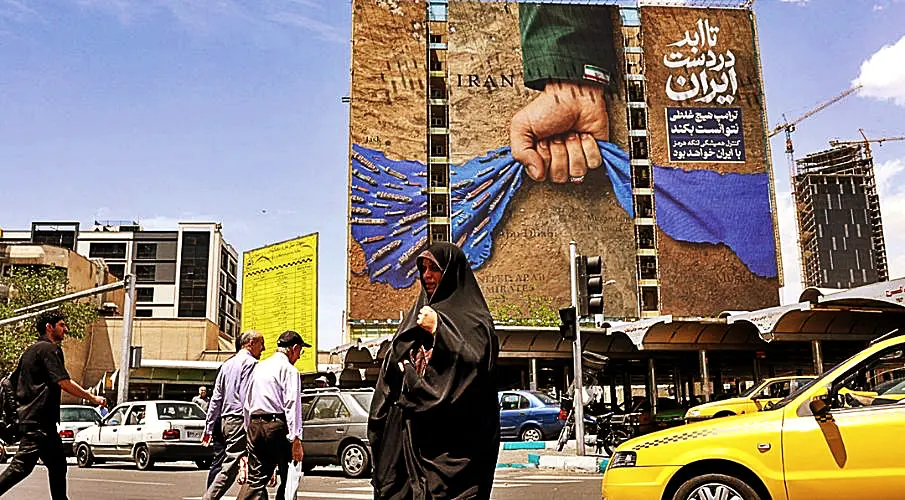
While Washington continues wavering between threats and negotiations, Iran is tightening its grip over the Persian Gulf more and more aggressively. Tehran has created a new state authority that will in the future inspect ships, approve passages and impose transit fees for movement through the Strait of Hormuz. Iran is therefore effectively institutionalizing its control over one of the world’s most important trade routes.

According to shipping service Lloyd’s List Intelligence, the new authority is already sending forms to shipping companies. The name of the institution itself makes the direction unmistakably clear. The “Persian Gulf Strait Authority” apparently claims to be the only legitimate body authorized to approve passage through the strait. The international shipping industry is already experiencing massive unrest because of it. Hundreds of commercial vessels remain trapped in the Persian Gulf and still cannot reach open waters.
The consequences now extend far beyond the region itself. Large portions of global oil, gas and fertilizer transport pass through the Strait of Hormuz. The uncertainty is driving energy prices higher and placing additional strain on the global economy during an already weak economic period. At the same time, the United States continues blocking Iranian ports. Two direct pressure systems are now facing each other head on - American blockades on one side and Iranian control over Hormuz on the other.

From the standpoint of international law, the situation is moving into extremely dangerous territory. International experts point out that demands for permits or transit fees could violate international maritime law. The United Nations Convention on the Law of the Sea generally guarantees peaceful passage through territorial waters. The United States and several Gulf states are therefore now attempting to push a resolution through the United Nations Security Council. Iranian allies such as Russia and China, however, previously blocked similar initiatives.

At the same time, Washington continues trying to pressure Tehran economically and politically. The US Treasury Department imposed new sanctions against Iraqi Deputy Oil Minister Ali Maarij Al-Bahadly, several Iraqi companies and leaders of Iranian backed militias. The American government accuses them of relabeling Iranian oil as Iraqi oil in order to evade sanctions and finance militant groups. Treasury Secretary Scott Bessent stated that the United States would not stand by while Iran uses Iraqi oil to finance terrorism against the United States and its partners.
At the same time, Washington is once again sending contradictory signals. Donald Trump unexpectedly halted the American military plan “Project Freedom,” under which the United States intended to create a protected corridor for commercial vessels through the Strait of Hormuz. According to information from Saudi Arabia, the kingdom refused all support for the operation. A Saudi official stated that Riyadh made it clear to Washington that neither Saudi territory nor Saudi military bases would be used for a forced reopening of the strait. Tehran also reportedly received assurances that Saudi Arabia would not participate in such an operation.

On May 6, 2026, Iranian Foreign Minister Abbas Araghchi met Chinese Foreign Minister Wang Yi in Beijing while tensions surrounding the Strait of Hormuz continued escalating. China pushed for the reopening of the crucial trade route through which roughly one fifth of the world’s oil trade passes. Iran simultaneously made clear that Tehran would not back down from its demands or from its control over Hormuz.
The ceasefire between the United States and Iran has largely held since April 8, but the situation remains extremely fragile. Earlier American claims that military operations had ended have now once again been replaced by fresh bombing threats. Trump continues pressuring Tehran and demanding an agreement that would allow the resumption of Iranian oil and gas exports. The actual negotiations are now taking place primarily through Pakistan. Foreign Minister Ishaq Dar again spoke by phone with Iranian Foreign Minister Abbas Araghchi. Pakistani government spokesman Tahir Andrabi stated that Islamabad expects an agreement “sooner or later.” Prime Minister Shehbaz Sharif publicly said Pakistan remains in contact with both Washington and Tehran day and night in an effort to end the war and stabilize the ceasefire.
Iran itself continues remaining publicly cautious. Foreign Ministry spokesman Esmail Baghaei stated that Tehran is currently reviewing the latest American proposals but has not yet reached a decision and has not delivered any response to Washington so far.
Additional tensions are now also emerging around the Vatican. US Secretary of State Marco Rubio met Pope Leo XIV after Donald Trump repeatedly publicly attacked the American pope over his calls for peace in the Middle East war. Behind the scenes, the meeting reportedly aimed at calming relations with the Vatican once again.
Inside Iran, investigations indicate that the new Supreme Leader Mojtaba Khamenei is now personally overseeing the negotiations. President Masoud Pezeshkian stated on state television that he met with Khamenei for more than two hours and described his behavior as “sincere.” Since his appointment in March, however, Khamenei has rarely appeared publicly. He assumed office after his father Ali Khamenei was killed during the first attacks of the war.
While diplomats continue negotiating, the Strait of Hormuz therefore remains one of the most dangerous places on Earth. Any further incident could destroy the fragile ceasefire within hours - with consequences reaching far beyond the Middle East.
Updates – Kaizen News Brief
All current curated daily updates can be found in the Kaizen News Brief.
To the Kaizen News Brief In English


Nun hat Trump sogar die Saudis verärgert.
Einen wichtigen Verbündeten im Nahen Osten.
Eine große Frage ist, werden andere Anreiner mit ziehen?
Dann bröckelt der Einfluss der USA im Nahen Osten massiv.
Was ist mit der südlichen Route?
In den Gewässern von Oman?