
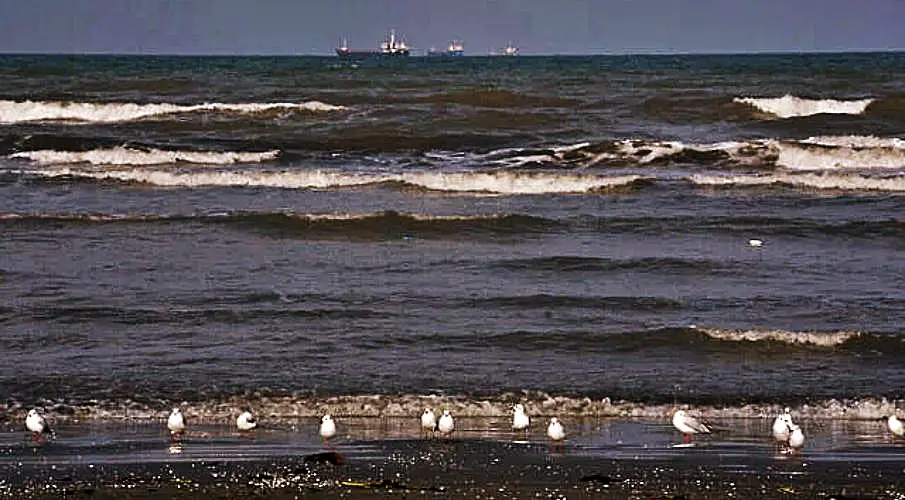
Hundreds of miles north of the Strait of Hormuz, a second supply line of the Iran war is now operating. No television cameras follow it. No American destroyers monitor the passage there. No Western navy can stop ships in those waters. That is exactly why the Caspian Sea is becoming one of the most important strategic zones of this conflict.

When Israeli fighter jets bombed the Iranian naval port of Bandar Anzali in March, the strike initially appeared unusual to many observers. Bandar Anzali is not located on the Persian Gulf, but on the southern edge of the Caspian Sea. Israel claimed it destroyed several Iranian naval vessels there and described the strike as one of the most significant attacks against Iran during the ongoing fighting. Only gradually is it becoming clear why this port has suddenly become so important.
While the Strait of Hormuz remains effectively blocked and American warships stop tankers near Iranian ports, part of Iran’s supply chain is increasingly shifting northward. That is exactly where the new connection between Moscow and Tehran begins. Russian cargo ships are now reportedly delivering drone components, grain, machinery, oil products and other goods directly to Iran through the Caspian Sea. According to multiple reports, American officials believe Russia is helping Iran rebuild its destroyed drone capabilities. Iran reportedly lost around sixty percent of its drone arsenal during the latest attacks.

The Caspian Sea offers one decisive advantage. Unlike in the Strait of Hormuz, the United States cannot inspect or seize ships there. Access is limited to Russia, Iran, Kazakhstan, Turkmenistan and Azerbaijan. For Western sanctions, this creates an almost sealed-off zone in which military and economic shipments become far more difficult to monitor.
Another problem for Washington is also emerging. A significant portion of shipping traffic is now operating in so-called Dark Mode. Cargo vessels switch off their transponders or transmit manipulated location data. According to several shipping observers, this practice is increasing dramatically between Russian and Iranian ports in particular. During the Ukraine war, Russia and Iran already used the Caspian Sea for weapons and ammunition deliveries. At that time, Iran transported Shahed drones toward Russia. Today, traffic is increasingly moving in the opposite direction as well.
The economic importance of the route is growing rapidly at the same time. For weeks, Iran has been scrambling to shift supply chains away from the south and toward the north. According to Iranian statements, four Iranian ports on the Caspian Sea are now operating around the clock. Through them, wheat, corn, animal feed, sunflower oil and other essential goods are entering the country. Russian port statistics also show a significant increase in traffic. Millions of tons of Russian wheat that once moved through the Black Sea are now being transported through the Caspian Sea into Iran.

The reason is obvious. Despite the ceasefire, the Strait of Hormuz remains extremely dangerous. According to U.S. Central Command, dozens of commercial ships have been stopped or turned back since mid-April. Several vessels were reportedly even “disabled” after ignoring American instructions. At the same time, Iran continues openly threatening attacks on American warships and other targets in the region. The result has been a massive collapse in shipping traffic. Instead of the usual roughly 130 ships per day, only a small number of cargo vessels are currently passing through the strait. Tankers are avoiding the route almost entirely.
Around 1,600 ships are now stranded inside the Persian Gulf. The consequences extend far beyond the Middle East. Oil prices are rising, insurance costs are exploding and supply chains are coming under pressure. Even European governments are now openly discussing international naval coalitions to secure the Strait of Hormuz again after the war. Britain is already deploying additional warships into the region.
At the same time, this creates a new geopolitical opportunity for Russia. Moscow can assist Iran without directly challenging American blockades in the south. The Caspian Sea is therefore becoming a kind of protected back door for two countries that are more heavily sanctioned than almost any other nations in the world. For years, Russia and Iran have been working on a massive North-South trade corridor stretching from the Baltic Sea to the Indian Ocean. Much of it remained theoretical for a long time. The war is now abruptly changing that.
The situation is becoming especially delicate for Washington because the region is divided internally among American agencies. Different military commands and multiple State Department divisions are each responsible for different Caspian coastal states. Some experts are now openly describing the region as a geopolitical blind spot for the United States.
That is precisely the true significance of the Caspian Sea. While the world focuses almost exclusively on the Strait of Hormuz, a second wartime supply route has already emerged to the north. A route that is barely controllable, enables military deliveries and keeps Iran economically alive despite overwhelming American power.
Updates – Kaizen News Brief
All current curated daily updates can be found in the Kaizen News Brief.
To the Kaizen News Brief In English


Tja – und Trump kuschelt immer weiter mit Putin, der wiederum liebend gern den Iran darin unterstützt, die USA zu schwächen. Es ist so absurd.
…das stimmt, es ist so grotesk mittlerweile alles, ….
Aber Trump verbeugt sich weiterhin vor Putin.
Mir fällt immer wieder Agent Krasnov ein.
Putin muss quasi kein Geld und keine echte Mühe investieren.
Trump liefert Infos via TruthSocial frei Haus.
Trump entscheidet immer Pro Russland.
Trump kann oder will nicht verstehen, dass Putin kein Freund ist.
Nicht einmal ein „Partner“ auf Augenhöhe.
Trump sieht mögliche Deals mit Russland, die vor allem seine Taschen fallen sollen.
Mit dieser Aussicht gängelt Putin Trump.
Während er Allianzen mit dem Iran, China und Nordkorea manifestiert und sich über Trump amüsiert.
Und seien wir ehrlich.
Wäre die Krim noch ukrainisch, würde das mit der Handelsroute ganz anders aussehen.
Auch ein Grund, warum Putin die Krim nie aufgeben wird.