
On February 21, Samantha Sanchez went with her husband, Allen Tayson, to an appointment with U.S. Immigration and Customs Enforcement in San Jose. It was supposed to be about adjusting his immigration status. About 10 minutes after Tayson had been called in, an employee came over to Sanchez and their children, ages 5 and 14. Her husband was being detained. Sanchez said she heard ringing in her ears and felt her heartbeat getting louder and louder. Her daughter tugged on her shirt and asked where her dad was. Her son tried to calm his mother down. After the family was escorted out of the building, Sanchez sat in the car for 20 minutes. She could not drive. She called her brother.

The Tayson family traveled to Lake Tahoe, California, in December 2025 to celebrate Christmas and their daughter’s birthday.
One thought kept her going at first: Once Tayson was transferred to an immigration detention facility, the family would at least be able to visit him. She pictured being able to touch her husband again. Then he was sent to the California City Detention Facility. There, plexiglass separates families from each other. Sanchez is now 7.5 months pregnant. Her husband has not touched her growing belly since his detention and has not felt a single kick from his unborn child. He has not been there for a single doctor’s appointment. A hug, something hardly worth mentioning outside those walls, suddenly becomes an unreachable luxury behind them.
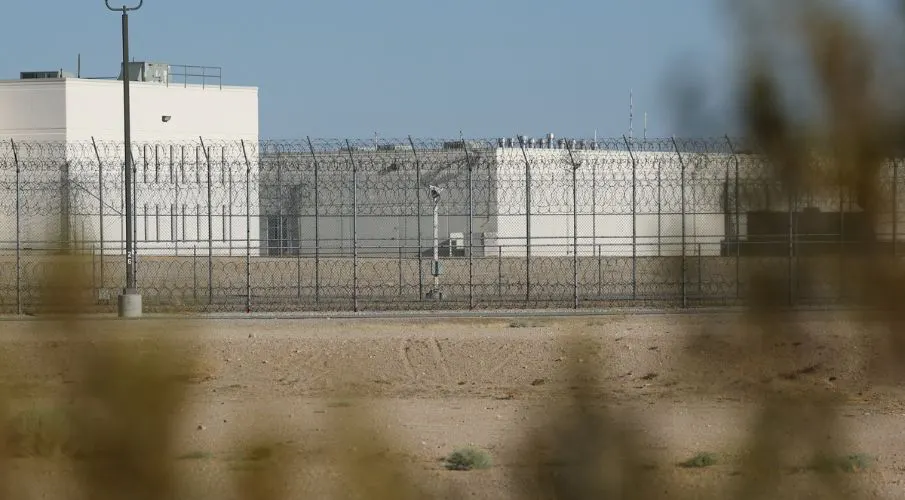
The California City Detention Facility is, according to the available information, the only immigration detention facility in California that does not allow contact visits. Most of the people being held there have no criminal record. Even so, months can pass while their cases move through the system and their families can only see them through glass. At the same time, families are struggling to scrape together money for attorneys. The very human contact that could give them at least some reassurance ends at the glass. CoreCivic, which operates the facility, did not respond to a request about the policy.
Before Tayson was detained, the family lived a pretty ordinary life. That is exactly why so much is missing now. On weekends, they took trips around California or did things with the kids. On Sundays, they would start the morning by going grocery shopping together, then head out for lunch. Later came laundry and cleaning the house. In the winter, they went to Lake Tahoe, in the summer to Disneyland. They documented some of those trips on YouTube. Tayson said he had consciously devoted his time to his family and tried to give his children memories he never had growing up.
Sanchez now gets up early before the kids wake up. Then she cries. She wants to get that moment out of the way before her children see her. What weighs especially heavily on her is the thought that her unborn baby is feeling her pain and stress too. Afterward, she wipes away her tears, washes her face and tries to carry herself through another day. Sometimes normal life is barely more than a closed bathroom door.
Tayson faces deportation to the Philippines. He has not been there since he was 9 years old. So far, he has even asked his family not to visit him in California City. The reason is sitting right there in front of the visiting chair: the glass. More than 10 years ago, Tayson had already been incarcerated once and was not allowed contact visits then either. His son was still a toddler. When he tried to hug his father, he ran straight into the glass. Tayson does not want to put his children through that experience a 2nd time. So all that is left are phone calls and video calls. But even that connection runs on a meter. According to the available information, the calls cost between 7 and 25 cents per minute and are often cut short because of it. Sanchez is not working right now because of her pregnancy. Her husband’s income is gone. Groceries and baby supplies still have to be paid for. Then there are the legal costs. Under conditions like these, even a longer conversation with your own father turns into a decision about money.
The children are paying in another way too. Tayson’s son stayed out of school for 4 weeks after the detention to cope with what had happened. His 5-year-old daughter asks about her father every day and prays for a miracle that will bring him home. She wants to know when she can see her dad. When he will be able to hold her hand again. Sanchez can only tell her that they have to wait. Out of that waiting, organized resistance has now grown. Tayson and hundreds of other people held at the California City Detention Facility are working with the California Collaborative for Immigrant Justice and the California Immigrant Youth Justice Alliance. Interfaith Movement for Human Integrity is involved as well, along with the Rapid Response Network of Kern. The campaign is called Hugs Beyond Bars. Its demand is almost painfully simple: People in immigration detention should be allowed to touch their loved ones during a visit.

Samantha Sanchez and her husband Allen Tayson during a trip to Lake Tahoe, California, in 2025.
Valeria Suarez, a community and legal organizer with the California Collaborative for Immigrant Justice and a lead organizer with Hugs Beyond Bars, said she had heard the same pain over and over again in conversations with detained people. For many of them, not being able to hug their families weighs especially heavily. Some relatives stop visiting altogether because the only option is to sit behind plexiglass. Yet the California City Detention Facility already has a visiting room. The building was previously used as a prison by the California Department of Corrections and Rehabilitation. The physical space is already there.
A report by the California Department of Justice cites staffing shortages as the reason contact visits are not being allowed. At the same time, the department found that CoreCivic was violating its own policy by denying them. The company had previously submitted a visitation policy to the California Department of Justice stating that physical contact should be allowed. On paper, the hug already exists. Between that paper and a child who wants to touch his father, apparently, sits a staffing decision. Edwin Carmona-Cruz, co-executive director of the California Collaborative for Immigrant Justice, sees in that the logic of private detention. CoreCivic has the resources to provide what is required, he said. Spending less money to run the facility, however, means more profit for shareholders, in his view. His 2nd accusation is even more serious. He believes the harsh conditions may be intended to wear detained people down until they sign deportation papers and give up their legal fight.
Tayson describes exactly that effect from inside his dorm. Hopelessness and emotional exhaustion are constantly visible there, he said. People are more likely to give up their legal options because they can no longer take the conditions. Some do not get a final hug from their loved ones before deportation. Others cannot say goodbye to a terminally ill family member. For Tayson himself, another possibility is coming frighteningly close: His child could be born without him ever being allowed to hold the baby. The due date is approaching. His next hearing is not until December.
At least 7 dorms inside the California City Detention Facility have now written letters to the head of the facility demanding contact visits, according to Suarez. Hugs Beyond Bars has also collected more than 1,200 signatures. The campaign is calling on California Senator Alex Padilla to launch a joint effort in Congress. Other lawmakers would then be asked to put pressure on U.S. Immigration and Customs Enforcement and CoreCivic. At the same time, they are being urged to speak directly with detained organizers and hear their accounts firsthand.
Suarez sees the fight as part of a long-running resistance led by detained people themselves against conditions in facilities like these. Sanchez also believes public involvement matters. Many immigrant families are afraid to speak out. Some also believe their voices cannot change anything anyway. Together, that feeling can change. As long as there is still some fight left in them and people stick together, they at least know they are not alone, Sanchez says. Carmona-Cruz sees contact visits as just 1 step on a much longer road. People should once again be able to fight their immigration cases outside facilities like these, in their communities and with their families. In his view, the facilities themselves should be shut down. His argument is radical and at the same time very simple: Nothing good comes out of these places for the people trapped inside them.
Until then, a pregnant woman is fighting for the right to touch her husband’s hand again. A 5-year-old girl is waiting for her father to hold hers. Between them stands plexiglass, paid for and maintained by a system that now treats a hug like a security risk.
To be continued ...
Updates – Kaizen News Brief
Alle aktuellen ausgesuchten Tagesmeldungen findet ihr in den Kaizen Kurznachrichten.
To the Kaizen News Brief In English


