
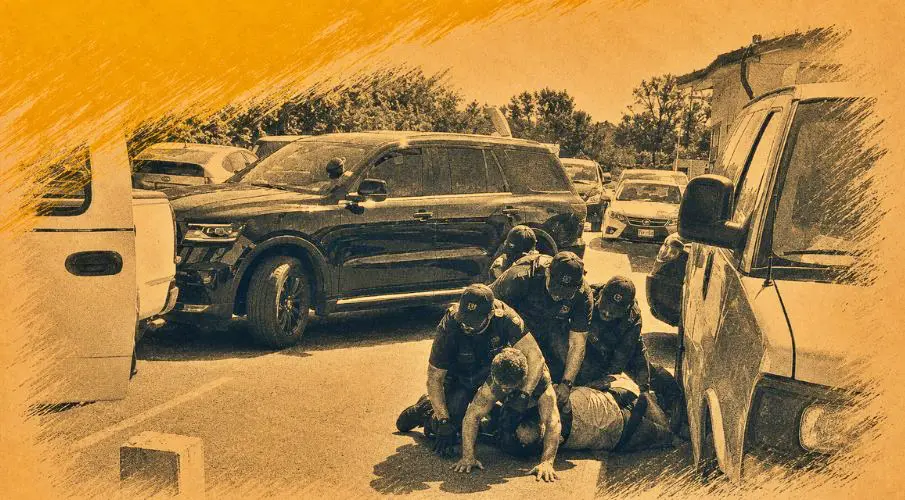
Nine to eleven arrests, a woman observing ICE who was sprayed with bear spray, and an American citizen who was released at a hospital after the early morning operations.
Santa Barbara - Before Santa Barbara had even awakened, immigration authorities had turned parts of the city into something else on Father’s Day. Before seven in the morning, on Sunday, June 21, seven ICE vehicles drove into neighborhoods in the west and east. Between nine and eleven people were arrested over unspecified allegations or none beyond questions about their immigration status. What began as fear and pursuit, as detention and uncertainty, did not affect only those who had been targeted. Court dates have already been scheduled for all detained individuals so they can regain their freedom as quickly as possible.

Among those detained were three mariachi musicians, traveling early in the morning near San Pascual and Mulberry Street. Whether they had already been on their way to play for fathers, as is a tradition among Mexican immigrants on Father’s Day, or were only heading there, accounts differ. The larger finding remains untouched by that. On a family holiday, June 21, 2026, the agency entered a neighborhood and took away men whose morning revolved around one of the day’s most personal customs. The operation also reached those near San Pascual and Sola Street, where a woman who belonged to an observing group was sprayed by an officer with bear spray. A quoted Homeland Security spokesperson specifically clarified that it was bear spray, not pepper spray. The allegation remains attributed, but it touches on a question of responsibility, because where those documenting government action are met with force, the public memory becomes harder to protect.

This is not new. Earlier this year, local reporting already described how ICE used force against observers during an operation in the east. Those who film and bear witness are part of the record, and when they are pushed away or sprayed, the community loses one layer of protection against disappearance and denial, against silence. On that Father’s Day, officers also detained an American citizen and later released him at a hospital in Oxnard, where he was treated for injuries after it apparently became clear that he was a US citizen. His significance remains clear nonetheless. Immigration enforcement can harm a person before the state has clarified who they are and whether they should have been detained at all. The case is going to court. Concerns over safety extend beyond the arrests. Agency vehicles reportedly drove through the city at dangerous speeds, around eighty miles per hour on San Andres Street and more than one hundred miles per hour entering Highway 101. Officers are also said to have driven in circles beneath an overpass. These claims remain attributed to observers, but they belong in the record because an operation does not happen on paper. It happens in neighborhoods, on streets, near homes, and around people who never chose to become part of a federal operation.

Local police had not been informed. Their chief, Kelly Gordon, said they had not known ICE was operating in the city and had received no emergency calls after one in the morning matching the reports from the west side. At the same time, she said that did not mean the reported events had not happened. We could only stare in disbelief. Responsibility therefore remains unresolved. When federal officers move through city streets without the city’s knowledge and the clearest account afterward comes from journalists and observers, residents are left to piece together what happened after the operation is already over.
An operation was called an enforcement action, but what people experienced reaches further than a file. It turns a holiday morning into a matter of public safety, pulls musicians and observers, drivers and neighbors, and presumed citizens into the same danger, and leaves hospitals and authorities with the consequences while federal agencies decide what they confirm. Immigration enforcement does not stop at status. It changes the safety of the street and the question of who still feels free to work, drive, gather, celebrate, and document what the state does. Immigration enforcement does not end when the vehicles leave the neighborhood. It leaves behind families searching for answers, workers exposed to detention, observers and journalists encountering force, and communities trying to preserve what happened before the record disappears. There is a power that can hurt a person before it knows their name and that chooses the very day when fathers are meant to be serenaded. Fear does not need a criminal charge in its calculation. What remains is a street where people feel watched and a state that decides what is confirmed while citizens must assemble the truth after it has already moved on.
In Germany, such scenarios also threaten if … : Example Mecklenburg-Vorpommern

In Mecklenburg-Vorpommern, this way of thinking can be read in a single document, the AfD migration platform in what they truly call a governing program for the state. It begins with the claim that serious crimes committed by non German offenders have risen sharply, suffering that the red-red government supposedly allowed, and from this derives the maximum hardness of the rule of law. On this single unsupported sentence, it builds an entire apparatus. A police task force against foreign offenders, reducing accommodation to a few large facilities, departure centers outside communities, dedicated detention for deportation, and electronic ankle monitors. In those facilities there would no longer be cash support but what the party calls the bed-bread-soap principle, reducing a person to a ration. Those who help become targets, from payment cards to organizations such as Greifswald Seebrücke Helps and the Refugee Council, whose funding would end. Syrians living in the state would lose their protection status and be prepared for return. Unaccompanied boys from age sixteen onward would be moved from youth services into collective accommodation and have their age reviewed. The state’s integration law would be replaced with a migration order law that places the interests of Germans, we call them AfD followers, at the center. Family reunification would be suspended and Ukrainian benefit recipients reviewed, and everyone whose protection ends should return. At the end, the document names one religion, Islam, which it seeks to tightly restrict and whose organizations it would force into self monitoring.
All of this stands on a foundation the numbers do not support. The program names a threat without quantifying or proving it and turns it into law before anyone has tested it. But anyone who actually reads the statistics does not find the danger where the finger points. They find it somewhere else entirely. The state domestic intelligence agency published its 2025 report on June 11 of this year, and for the first time counted more than two thousand right wing extremists in Mecklenburg-Vorpommern, exactly two thousand thirty. One year earlier there had been one thousand nine hundred fifty, twenty years earlier twelve hundred. The curve has known only one direction for years, upward, and it is getting younger, and more than half of the state’s total extremist potential falls into this one area. Right wing extremism, according to the agency’s assessment, remains the greatest threat to democracy in the northeast. The year before, politically motivated crime had already reached a record level, almost three quarters higher than before, and by far the largest share of that, more than two thousand incidents, was motivated by the far right.
That is the danger that is growing, counted and documented, with dates and in an official report, while the party invents another one. That is the truly disturbing part, and it reaches beyond this one party. Such thinking does not need reality. It replaces reality with a story and then arranges a country around it. A democracy can endure many things. It can endure conflict and error. It can even endure anger. What it cannot endure is a power that decides which numbers count and turns reality itself into something negotiable. Whoever wants to govern with invented numbers will also govern with invented enemies. And a country that trades its real dangers for invented ones loses the ground on which democracy stands, the willingness to hold truth higher than its own image of truth.
Updates – Kaizen News Brief
All current curated daily updates can be found in the Kaizen News Brief.
To the Kaizen News Brief In English


Unglaublich furchtbar 😞
All die willfähigen Helfer, die gerne Gewalt anwenden, die Sicherheit von Bürgern massiv gefährdet.
Und es soll nicht einen einzigen Notruf gegeben haben.
Wie wahrscheinlich ist das denn?
Hat Newsom nicht ein Gesetz unterzeichnet, dass ICE sich an geltende Gesetze halten muss?
Wo war die Polizei als die ICE Wagen, sicher unmarkiert, durch die Strassen rasten?
Erst Ihr und Anwohner dokumentieren das und bringen es an die Öffentlichkeit.
… ja das ist es, aber wenn du doch die wenigen reaktionen siehst, merkt man, die meisten haben die gefahr noch überhaupt nicht realisiert