
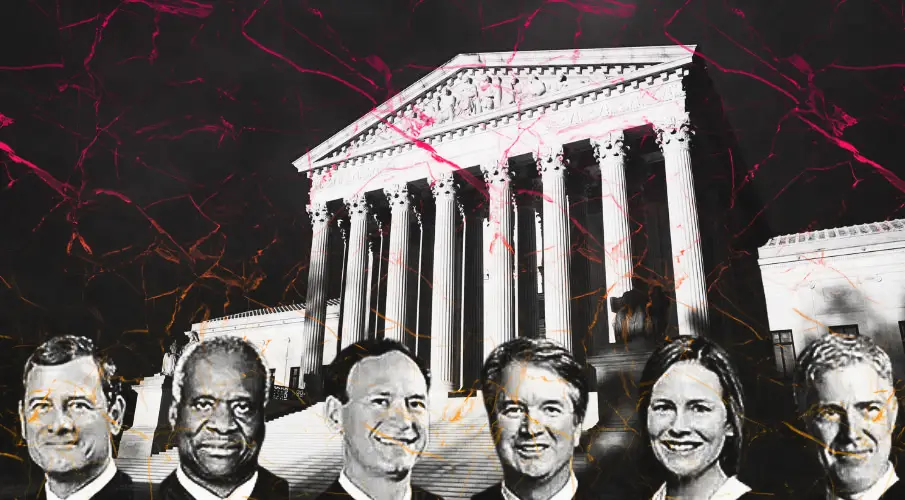
Washington D.C. - The Supreme Court of the United States issued a ruling that reveals far more than America's approach to the death penalty. In a five to four decision, the Court allowed previous rulings to stand that prohibit the execution of people with intellectual disabilities. At the center of the case was Joseph Clifton Smith from Alabama, a man whose school records had documented long before his murder trial that he required special educational assistance because of intellectual limitations. Despite that, the state of Alabama continued trying to execute him. In the end, the dispute revolved around a question that could hardly be more disturbing: can a single IQ test determine whether a person is allowed to live or will be killed by the state?


The September 18, 1998 edition of the Mobile Register reported on an Alabama jury's decision to sentence Joseph Clifton Smith to death for a robbery murder. Smith had beaten sixty five year old carpenter Larry Reed to death. The jury delivered its recommendation for the death penalty after only about one hour of deliberation.
Even then, the report included references to Smith's intellectual limitations. His mother told the court that her son had attended special education classes, had started using alcohol and drugs at an early age, and was "borderline intellectually disabled." Former teachers confirmed similar problems. Despite that, the jury chose the death penalty.
The case of Hamm - the state of Alabama, represented by prison commissioner John Hamm - versus Smith occupied the Court for months. Alabama argued that Smith was not intellectually disabled enough to qualify for protection under previous rulings. His attorneys countered that several documented test results placed him within the range of mild intellectual disability. In total, five IQ tests existed. Four of them placed him within the lowest range of the population. That point reveals the coldness of such proceedings. Because suddenly the issue is no longer guilt or remorse, but which number a court ultimately decides matters more.

The following five justices voted to dismiss Hamm v. Smith and therefore leave existing protections for people with intellectual disabilities in place:
- Sonia Sotomayor
- Elena Kagan
- Ketanji Brown Jackson
- Amy Coney Barrett
- Brett Kavanaugh


The following four justices dissented:
- Clarence Thomas
- Samuel Alito
- John Roberts
- Neil Gorsuch

Justice Sonia Sotomayor made clear in her opinion that intellectual disability cannot be determined through isolated scores alone. Together with Ketanji Brown Jackson, she explained that the Court could not establish a rigid formula for balancing multiple IQ results against one another. Previous Supreme Court rulings had already established that intelligence tests alone are insufficient. Back in 2002, the Court ruled in Atkins v. Virginia that executing intellectually disabled individuals violates the Constitution. That line was later reaffirmed in additional decisions. That is precisely why the current conflict appears so explosive. Because four conservative justices openly signaled that they would be willing to revisit even that protective boundary.

Clarence Thomas went the furthest. In his dissent, he openly declared that the Atkins ruling had produced nothing but confusion and absurdity. Nothing in the American Constitution supports that ruling, Thomas wrote. It should be overturned. The fact that a justice of the highest court in the United States is publicly demanding the removal of protections preventing intellectually disabled individuals from being executed by the state is among the most drastic signals to emerge from this case.

The documents show excerpts from the official Supreme Court ruling in Hamm v. Smith from May 21, 2026. The majority of the Court blocked Alabama's attempt to reopen the case, thereby allowing earlier decisions to stand that prohibit the execution of intellectually disabled individuals. The actual ruling itself consists of only a few lines and was issued without a named author.
Alongside it appears the sharply opposing position of Justice Clarence Thomas. In it, Thomas directly attacks the landmark 2002 ruling Atkins v. Virginia, which prohibits the execution of intellectually disabled individuals. He writes that the decision created only "confusion and absurdity" and openly calls for those protections to be removed. In doing so, a Supreme Court justice is publicly questioning for the first time in years whether intellectually disabled offenders should remain protected from the death penalty at all.
The case also raises a larger issue that civil rights groups have discussed for years. Although the execution of intellectually disabled individuals is officially prohibited, there are repeated doubts about whether that ban is actually enforced consistently. In Alabama, Willie Smith was executed in 2021 even though discussions regarding possible intellectual limitations existed in that case as well. It is precisely in that gray area where the real brutality of the system emerges. Courts, experts, and politicians debate who is considered impaired enough to be spared and who, in the eyes of the state, remains eligible to be killed.

Justice Sonia Sotomayor, joined by Ketanji Brown Jackson, stated in her opinion that the Supreme Court could not use this case to establish broad rules regarding the evaluation of IQ tests involving intellectually disabled individuals. She emphasized that scientific findings and medical standards are more complex than some courts have previously portrayed them. In her view, courts handling death penalty cases must carefully evaluate multiple IQ scores and possible margins of error.
Justice Samuel Alito strongly disagreed. Joined by Clarence Thomas and partially supported by Chief Justice John Roberts, he accused the Court of refusing to answer an important legal question. Alito specifically criticized the fact that Alabama received no clear guidance regarding how courts should evaluate multiple differing IQ results. In his view, that creates uncertainty and inconsistent rulings in cases involving the death penalty and intellectual disability.
Added to this is the question of racial inequality. According to organizations opposing the death penalty, nearly three quarters of individuals sentenced to death at the federal level belong to minority groups. Disability rights activist Dom Kelly therefore stated that the death penalty in the United States has long become a reflection of social power structures. Black individuals and people with disabilities, he said, are disproportionately affected. Kelly even described it as a modern continuation of racist violence carried out through state mechanisms.

Joseph Clifton Smith will now most likely spend the rest of his life in prison. But the ruling leaves behind a country in which four Supreme Court justices openly demonstrated that even a protection in place for decades is no longer untouchable. That is what makes this ruling so disturbing. Not only the question of whether the state kills, but how quickly even the final remaining limits can once again become subject to negotiation.
Updates – Kaizen News Brief
All current curated daily updates can be found in the Kaizen News Brief.
To the Kaizen News Brief In English


Einfach nur grausam und gruselig!
Todesstrafe gehört abgeschafft.
Kein Mensch sollte entscheiden, ob ein anderer Mensch hingerichtet werden darf.
Eine lebenslange Haftstrafe ohne Recht auf Bewährung (oder wenn man ganz sicher gegen will 2x Lebenslang ohne Chance auf Bewährung) ist eine Strafe.
Und gerade in republikanischen Staaten wird besonders oft hingerichtet.
Alabama, Texas, Louisiana….
Alles tiefrote Staaten.
Staaten in denen Abtreibung nicht mal bei Vergewaltigung erlaubt ist.
Pro Life….
Aber gleichzeitig Pro Todesstrafe
Und ja, es ist auffällig, dass es überproportional häufig Personen aus Minderheiten trifft.
Ein Relikt aus der Sklaverei und Segregation.
Die noch in den Köpfen der weißen Südstaatler verankert sind.
Es sind auch immer die gleichen Richter, die pro Trump entscheiden.
Alito stich da besonders hervor.
Er hat noch nie gegen Trump gevotet.
Die Todesstrafe ist barbarisch. Immer, in jedem Fall. Mehr ist dazu nicht zu sagen.