
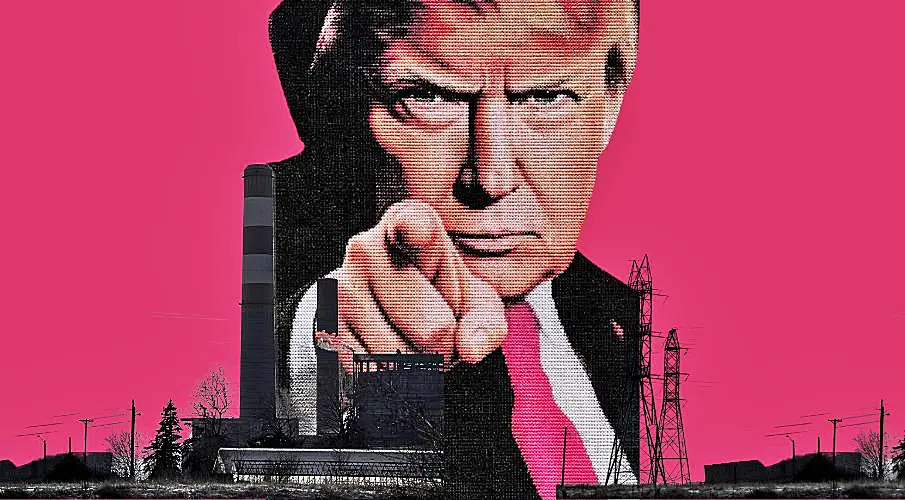
With nearly 700 million dollars and a Cold War era law, Donald Trump is propping up an industry the market has been abandoning for years, and the public pays the bill twice!
This Thursday, Donald Trump intends to spend nearly 700 million dollars to support the struggling American coal industry, and he is reaching for a law written for entirely different purposes. The Defense Production Act of 1950 dates back to the Cold War and grants the president broad authority over industries serving national security. It was designed for emergencies, for threats from outside. Now it is being used to preserve the survival of an industry threatened not by foreign powers but by the market. That is the first conclusion worth noting. Where no emergency exists, one is declared so that ordinary rules and the judgment of the market no longer apply.
According to a White House official, the administration will use this authority to support thirteen coal fired power plants across the country and promote the construction of coal plants in Alaska and West Virginia, the first new coal power facilities in the United States since 2013. The money will also help bring a closed coal plant in Maryland back online and advance the long delayed construction of a coal export terminal in Oakland, California. Together, according to the same official, who remained anonymous because he was not authorized to speak ahead of the president’s announcement, the projects would secure or create more than 14,000 jobs in coal mining, construction, rail transport, and port operations. Appearing alongside Trump this Thursday are expected to be Interior Secretary Doug Burgum, Energy Secretary Chris Wright, and Environmental Protection Agency Administrator Lee Zeldin.

This is the latest step in a longer effort to reverse coal’s decline, which has continued for years. Last fall, the administration already announced plans to open roughly five million acres of federal land for coal mining and provide 625 million dollars to restart or modernize coal plants. Shortly after returning to office, Trump issued orders aimed at reviving coal, a reliable but dirty energy source that has long been shrinking under environmental regulations and competition from cheaper natural gas and renewable energy. Under his direction, the Department of Energy forced coal plants in Michigan, Indiana, Colorado, and Washington state to continue operating beyond their planned retirement dates in order to meet rising electricity demand driven by the growth of data centers, artificial intelligence, and electric vehicles. Those temporary orders have been extended, and oil and gas plants in Maryland and Pennsylvania are also required to remain online longer than planned. Wright stated that the use of such emergency orders helped prevent major blackouts during the severe cold that hit the country at the end of January and beginning of February.
This enthusiasm becomes remarkable only when compared to what the same administration is doing to cheaper and cleaner energy sources. While forcing aging coal plants to continue operating, it has slowed renewable energy development, frozen permits for offshore wind projects, ended tax incentives for clean energy, and blocked wind and solar projects on federal land. So the expensive and dirty option is being kept alive through orders and public money while the cheaper and cleaner option is being delayed through government power. Anyone trying to explain this approach through energy security must first explain why the same concern does not apply to the sources growing the fastest.

Environmental organizations sharply condemned the move. “Supporting coal billionaires with taxpayer money is another way the Trump administration puts polluters first and puts the rest of us at risk,” said Kit Kennedy, who leads electricity policy at the Natural Resources Defense Council. “What comes next, a taxpayer funded rescue package for building new phone booths?” Trump’s order would lead to higher electricity bills and dirtier air, Kennedy and other critics said. “The best thing for the air, the climate, and our electricity bills is to let these plants retire peacefully.” Rich Nolan, president and chief executive officer of the National Mining Association, argued the opposite, saying coal power helps protect consumers from volatile energy prices and supply challenges worsened by artificial intelligence. Trump’s strategy, he argued, would ensure improvements are made to domestic energy facilities and ports so American coal can meet global demand.
The market verdict this policy is resisting is clear. Coal once generated more than half of America’s electricity, but by 2024 its share had fallen to roughly 15 percent, down from around 45 percent in 2010. Natural gas now supplies approximately 43 percent, while the remainder comes from nuclear energy and renewables such as wind, solar, and hydropower. Coal exports declined during the first year of Trump’s second term, largely because less coal was shipped to China after Beijing imposed retaliatory tariffs on American goods in response to Trump’s broad tariffs last year, according to the Energy Information Administration. Global demand for coal recently reached record highs but according to the International Energy Agency is expected to level off or decline in the coming years. American companies face difficulty entering new markets because coal reserves are abundant across the globe. Nevertheless, Trump continues pushing to revive coal exports along the West Coast. Miners have long sought to ship coal from Utah and from the Powder River Basin in Montana and Wyoming to Asia. In Oakland, developers remain in conflict with the city over an export terminal planned on the site of a former military base, while residents and organizations have raised concerns about the impact of coal trains on health, safety, and the environment.
Those concerns are not sensitivity but are rooted in the nature of coal itself. Among major energy sources, coal ranks among the highest emitters and produces extremely high greenhouse gas emissions throughout its lifecycle, which is why it has long been regarded in international energy scenarios as one of the largest individual drivers of global warming. In addition to carbon dioxide, burning coal releases fine particulate matter, nitrogen oxides, sulfur dioxide, mercury, other heavy metals, ash, and additional residues that burden air, soil, and waterways. The criticism therefore extends far beyond climate concerns. Coal generated electricity has for years been associated with health damage, higher exposure to fine particles, increased respiratory illness, strain on the cardiovascular system, and elevated risks for children, older adults, and people with preexisting conditions, alongside the effects of mercury and other pollutants. The regions most consistently affected are those surrounding power plants, transportation corridors, mining areas, and export ports. Oakland falls directly into that pattern, where public concern has already been raised over coal trains and coal dust. Added to that are land use impacts from mining, water consumption including cooling water needs, coal ash contamination, and increased rail and port traffic bringing dust and noise to terminal areas.
That brings the actual conflict into focus, and it is narrower than the question of whether coal works. Coal works, but it has been losing market share for years because alternatives became cheaper. Many utilities did not move away from coal primarily because of climate rules but because economics forced them to. The administration justifies its approach through energy security, baseload power, demand from data centers and artificial intelligence, protection against blackouts, and national security. Critics respond that subsidies shift costs onto taxpayers, aging coal plants require additional investment, consumers ultimately face higher electricity prices, and new coal facilities may become economically unattractive if demand continues falling. The question therefore is not whether coal is possible but whether taxpayer money and the extraordinary powers of a defense law should be used to preserve an industry that has been shrinking for years, or whether those same resources should go into other forms of energy, electric grids, storage, and infrastructure.
In the end, there is a double contradiction, and it is what makes this policy so difficult to tolerate. A movement that celebrates the free market is here practicing its sharpest form of central planning by forcing private power plants to operate beyond their planned end and invoking wartime legislation to reverse an outcome it dislikes. And the public pays for this intervention twice, first as taxpayers funding the subsidies and second as people breathing dirtier air, the consequences of which fall most heavily on children and older people living near plants, rail lines, and ports. There is dignity in stopping, and Kennedy captured it when she said these plants should be allowed to retire in peace. Instead, yesterday is kept alive with the money of the living, against the market, against the air, and against the simple realization that not everything that once existed must therefore remain.
Updates – Kaizen News Brief
All current curated daily updates can be found in the Kaizen News Brief.
To the Kaizen News Brief In English


Was hat Trump vor? Will er Arbeitsplätze schaffen? Oder gibt es für Stromerzeuger keine Alternativen in der Region? Will er die die Stahlindustrie wieder anwerfen? Oder nur einfach Asthma bei Menschen erzeugen oder sonstigen Mist? Oder willer nur mal wieder ohne Plan? Unsere Katharina Reiche verstehe ich auch nicht, aber die geplanten Gaskraftwerke lassen die fossile Lobby verdienen. Aber Kohle?
Oder gibt es da Verfahren, die ich mit meinem laienhaften technischen Verstand nicht erfasse?
Kohle soll hier vor allem drei Dinge liefern: Jobs in bestimmten Bundesstaaten, mehr verfügbare Stromkapazität und politische Industriepolitik. Technisch gibt es Alternativen – Gas, Kernkraft, Netzausbau, Speicher und Erneuerbare sind oft wirtschaftlicher. Genau deshalb kritisieren viele den Schritt: Der Markt baut Kohle seit Jahren ab, der Staat versucht sie jetzt mit Geld und Sonderrechten zu erhalten.