
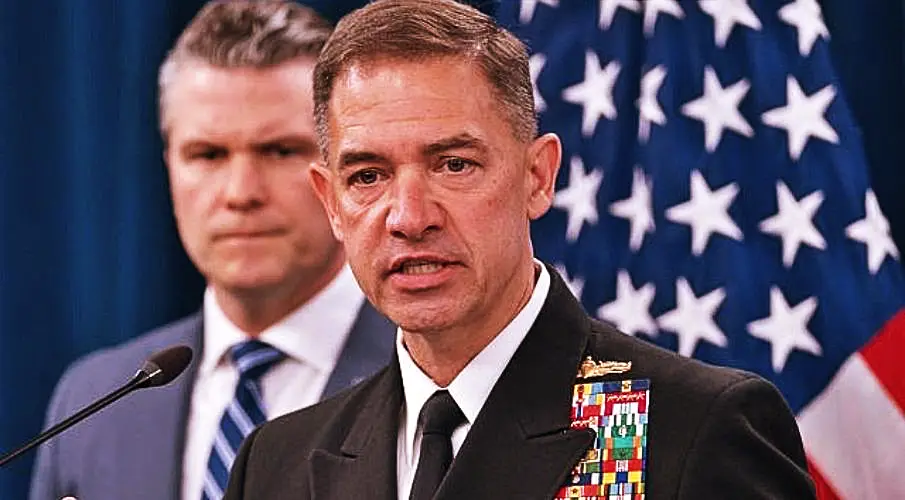
13,600 airstrikes. Thousands of destroyed buildings. Hundreds of documented impacts in residential neighborhoods, schools, and medical facilities. And yet Admiral Brad Cooper seriously told the U.S. Senate that he was aware of only a single possible incident involving civilian casualties.

That sentence alone turned the Senate Armed Services Committee hearing into a political disaster for the Pentagon. Cooper, commander of U.S. Central Command and therefore responsible for American military operations against Iran, defended the conduct of the war with a narrative that triggered open skepticism even within Washington itself. According to his testimony, only one attack - the February 28 strike on the Shajarah Tayyebeh elementary school - might possibly have been caused by an American bomb. Iranian authorities say 175 people were killed there, including numerous children.
When Senator Kirsten Gillibrand directly confronted Cooper with those figures, the admiral responded in a way that visibly unsettled even seasoned observers in Congress. He said the military could not confirm the information. There was no evidence supporting it.
KIRSTEN GILLIBRAND: If the Iranians were warned, how could 22 schools have been bombed?
ADMIRAL BRAD COOPER: According to our information, there is no confirmed evidence of that.
GILLIBRAND: How many schools did we bomb?
COOPER: There is an ongoing investigation into possible civilian casualties.
GILLIBRAND: Then how do you explain publicly available information showing that 22 schools and multiple hospitals were hit?
COOPER: There is no way to confirm that.
GILLIBRAND: Have you investigated those allegations?
COOPER: No, we have not.
Read also our article: Minab, 175 Dead and a Tomahawk - One Video and 116 Meters
For Cooper, the rest of the destruction seemed to barely exist.
Yet publicly documented damage has long been available. Investigations have confirmed destruction at at least 22 schools and 17 medical facilities. The Iranian Red Crescent stated as early as April that at least 763 schools and 316 health care facilities had been damaged or destroyed. According to the Human Rights Activists News Agency, at least 1,700 Iranian civilians were killed during the war.

We ourselves spent weeks in Tehran and cannot confirm many of the alleged warnings supposedly issued by the United States or Israel in the way they are now being described. In many cases, the strikes came without any recognizable warning at all. On the ground, there was often little sign of the repeatedly claimed precision targeting. Civilian infrastructure was struck again and again, including residential neighborhoods, infrastructure facilities, and buildings with no visible military significance. That is precisely why the current statements coming out of Washington increasingly appear detached from reality to many people who personally witnessed the aftermath of the attacks.

The hearing became especially explosive because Cooper simultaneously admitted that his command had not even investigated many of the documented incidents. It was at that point that the Pentagon’s defensive narrative visibly began collapsing. Under official guidelines, every reported civilian casualty incident is supposed to undergo an initial review to determine whether American forces were active in the relevant area.
Human rights organizations reacted with corresponding fury. Emily Tripp of Airwars openly stated that the idea that the military was investigating only a single incident was “ridiculous.” Airwars has now documented at least 300 incidents involving possible civilian casualties in Iran. Many of them, according to the organization’s own investigations, are connected to heavy bombardments in densely populated areas.

Annie Shiel of the Center for Civilians in Conflict also attacked the admiral’s testimony in unusually direct language. She said it was completely absurd to claim the United States was investigating only a single strike despite thousands of reported civilian casualties. Cooper’s statements come as the Pentagon under Pete Hegseth has dismantled large portions of the very structures originally created to investigate incidents like these. Dozens of positions connected to civilian harm assessment have been eliminated or drastically reduced. One of the hardest-hit offices was the Civilian Harm Mitigation Response Office, established under Lloyd Austin to systematically document and prevent civilian casualties.
Admiral Cooper himself confirmed that the responsible team within Central Command had been reduced within a single year from ten officers to only one person. Many of the former staff members, Cooper said, had been reassigned to other areas and continued working on civilian harm prevention in some capacity. What responsibilities they still actually perform, however, remained unclear. At the same time, it became known that several investigations have now been shifted into a small remaining structure inside the Pentagon. Military officials speaking anonymously confirmed that many earlier investigative procedures have effectively been dismantled.
Despite all this, Cooper attempted throughout the hearing to create the impression that the U.S. military operates with extreme caution. He stated that the Iranian population had been warned more than one hundred times not to allow itself to be used as human shields. The admiral even claimed he personally had warned the people of Iran.
The attack on the Shajarah Tayyebeh elementary school remains especially sensitive. As early as March, an internal preliminary review reportedly concluded that the school was likely struck because of an American targeting error. According to military sources, the intended target had actually been a nearby Iranian base. Yet the Pentagon still has not released an official explanation for the strike.
Former Admiral William McRaven has since openly stated that it became clear very early on that the United States was responsible. He said he himself could barely understand why the investigation remained unfinished more than two months later. Senator Mark Kelly also increased pressure on Cooper during the hearing. Kelly asked whether the eliminated civilian casualty investigation positions would be rebuilt if targeting failures were confirmed. Cooper avoided the question. He briefly stated that they would first wait to see what the investigation concluded.

That is now the Pentagon’s real problem. The discussion is no longer merely about individual bombings. Increasingly, the impression is emerging that civilian casualties in the Iran war are being politically minimized as much as possible - while at the same time the very offices capable of documenting such incidents are disappearing. Defense Secretary Pete Hegseth played a particularly central role in that process. Under his leadership, the exact structures created after earlier wars to systematically document and investigate civilian casualties were dramatically reduced. Dozens of positions connected to so-called “Civilian Harm Mitigation” disappeared within a short period of time. Admiral Brad Cooper himself confirmed that the responsible team at Central Command had been reduced from ten officers to only one person. That is exactly why the Pentagon’s current position appears so contradictory. While publicly claiming that virtually no confirmed civilian casualty incidents exist, the military simultaneously dismantled the very units capable of comprehensively investigating those incidents in the first place. Critics therefore accuse Hegseth not only of reducing transparency, but also of weakening the military’s ability to properly investigate its own mistakes at all.
And the longer the military attempts to effectively erase hundreds of documented impacts, destroyed schools, and civilian deaths from public view, the larger the question becomes whether this is still an effort at accountability - or merely damage control for the Pentagon’s own credibility.
To be continued ...
Updates – Kaizen News Brief
All current curated daily updates can be found in the Kaizen News Brief.
To the Kaizen News Brief In English


Dieses Regime ist menschenverachtend. Da fehlen einem die Worte.
Unglaublich!
Copper weiß mit Sicherheit um die zivilen Opfer.
Aber sie existieren im Trumpversum schlicht nicht.
Es wird eine ähnliche Taktik, wie bei den Tötungen von Zivilisten im Pazifik.
Zig Boote, zig Zivilisten.
Keine Belege für Drogen.
Aber dennoch wird an der Darstellung der Drogenschmuggler fest gehalten.
Im Iran, ich zitiere Dich einmal „…Und je länger das Militär versucht, hunderte dokumentierte Einschläge, zerstörte Schulen und zivile Tote praktisch auszublenden, desto größer wird die Frage, ob hier noch Aufklärung betrieben wird – oder längst nur noch Schadensbegrenzung für die eigene Glaubwürdigkeit….“
Geht es auch nur um Ausblendung und Schadensbegrenzung.
Menschenleben?
Zählen im Trumpversum nicht. Sie passen nicht zur offiziellen Märchenerzählung.