
Thousands of cars stand Friday morning in a line stretching for miles along the coastal road to the south. Mattresses on the roofs, in the trunks what remains of a life. The Qasmiyeh bridge over the Litani River, damaged by an Israeli airstrike the day before, has been patched up - one lane through which everything must pass. More than one million people were displaced from the south of the country during this war. Many of them are now driving back, even though both the Lebanese army and Hezbollah warned against it. In Jibsheet, returnees find collapsed apartment blocks, concrete debris on the streets, bent aluminum shutters, hanging power lines.
“We do not know at what hour they might shell us again”

In Haret Hreik, Israel struck 62 times over the past six weeks, says Deputy Mayor Sadek Slim. 26 buildings were completely destroyed. At Al Najda al Shaabiya hospital in Nabatiyeh, wounded patients were still arriving up to an hour after the ceasefire took effect. Mahmoud Sahmarani, 33 years old, left eye swollen shut, head bandaged, says from his hospital bed that he stepped outside to buy charcoal for a hookah when an Israeli strike killed his father and his cousin as they were peeling potatoes. His five story residential building is rubble. His family has no roof left. The Lebanese Health Ministry reports 98 deaths for Thursday alone - the deadliest day since the war began on March 2. The total death toll stands at 2,294, including 274 women and 177 children.

People on the road back to Beirut
The ceasefire between Israel and Hezbollah lasts ten days, effective since midnight local time. UNIFIL spokesperson Tilak Pokharel says UN observers have recorded no airstrikes since midnight. Artillery fire in several areas of southern Lebanon, however, continued until 6 am. Israeli forces continue to move in the region, but have not withdrawn. They are holding their positions, including in Bint Jbeil, five kilometers from the border. Israeli Defense Minister Israel Katz says the forces will retain all currently held positions, including a ten kilometer deep buffer zone on Lebanese territory. Many homes in this area have been destroyed, Lebanese residents cannot return. The entire south up to the Litani must be cleared of Hezbollah - through diplomacy or through continued military operations.

Netanyahu says in a video statement that Israel agreed to the ceasefire at the request of his friend President Trump. Israel has destroyed about 90 percent of Hezbollah’s missile and launcher stockpiles. But: “We are not finished.” Trump responds with a post explicitly forbidding Israel from continuing to bomb Lebanon. “Israel must not bomb Lebanon any longer. They are forbidden to do so by the United States. Enough is enough.” Whether this prohibition also applies to defensive strikes was left open by the White House.
Hezbollah parliament member Hassan Fadlallah says the group’s leadership was informed early Thursday morning at 4 am by the Iranian ambassador about the upcoming ceasefire. Talks with Saudi Arabia and Pakistan had eased the conditions. Fadlallah simultaneously warns the Lebanese government not to enter direct negotiations with Israel. As long as Israeli troops remain on Lebanese soil, direct talks would be a free concession. Hezbollah will keep its finger on the trigger during the ceasefire, the group says in a statement. It states that it carried out 2,184 attacks during the 45 days of war.
Lebanese President Joseph Aoun says the Lebanese army will assume a fundamental role in the south after an Israeli withdrawal and will end non state armed presence. He calls Trump’s commitment to Lebanon’s sovereignty and territorial integrity an important signal for the ongoing negotiations.
While people in Lebanon search for their homes among the rubble, something opens this Friday that has kept the global economy on edge for weeks. Iran’s Foreign Minister Abbas Araghchi writes on X that the Strait of Hormuz is fully open for all commercial ships, in line with the ceasefire in Lebanon. Trump responds immediately and thanks Iran. Oil prices fall by more than ten percent within minutes. Brent crude drops below 90 dollars per barrel, the lowest level in more than a month - even though it still remains more than 20 percent above the level before the war began. The Dow Jones rises by more than 1,000 points, the S and P 500 gains 1.3 percent, the Nasdaq 1.5 percent. Since the end of March, markets have gained more than eleven percent, driven by the hope that the United States and Iran will avoid the worst.
The journey begins - the problem with insurance

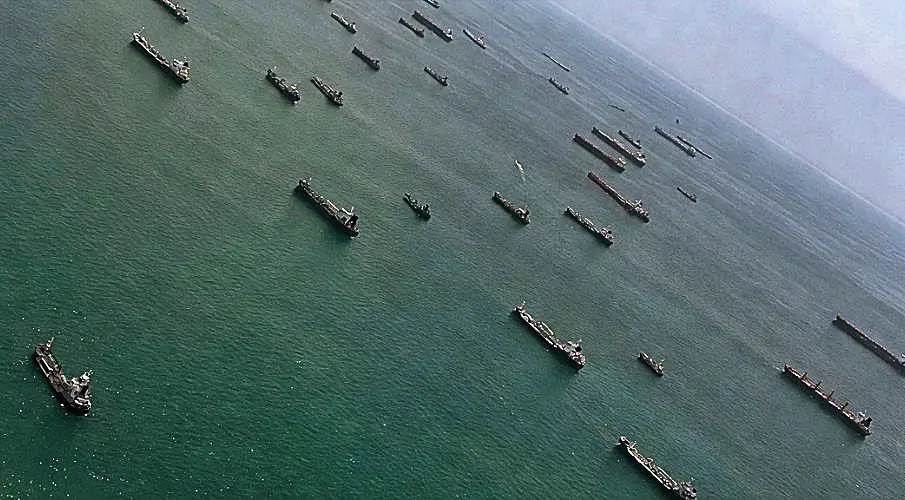
But the opening comes with a catch - and it is not a small one. Araghchi says ships must take a specific route that runs close to the Iranian coast and the island of Larak. That is not the same as free passage. Before the war, about 130 ships passed through the strait daily, on two main corridors in Omani waters. The route prescribed by Iran is shallower, narrower, less suited for mass traffic. Shipping analyst Alexis Ellender says on paper it sounds good, but it will take weeks, not days, before traffic really increases. Around 900 ships have been stuck in the Persian Gulf for weeks. Hapag Lloyd convened a crisis meeting after news of the opening.

A Pakistani-flagged tanker, Shalamar, became the first crude carrier to pass through the Strait of Hormuz today since the US blockade took effect on Monday.
A shipowner in Istanbul wants to refloat his vessel on Friday. He has the people, he has the plan. What he does not have: insurance he can afford. So the ship stays where it is. And he is not the only one. Cargo ships are stranded everywhere - not because they cannot sail, but because no insurer will sign at a price a shipowner can survive. The technology is ready. The sea is open. But the spreadsheet says no. That is the real standstill now: money against movement. And money wins. It shows how quickly economic logic ends where real movement becomes possible again.“
The claim that is not true - like so much from Mr Trump

Donald Trump claims Iran has agreed never to close the Strait of Hormuz again and not to use it as leverage against the world. At the same time, he attacks media outlets such as the New York Times and CNN, accusing them of continuing to criticize him despite this development instead of giving him credit.
Trump claims on social media that Iran has agreed never to close the Strait of Hormuz again and that Iran is removing all sea mines with American assistance. Iran has publicly confirmed neither claim. According to the US military, Iran had not been able to locate all the mines it had laid. The US Navy has a minesweeper on site as well as two more arriving from Japan. At the same time, Trump states that the American naval blockade against Iranian ships will remain “in full force” until negotiations are concluded. How both can apply at the same time - an open strait and an ongoing blockade - remains unanswered in Washington.
19 ships turned around during the blockade and returned to Iran on the orders of American forces. Not a single ship bypassed US forces, Central Command reports.
Europe meets …

Chancellor Friedrich Merz is pushing for US participation in a mission to secure the Strait of Hormuz.
In Paris on Friday, heads of state and government from 48 countries gather, by video or in person, to discuss a multinational mission to secure shipping in the Strait of Hormuz. Emmanuel Macron and Keir Starmer convened the conference. In the room sit Friedrich Merz and Giorgia Meloni. News of the opening of the strait interrupts the conference - but does not end it. Macron says the opening is a hope, but it must be lasting and reliable. Starmer says the same. Merz says Germany can contribute mine clearing capabilities and maritime surveillance, but needs parliamentary approval and a secure legal basis, preferably a UN Security Council resolution. He also says Germany would prefer the United States to be involved in the mission. Macron counters: France insists that only non belligerent countries should participate. The contradiction remains unresolved.
France has an aircraft carrier, the Charles de Gaulle, six frigates, two helicopter carriers and 50 Rafale fighter jets in the region. Macron says part of this could be moved into the strait. Starmer expects more than a dozen countries to contribute military resources. Military planners will meet next week in London. Where the headquarters of the mission will be located remains open. The United Arab Emirates are considered by some to be too close to the United States. Oman sees itself as a mediator. Qatar is an option.
Russia declares itself ready to store Iran’s uranium stockpiles. Kremlin spokesperson Dmitry Peskov says Putin has made this offer repeatedly. The American side is currently not interested. Trump continues to claim Iran has agreed to hand over enriched uranium - the material that lies deep beneath Iranian nuclear facilities after US bombardments with B 2 bombers. He calls it “nuclear dust” and says no money will change hands. Neither Iran nor the mediators have confirmed this claim.

Iran’s UN Ambassador Amir Saeid Iravani had said on Thursday that despite deep mistrust toward the United States, his country is entering negotiations in good faith. If Washington acts constructively, something meaningful could emerge. A second round of talks between the United States and Iran has not yet been scheduled.
In South Korea on Friday, a South Korean tanker carrying Saudi crude passes through the Red Sea - the first such delivery since the search for alternative routes began. President Lee Jae Myung calls it a valuable achievement. 26 South Korean ships remain stranded in the Strait of Hormuz.

In Beirut and Tel Aviv, opinions are divided. In Beirut, they fired into the sky during the night. In the villages of the south, people stand in front of what remains of their homes. And on the Qasmiyeh bridge, patched together, lane by lane, everything slowly moves back home.
Updates – Kaizen News Brief
All current curated daily updates can be found in the Kaizen News Brief.
To the Kaizen News Brief In English


Es bleibt immer noch ein Chaos.
Menschen leiden und stehen vir den Trümmern ihrer Existenz.
Ob die Feuerpause zwischen Israel und Libanon verlängert wird?
Keiner weiß es.
Trump gibt den großen Alleinherrscher.
Er verbietet Israel weitere Angriffe auf den Libanon.
Gleichzeitig verbreitet er so viele Lügen, dass einem ganz schwindlig wird.
Seine MAGA feiern ihn.
„Nur die DemoRats, radikalen Linken“ können Trumps Leistung nicht sehen oder anerkennen.
Fakt ist:
Vor dem Angriff war die Strasse von Hormus ein vielgenutzter Handelsweg.
Die Wirtschaft floss.
Nun wird jede winzige Öffnung als großer Erfolg gefeiert.
Ohne den Krieg gäbe es die Situation nicht.
Viele Menschen hätten ihre Leben nicht verloren.
Und noch steht kein Termin für offizielle Gespräche zwischen USA und Iran.
Nun ist Wochenende, da muss Trump in Florida golfen 🙈